 Indietro
Photosynthesis: Mechanisms, Evolution, and Adaptations
Guida di studio - Note intelligenti
 Appunti personalizzati basati sui tuoi materiali, ampliati con definizioni chiave, esempi e contesto.
Photosynthesis: An Overview
General Equation and Importance
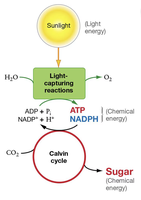
Photosynthesis is the process by which autotrophic organisms convert light energy into chemical energy, producing glucose and oxygen from carbon dioxide and water. This process is fundamental to life on Earth, as it provides both food and oxygen for other organisms.
General Equation:
Key Products: Glucose (energy storage), Oxygen (byproduct)
Two Main Stages: Light-capturing reactions and the Calvin cycle
Light Absorption and Pigments
Types of Pigments and Their Functions
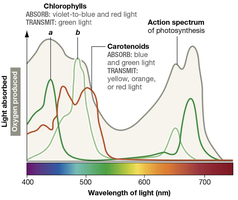
Photosynthetic pigments absorb light energy at specific wavelengths, initiating the process of energy conversion. Chlorophylls and carotenoids are the primary pigments involved.
Chlorophylls: Absorb violet-to-blue and red light; transmit green light
Carotenoids: Absorb blue and green light; transmit yellow, orange, or red light
Action Spectrum: Shows the efficiency of photosynthesis at different wavelengths
Structure of Chlorophyll
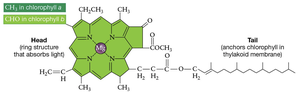
Chlorophyll molecules have a ring structure that absorbs light and a hydrophobic tail that anchors them in the thylakoid membrane. The central magnesium ion is crucial for light absorption.
Chlorophyll a: Main pigment in reaction centers
Chlorophyll b: Accessory pigment, broadens absorption spectrum
Photosystems and Light Harvesting
Photosystem II: Capturing Sunlight and Electron Transport
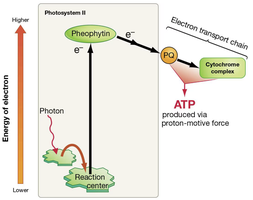
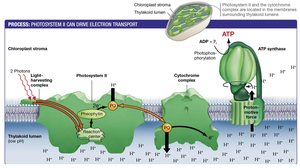
Photosystem II (PSII) initiates the light-dependent reactions by absorbing photons and transferring energy through antenna pigments to the reaction center. Excited electrons are passed to pheophytin and then to plastoquinone (PQ), which transports electrons and protons across the thylakoid membrane, contributing to ATP synthesis.
Antenna Pigments: Collect and transfer energy to reaction center
Pheophytin: Accepts excited electrons from special pair chlorophylls
Plastoquinone: Transports electrons and protons, helps generate proton gradient
ATP Synthase: Uses proton gradient to synthesize ATP (photophosphorylation)
Regeneration of Electrons in PSII
Electrons lost from PSII are replenished by the splitting of water, a highly endergonic reaction catalyzed by the oxygen-evolving complex. This process releases oxygen as a byproduct.
Water Splitting Reaction:
Hydrogen ions: Released into thylakoid lumen, contributing to proton gradient
Photosystem I: NADPH Production
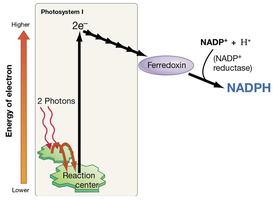
Photosystem I (PSI) uses light energy to excite electrons, which are transferred to ferredoxin and then used by NADP+ reductase to reduce NADP+ to NADPH. NADPH is essential for the Calvin cycle.
Ferredoxin: Electron carrier, substrate for NADP+ reductase
NADPH: Reducing power for carbon fixation
The Z Scheme: Linking PSII and PSI
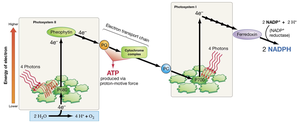
The Z scheme describes the flow of electrons from water through PSII and PSI, resulting in the production of ATP and NADPH. Plastocyanin shuttles electrons between the two photosystems.
Plastocyanin: Diffusible protein, transfers electrons from cytochrome complex to PSI
ATP and NADPH: Used in the Calvin cycle for sugar synthesis
Evolutionary Impact of Oxygenic Photosynthesis
The Great Oxidation Event
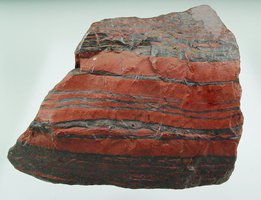
Oxygenic photosynthesis, first evolved in cyanobacteria, dramatically increased atmospheric oxygen levels, enabling aerobic respiration and the formation of the ozone layer. Banded iron formations provide geological evidence of this transition.
Cyanobacteria: First organisms to perform oxygenic photosynthesis (~2.7 billion years ago)
Banded Iron Formations: Layers of iron oxides and chert, record changes in atmospheric oxygen
Ozone Layer: Protects life from harmful UV radiation
Carbon Fixation and the Calvin Cycle
CO2 Uptake and Stomata
Carbon dioxide is a small, non-polar molecule that diffuses across membranes. In terrestrial plants, a waxy cuticle prevents dehydration but also restricts gas exchange. Stomata regulate the entry of CO2 and exit of O2.
Stomata: Pores for controlled gas exchange
Concentration Gradient: Favors diffusion of CO2 into chloroplasts
Rubisco and Carbon Fixation
Rubisco catalyzes the addition of CO2 to ribulose-1,5-bisphosphate (RuBP), forming organic compounds. However, rubisco is slow and can also catalyze the addition of O2, leading to photorespiration.
Rubisco: Ribulose-1,5-bisphosphate carboxylase/oxygenase; 16 subunits, 8 active sites
Photorespiration: Wasteful process when O2 is fixed instead of CO2
Preventing Photorespiration: C4 and CAM Plants
Plants in hot, dry environments have evolved mechanisms to minimize photorespiration. C4 plants concentrate CO2 in the leaf interior, while CAM plants concentrate CO2 during times when rubisco is inactive.
C4 Plants: Spatial separation of CO2 uptake and fixation
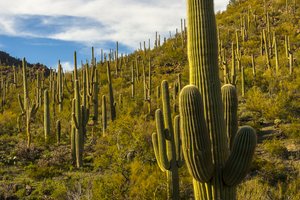
CAM Plants: Temporal separation; CO2 uptake at night, fixation during the day
The Calvin Cycle
Three-Step Process and Products
The Calvin cycle uses ATP and NADPH to fix carbon and produce glyceraldehyde-3-phosphate (G3P), which is used to synthesize glucose. Three turns of the cycle are required to generate one G3P and regenerate RuBP.
Key Steps: Carbon fixation, reduction, regeneration
Products: G3P (precursor to glucose), RuBP (regenerated)
Photosynthetic Adaptation | Mechanism | Example |
|---|---|---|
C3 | Direct CO2 fixation by rubisco | Most plants |
C4 | CO2 concentrated in bundle sheath cells | Maize, sugarcane |
CAM | CO2 uptake at night, fixation during day | Cacti, succulents |
Summary
Photosynthesis is a complex, multi-step process essential for life on Earth. It involves the capture of light energy, electron transport, ATP and NADPH production, and carbon fixation. Evolutionary adaptations have enabled plants to thrive in diverse environments, and oxygenic photosynthesis has shaped Earth's atmosphere and biosphere.
