 Indietro
Photosynthesis: Mechanisms, Pathways, and Adaptations
Guida di studio - Note intelligenti
 Appunti personalizzati basati sui tuoi materiali, ampliati con definizioni chiave, esempi e contesto.
Photosynthesis and Organisms
Overview of Photosynthesis
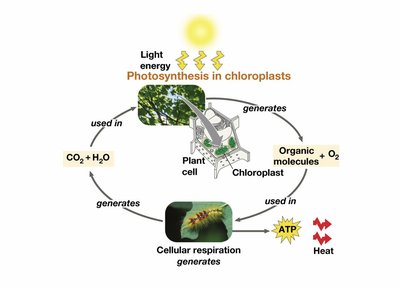
Photosynthesis is the process by which autotrophic organisms convert solar energy into chemical energy, storing it in carbohydrates. This process is fundamental for life on Earth, providing both food and oxygen for nearly all living organisms.
Autotrophs (e.g., plants, cyanobacteria) produce their own food by converting inorganic CO2 into organic molecules like glucose.
Heterotrophs (consumers) obtain organic molecules by consuming other organisms.
Oxygen is a byproduct of photosynthesis, enabling aerobic respiration.
Photosynthesis was first performed by prokaryotic cyanobacteria, which contributed to the oxygenation of Earth's atmosphere.
Photosynthetic Structures and Chloroplast Anatomy
Chloroplast Structure
Chloroplasts are the organelles where photosynthesis occurs. They have a double membrane, their own DNA, and ribosomes, supporting the endosymbiotic theory.
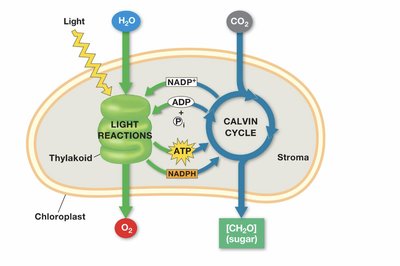
The stroma is the fluid-filled interior where the Calvin cycle takes place.
Thylakoid membranes contain pigments and are the site of the light-dependent reactions.
A stack of thylakoids is called a granum (plural: grana).
Photosynthesis: Redox Reactions and the Role of NADP+
Overall Reaction
The overall equation for photosynthesis is:
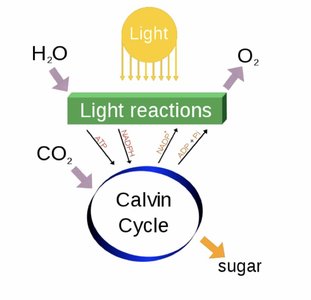
Water provides electrons, which are transferred to NADP+ during the light-dependent reactions, forming NADPH.
NADPH and ATP are used in the Calvin cycle to reduce CO2 to glucose.
The Light Reactions
Light Absorption and Pigments
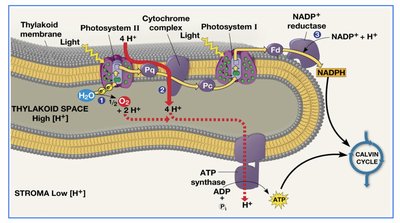
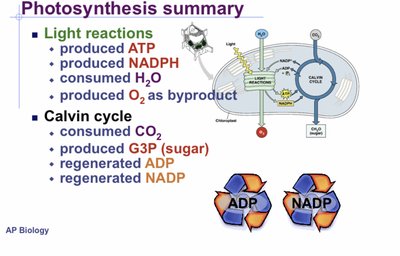
Light reactions occur in the thylakoid membranes and convert solar energy into chemical energy (ATP and NADPH).
Visible light (380–740 nm) is absorbed by pigments such as chlorophyll a, chlorophyll b, and carotenoids.
Chlorophyll reflects green light, making plants appear green.
A photosystem is a complex of pigments and proteins that captures light energy.
Noncyclic (Linear) Electron Flow
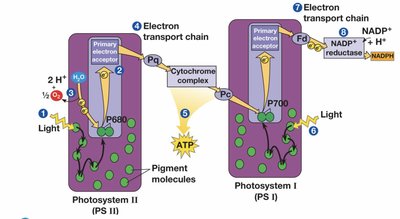
Involves both Photosystem II (PSII) and Photosystem I (PSI):
Light excites electrons in PSII (P680), which are replaced by splitting water (releasing O2).
Electrons travel down an electron transport chain, generating a proton gradient.
Electrons reach PSI (P700), are re-excited by light, and are transferred to NADP+ to form NADPH.
Cyclic Electron Flow
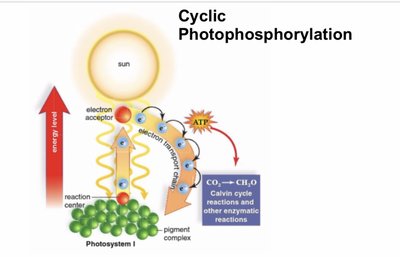
In cyclic electron flow, only PSI is involved. Electrons cycle back to the electron transport chain, generating ATP but not NADPH or O2. This pathway is used under certain conditions, such as high oxygen levels or in some prokaryotes.
Helps balance the ATP/NADPH ratio.
Does not involve water splitting or oxygen production.
ATP Production: Chemiosmosis
The movement of electrons through the electron transport chain pumps protons into the thylakoid space, creating an electrochemical gradient. Protons flow back into the stroma through ATP synthase, driving the synthesis of ATP from ADP and inorganic phosphate.
The Calvin Cycle (Light-Independent Reactions)
Overview and Steps
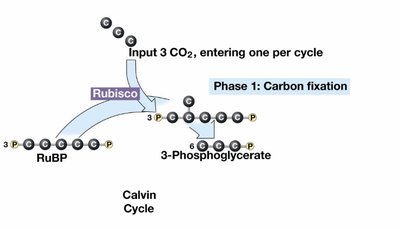
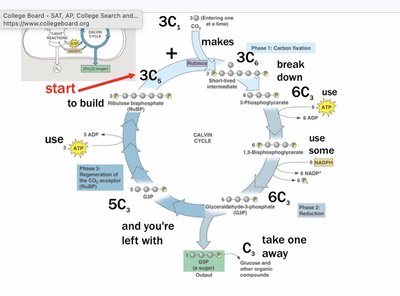
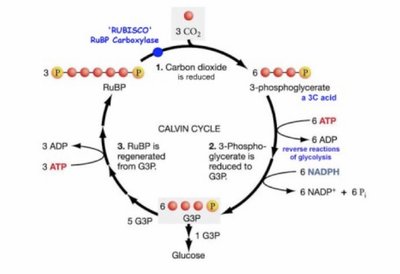
The Calvin cycle occurs in the stroma and uses ATP and NADPH from the light reactions to fix CO2 into carbohydrates. It consists of three main phases:
Carbon Fixation: CO2 is attached to RuBP (ribulose bisphosphate) by the enzyme Rubisco, forming 3-phosphoglycerate (3PG).
Reduction: 3PG is phosphorylated and reduced by ATP and NADPH to form G3P (glyceraldehyde-3-phosphate).
Regeneration: Most G3P is used to regenerate RuBP, enabling the cycle to continue.
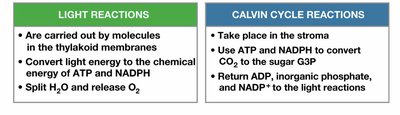
Summary Table: Light Reactions vs. Calvin Cycle
Light Reactions | Calvin Cycle Reactions |
|---|---|
Occur in thylakoid membranes | Occur in the stroma |
Convert light energy to ATP and NADPH | Use ATP and NADPH to convert CO2 to G3P (sugar) |
Split H2O, release O2 | Return ADP, Pi, and NADP+ to light reactions |
Factors Affecting Photosynthesis
Light Intensity: Increases the rate of photosynthesis up to a saturation point.
Temperature: Rate increases with temperature up to an optimum, then decreases as enzymes denature.
Oxygen Concentration: High O2 can decrease photosynthesis due to photorespiration.
Adaptations: C4 and CAM Photosynthesis
Photorespiration
Photorespiration occurs when O2 competes with CO2 for Rubisco, reducing the efficiency of photosynthesis, especially under hot, dry conditions.
C4 Plants
Spatial separation of steps: CO2 is initially fixed in mesophyll cells by PEP carboxylase (which does not bind O2), then transported to bundle-sheath cells for the Calvin cycle.
Adapted to high light, high temperature, and low water environments.
CAM Plants
Temporal separation of steps: CO2 is fixed at night (when stomata are open) and used during the day for the Calvin cycle.
Adapted to extremely arid conditions.
Key Concepts to Know
The summary equation of photosynthesis and the fate of reactants/products.
How chloroplast structure relates to function.
The roles of photosystems, electron flow, and chemiosmosis in ATP/NADPH production.
How the Calvin cycle uses ATP and NADPH to fix carbon.
Adaptations (C4, CAM) that minimize photorespiration.
