 Indietro
Photosynthesis: Mechanisms, Pigments, and Adaptations
Guida di studio - Note intelligenti
 Appunti personalizzati basati sui tuoi materiali, ampliati con definizioni chiave, esempi e contesto.
Photosynthesis
How Organisms Get Their Food
Organisms differ in how they obtain organic molecules required for energy and growth. The two main categories are autotrophs and heterotrophs.
Autotrophs: Use CO2 or another inorganic carbon source to build organic molecules.
Photoautotrophs: Use light energy to drive the synthesis of organic compounds.
Chemoautotrophs: Use energy from chemical reactions.
Heterotrophs: Obtain carbon from organic molecules made by other organisms. Includes animals, fungi, many protists, and many bacteria.
What Is Photosynthesis?
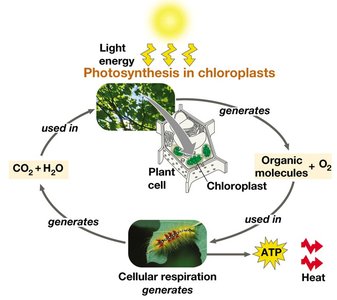
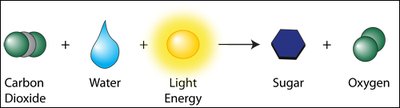
Photosynthesis is the process that uses light energy to make chemical energy stored in sugars. It uses CO2 and H2O as raw materials and produces glucose and O2. This process sustains nearly all life on Earth, directly or indirectly.
Who Performs Photosynthesis?
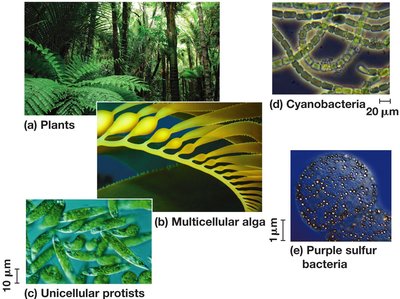
Photosynthesis occurs in organisms that use light energy to make their own food (photoautotrophs). This includes plants, algae, and cyanobacteria.
Plants: Multicellular, terrestrial photoautotrophs.
Algae: Both unicellular and multicellular aquatic photoautotrophs.
Cyanobacteria: Prokaryotic photoautotrophs.
Where Does Photosynthesis Occur?
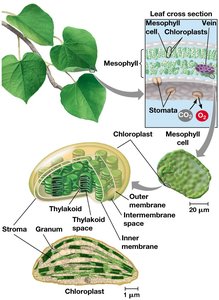
In plants and algae, photosynthesis takes place in chloroplasts, specialized organelles inside plant cells. Chloroplasts are found mainly in the mesophyll cells of leaves, which are well positioned to capture light and exchange gases. In cyanobacteria, photosynthesis occurs on folded internal membranes within the cell instead of in chloroplasts.

Inside the Chloroplasts
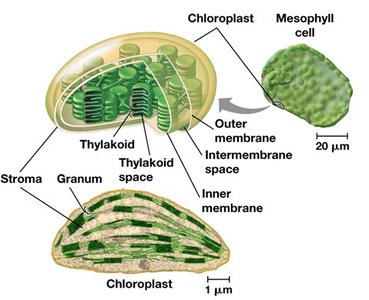
The chloroplast carries out two coordinated stages of photosynthesis:
Light Reactions: Occur in the thylakoid membranes; use light energy to make ATP and NADPH.
Calvin Cycle: Occurs in the stroma; uses ATP and NADPH to build sugars from CO2.
Energy captured in the light reactions powers the Calvin cycle. This division of labor makes photosynthesis efficient and self-contained within the chloroplast.
Sunlight and Photosynthesis
The Electromagnetic Spectrum
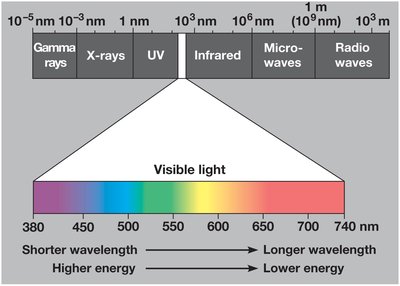
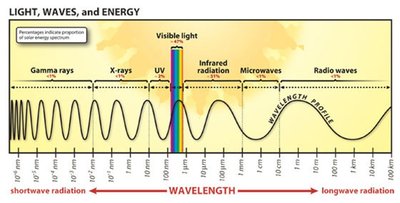
Sunlight is part of the electromagnetic spectrum, which includes many forms of energy. Only a small portion of this spectrum is visible light, which has the right range of energy to power photosynthesis. Within visible light, blue light (around 450 nm) and red light (around 680 nm) are most effective at driving photosynthesis.
Pigments and Photosynthesis
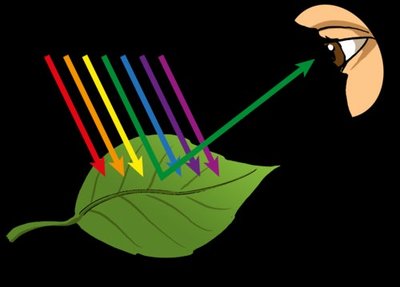
Pigments are molecules that absorb specific wavelengths of light. The main photosynthetic pigment is chlorophyll a, which absorbs blue (≈450nm) and red (≈680nm) light most strongly. Green light (≈520 - 560nm) is reflected, which is why plants appear green.
Major Types of Photosynthetic Pigments
Different pigments work together to capture more of the Sun’s energy:
Chlorophyll a: Directly participates in the light reactions; absorbs blue-violet and red light most effectively.
Chlorophyll b: Absorbs light at slightly different wavelengths; passes its captured energy to chlorophyll a.
Accessory pigments: Include carotenoids (yellow/orange pigments); widen the range of light absorbed and help protect the plant from damage by excess light (photo-protection).

The Photosynthesis Reaction
What Happens During Photosynthesis
In photosynthesis, light energy is transformed into chemical energy stored in sugars. CO2 from the air provides carbon for building sugars. H2O provides hydrogen and electrons and is also the source of oxygen gas released. Light provides the energy needed to power these conversions. Energy is stored in the chemical bonds of glucose.
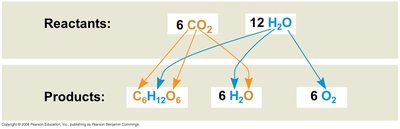
Photosynthesis equation:
The Nature of the Photosynthetic Reaction
Energy Flow
Photosynthesis is an endergonic process; it requires an input of energy from sunlight. The energy from light is stored in the bonds of sugar molecules (chemical energy). The light reactions capture this energy, and the Calvin cycle uses it to build carbohydrates.
Electron Flow
Photosynthesis is a redox reaction as it involves transfer of electrons:
Water (H2O): Is oxidized (loses electrons) to form oxygen (O2).
Carbon dioxide (CO2): Is reduced (gains electrons) to form glucose (C6H12O6).

The Light Reactions
Overview of Light Reactions
The light reactions are the first stage of photosynthesis and occur in the thylakoid membranes of the chloroplast.
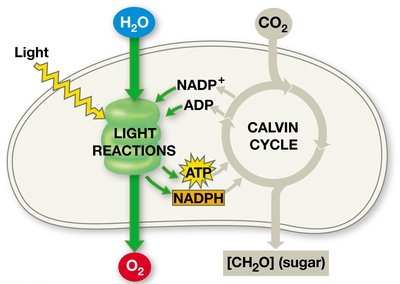
Light Reactions and Photosystems
Photosystems are clusters of pigments and proteins in the thylakoid membrane. Pigments in each photosystem absorb light and transfer the energy to a reaction-center chlorophyll.
Photosystem II (PSII): Absorbs light first and replaces its lost electrons by splitting water.
Photosystem I (PSI): Absorbs light later and transfers energized electrons to help produce NADPH.
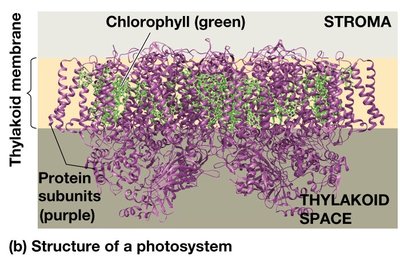

How the Light Reactions Work
Photosystem II Starts Electron Flow
Pigment molecules in PSII absorb photons of light.
The pigments transfer the captured energy from one pigment to another until it reaches the reaction-center chlorophyll, P680.
The transferred energy excites an electron in P680 to a higher energy level.
The excited electron leaves P680 and transfers to the primary electron acceptor, which passes it into the electron transport chain.
After P680 loses an electron, it becomes positively charged and must receive a replacement electron.
Water is split to supply replacement electrons to P680. Water splitting also releases H+ into the thylakoid space and produces O2 as a by-product.
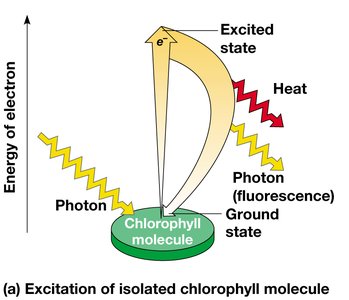
Electron Transport Chain
As the electron from PSII moves through the ETC, it loses energy.
The electron transport chain uses this energy to move H+ from the stroma into the thylakoid space.
The resulting proton gradient stores potential energy.
Chemiosmosis in Photosynthesis
The proton gradient forces H+ ions to flow back into the stroma through ATP synthase, a membrane enzyme.
As H+ flows through, ATP synthase spins like a turbine, converting ADP + Pi → ATP.
Photosystem I and NADPH Formation
The electron reaches PSI after it passes through the electron transport chain.
PSI absorbs another photon and re-energizes an electron in its reaction-center chlorophyll, P700.
The electrons help convert NADP+ to NADPH, which carries high-energy electrons to the Calvin cycle.
Chemiosmosis in Chloroplasts vs. Mitochondria
Both chloroplasts and mitochondria use an electron transport chain (ETC) to create a proton (H+) gradient. ATP synthase allows H+ to flow back, powering ATP production. ATP synthase and ETC components are structurally similar in both. In both, energy flow across membranes drives ATP synthesis.
Feature | Chloroplasts | Mitochondria |
|---|---|---|
Energy conversion | Light energy → ATP + NADPH | Chemical energy → ATP |
Proton pumping | H+ pumped into thylakoid space, flows back into stroma | H+ pumped into intermembrane space, flows back into matrix |
Main purpose | Fuel the Calvin cycle | Supply ATP for cellular work |
The Calvin Cycle
Overview of the Calvin Cycle
The Calvin cycle occurs in the stroma and uses ATP and NADPH from the light reactions. Overall, the Calvin cycle is anabolic (builds molecules). Carbon enters as CO2 and leaves as G3P (glyceraldehyde-3-phosphate). To produce one net G3P, the cycle must fix three CO2 molecules. The Calvin cycle has three main phases:
Carbon Fixation
Reduction
Regeneration of ribulose-1,5-bisphosphate (RuBP)
Calvin Cycle Steps
Carbon Fixation: CO2 joins ribulose-1,5-bisphosphate (RuBP, a 5-carbon sugar). The enzyme Rubisco (RuBP carboxylase/oxygenase) catalyzes the reaction. Forms an unstable 6-carbon intermediate, which quickly splits into two 3-phosphoglycerate (3-PGA) molecules.
Reduction: ATP phosphorylates 3-PGA → 1,3-bisphosphoglycerate. NADPH reduces it to G3P (the sugar output). Out of six G3P produced, only 1 exits; the rest recycle.
Regeneration of RuBP: Remaining 5 G3P molecules rearranged to regenerate three RuBP molecules. Requires 3 additional ATP.
Cycle Summary: To produce one net G3P, the cycle uses: 9 ATP + 6 NADPH. G3P is the building block for glucose and other carbohydrates.
Carbon Fixation in Hot, Dry Climates
On hot, dry days, plants close their stomata to conserve water. Stomatal closure reduces CO2 entry. As photosynthesis continues, the CO2 concentration falls relative to the O2 concentration inside the leaf.
Rubisco can bind either CO2 or O2.
When CO2 is scarce, Rubisco binds O2 more frequently.
The resulting photorespiration pathway consumes energy and releases CO2.
Photorespiration reduces the efficiency of carbon fixation.
C4 and CAM Pathways
Some plants evolved strategies to minimize photorespiration:
C4 photosynthesis: Separates carbon fixation and the Calvin cycle into different cells (spatial separation).
CAM photosynthesis: Separates carbon fixation and the Calvin cycle into different times (temporal separation).
Spatial Separation to Reduce Photorespiration
In mesophyll cells of C4 plants, PEP carboxylase captures CO2 in a four-carbon compound.
The compound moves to bundle-sheath cells and releases CO2 near Rubisco.
This process concentrates CO2 around Rubisco and reduces photorespiration.
Temporal Separation to Save Water
Crassulacean acid metabolism (CAM) occurs in plants like cacti, succulents, and pineapples.
Stomata open at night, allowing CO2 to be fixed into organic acids and stored.
Stomata close during the day; CO2 is released from organic acids and used in the Calvin cycle.
