 Indietro
Photosynthesis: Mechanisms, Pigments, and Adaptations
Guida di studio - Note intelligenti
 Appunti personalizzati basati sui tuoi materiali, ampliati con definizioni chiave, esempi e contesto.
Photosynthesis
Overview and Importance
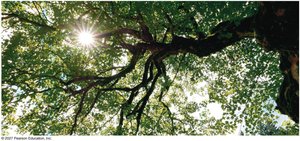
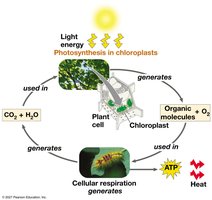
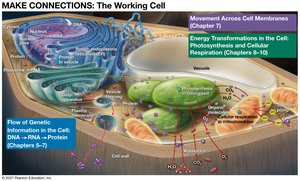
Photosynthesis is the fundamental biological process by which plants, algae, and certain prokaryotes convert solar energy into chemical energy, sustaining nearly all life on Earth. It occurs within specialized organelles called chloroplasts and provides the organic molecules and oxygen necessary for heterotrophic organisms.
Autotrophs: Organisms that produce their own food from inorganic substances. Most plants are photoautotrophs, using sunlight to synthesize organic molecules.
Heterotrophs: Organisms that obtain organic material by consuming other organisms. Includes consumers and decomposers.
Fossil fuels: Ancient stores of solar energy, formed from the remains of photosynthetic organisms.
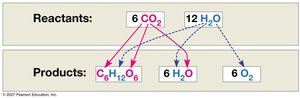
Photosynthesis equation:
Types of Photosynthetic Organisms
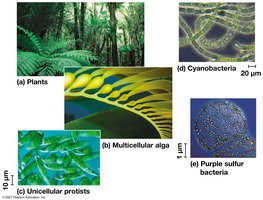
Photosynthesis is not limited to plants; it also occurs in multicellular algae, unicellular protists, cyanobacteria, and purple sulfur bacteria.
Photoautotrophs: Use sunlight to make organic molecules.
Examples: Ferns, algae, cyanobacteria, purple sulfur bacteria.
Chloroplasts: The Sites of Photosynthesis
Structure and Function
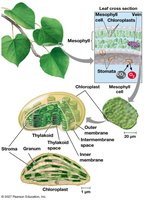
Chloroplasts are found mainly in the mesophyll cells of leaves. Their structural organization enables the chemical reactions of photosynthesis.
Stomata: Microscopic pores for gas exchange.
Veins: Transport water and sugars.
Stroma: Dense fluid inside chloroplasts.
Thylakoids: Membranous sacs, often stacked as grana, containing chlorophyll.
Photosynthesis: Chemical Process and Redox Reactions
Tracking Atoms and Water Splitting
Photosynthesis involves splitting water molecules and incorporating hydrogen into sugars, releasing oxygen as a by-product. The process is a series of redox reactions, reversing the electron flow seen in cellular respiration.
Water splitting:
Redox process:
CO2 is reduced; H2O is oxidized.

The Two Stages of Photosynthesis
Light Reactions and Calvin Cycle
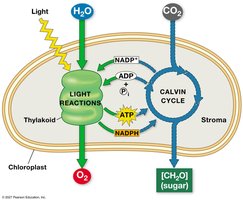
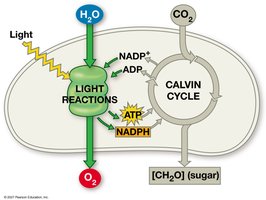
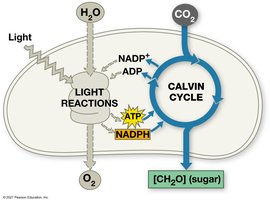
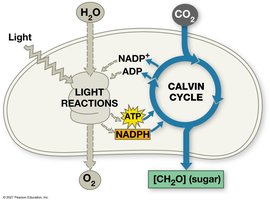
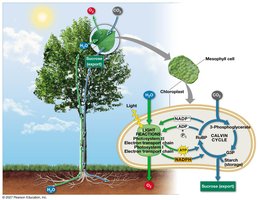
Photosynthesis consists of two main stages: the light reactions and the Calvin cycle. The light reactions occur in the thylakoid membranes and generate ATP and NADPH, while the Calvin cycle occurs in the stroma and synthesizes sugars.
Light reactions: Split water, release O2, reduce NADP+ to NADPH, generate ATP by photophosphorylation.
Calvin cycle: Uses ATP and NADPH to fix carbon and produce sugars.
Carbon fixation: Incorporation of CO2 into organic molecules.
The Nature of Sunlight
Electromagnetic Spectrum and Photons
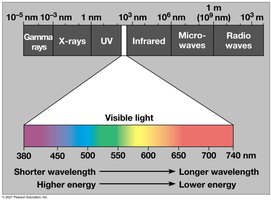
Light is electromagnetic energy, traveling in waves. The visible spectrum (380–740 nm) is most effective for photosynthesis. Light also behaves as discrete particles called photons, each with a fixed energy inversely related to wavelength.
Shorter wavelengths: Higher energy (e.g., UV, gamma rays).
Visible light: Drives photosynthesis.
Photosynthetic Pigments: Light Receptors
Pigments and Absorption
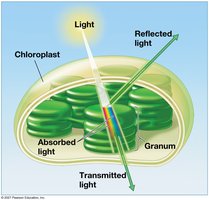
Pigments absorb specific wavelengths of light. Chlorophyll absorbs violet-blue and red light, reflecting green. Accessory pigments like chlorophyll b and carotenoids broaden the spectrum and provide photoprotection.
Chlorophyll a: Main pigment for light reactions.
Chlorophyll b: Accessory pigment.
Carotenoids: Accessory pigments, absorb violet and blue-green light.
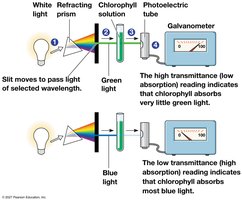
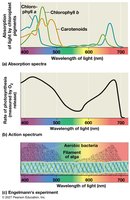
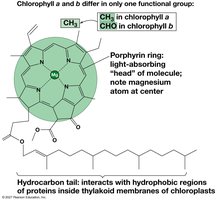
Excitation of Chlorophyll by Light
When chlorophyll absorbs light, electrons are excited to a higher energy state. In isolation, these electrons return to the ground state, releasing energy as heat or fluorescence.
Fluorescence: Afterglow from excited electrons returning to ground state.
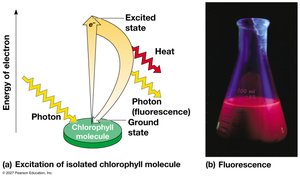
Photosystems and Electron Flow
Structure and Function of Photosystems
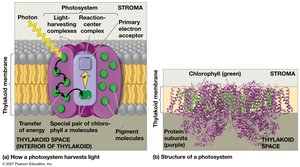
A photosystem consists of a reaction-center complex surrounded by light-harvesting complexes. There are two types: Photosystem II (P680) and Photosystem I (P700), each absorbing different wavelengths.
Reaction-center complex: Holds special chlorophyll a molecules and a primary electron acceptor.
Light-harvesting complex: Transfers energy to the reaction center.
Linear Electron Flow
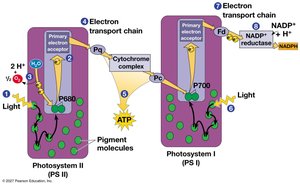
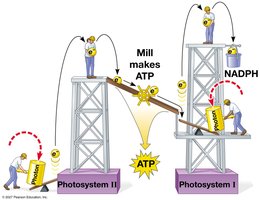
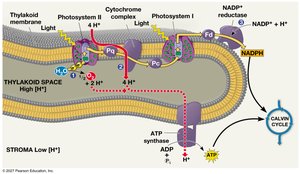
Linear electron flow is the primary pathway during light reactions, involving both photosystems and producing ATP and NADPH. It includes water splitting, electron transport chains, and chemiosmosis.
Photosystem II: Splits water, releases O2, transfers electrons.
Electron transport chain: Pumps protons, creates gradient.
Photosystem I: Excites electrons, reduces NADP+ to NADPH.
ATP synthesis: Driven by proton gradient.
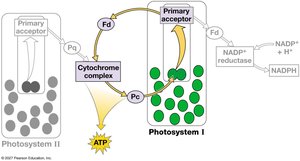
Cyclic Electron Flow
Cyclic electron flow involves only Photosystem I and produces ATP without generating NADPH or O2. It is an evolutionary relic and may provide photoprotection.
ATP production: Via cyclic electron flow.
No NADPH or O2 produced.
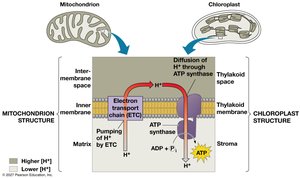
Comparison of Chemiosmosis in Chloroplasts and Mitochondria
Mechanisms and Differences
Both organelles generate ATP by chemiosmosis, but differ in electron sources and spatial organization. Chloroplasts use light energy; mitochondria use chemical energy from food.
Electron transport chain: Pumps protons across membranes.
ATP synthase: Couples proton diffusion to ATP production.
Chloroplasts: Protons pumped into thylakoid space, ATP produced in stroma.
Mitochondria: Protons pumped into intermembrane space, ATP produced in matrix.
The Calvin Cycle
Phases and Mechanisms
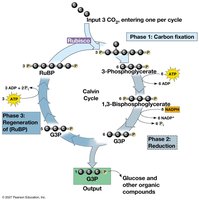
The Calvin cycle is an anabolic pathway that uses ATP and NADPH to fix carbon and produce sugars. It consists of three phases: carbon fixation, reduction, and regeneration of the CO2 acceptor (RuBP).
Phase 1: Carbon fixation: CO2 binds to RuBP, catalyzed by rubisco.
Phase 2: Reduction: 3-phosphoglycerate is converted to G3P using ATP and NADPH.
Phase 3: Regeneration: RuBP is regenerated from G3P, using ATP.
Net synthesis: For one G3P, cycle consumes 9 ATP and 6 NADPH.
Alternative Mechanisms of Carbon Fixation
C4 and CAM Pathways
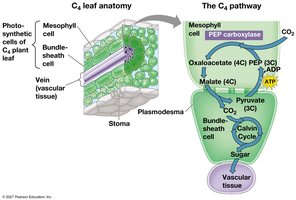
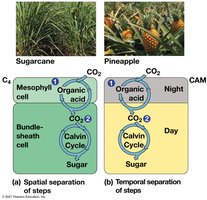
Plants in hot, arid climates have evolved alternative carbon fixation mechanisms to minimize photorespiration and optimize water use. C4 plants spatially separate steps, while CAM plants temporally separate them.
C4 plants: Fix CO2 into four-carbon compounds in mesophyll cells, then release CO2 in bundle-sheath cells for the Calvin cycle.
CAM plants: Open stomata at night, fix CO2 into organic acids, release CO2 during the day for the Calvin cycle.
Examples: Sugarcane (C4), pineapple (CAM).
Photosynthesis: Essential for Life
Summary and Applications
Photosynthesis stores solar energy as chemical energy in organic compounds, providing energy and carbon skeletons for all living organisms. Plants store excess sugar as starch in various structures.
Energy flow: Sunlight → chemical energy → organic molecules.
Storage: Starch in roots, tubers, seeds, fruits.
Summary Tables
Key Concepts: Linear Electron Flow
Process | Photosystem II | Photosystem I |
|---|---|---|
Water splitting | Yes | No |
ATP production | Yes | No |
NADPH production | No | Yes |
Oxygen release | Yes | No |
*Additional info: Table inferred from summary diagrams and text*
Key Concepts: Calvin Cycle
Phase | Key Steps | Inputs | Outputs |
|---|---|---|---|
Carbon fixation | CO2 binds to RuBP | CO2, RuBP | 3-phosphoglycerate |
Reduction | 3-phosphoglycerate → G3P | ATP, NADPH | G3P |
Regeneration | RuBP regenerated | ATP | RuBP |
*Additional info: Table inferred from Calvin cycle schematic*
