 Indietro
Photosynthesis: Mechanisms, Pigments, and Adaptations
Guida di studio - Note intelligenti
 Appunti personalizzati basati sui tuoi materiali, ampliati con definizioni chiave, esempi e contesto.
Photosynthesis: The Power Cycle of Life
Overview of Photosynthesis
Photosynthesis is a fundamental biological process by which photoautotrophs convert light energy into chemical energy, producing carbohydrates and oxygen. This process is essential for life on Earth, as it forms the basis of most food webs and drives ecological interdependency. - Definition: Photosynthesis is the conversion of light energy into chemical energy, primarily in the form of glucose. - Importance: Provides energy for autotrophs and oxygen for heterotrophs. - General Equation: 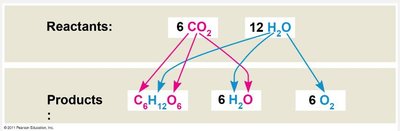
Cellular and Ecological Interdependency
The relationship between heterotrophs and photoautotrophs is central to ecosystem function. Heterotrophs rely on plants for energy, while plants depend on heterotrophs' waste products for photosynthesis. - Heterotrophs: Obtain energy by consuming organic molecules; require oxygen and produce waste. - Photoautotrophs: Use light energy to synthesize sugars; require CO2 and produce oxygen. 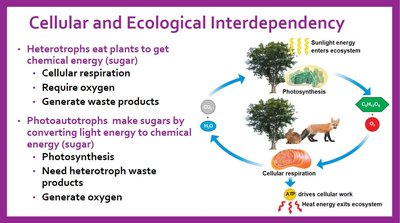
Photosynthesizers: Diversity of Organisms
Photosynthesis is not limited to plants; it occurs in various organisms, including algae, protists, and certain bacteria. - Plants: Primary terrestrial photosynthesizers. - Multicellular algae: Major aquatic photosynthesizers. - Unicellular protists: Include euglenoids and diatoms. - Cyanobacteria: Prokaryotic photosynthesizers. - Purple sulfur bacteria: Use alternative electron donors. 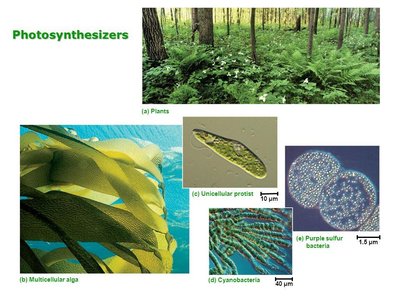
Mechanisms of Photosynthesis
Photosynthesis as an Anabolic Pathway
Photosynthesis is an anabolic, endergonic pathway that builds organic molecules using the outputs of cellular respiration. - Anabolic: Builds up molecules. - Endergonic: Requires energy input (light).
The Electromagnetic Spectrum and Light Energy
Light energy is absorbed by pigment molecules, exciting electrons and driving photosynthetic reactions. - Electromagnetic Spectrum: Range of wavelengths; visible light is used in photosynthesis. - Energy: Shorter wavelengths have higher energy. 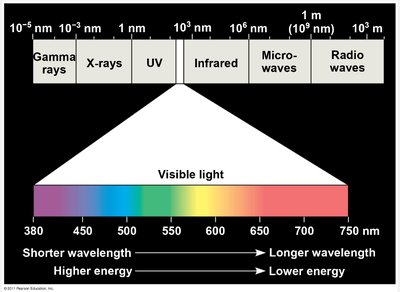
Excited Electrons and Energy Transfer
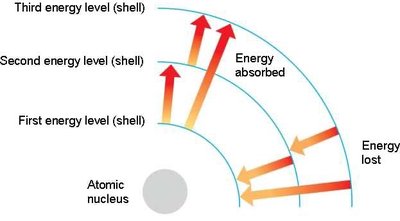
Electrons in atoms can absorb energy and move to higher shells, releasing energy as they return to lower shells. - Valence Shells: Outermost electron shells involved in energy absorption. 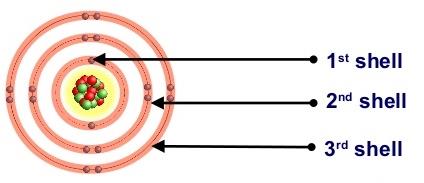
Pigments and Light Absorption
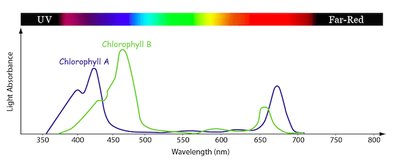
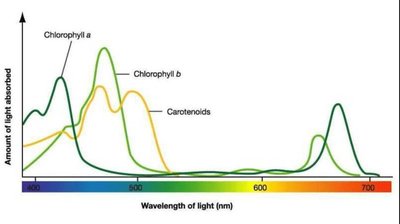
Pigment molecules, such as chlorophylls, absorb specific wavelengths of light, determining leaf color and photosynthetic efficiency. - Chlorophyll a: Main photosynthetic pigment. - Chlorophyll b: Accessory pigment. - Carotenoids: Absorb additional wavelengths, protect from photo-damage. 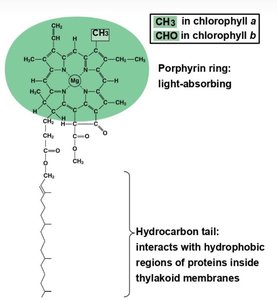
Leaf Anatomy and Gas Exchange
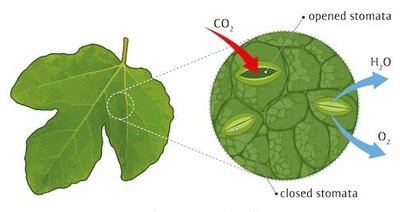
Leaves are specialized organs for photosynthesis, containing mesophyll cells and stomata for gas exchange. - Stomata: Pores for CO2 uptake and O2 release. - Mesophyll cells: Contain chloroplasts, site of photosynthesis. 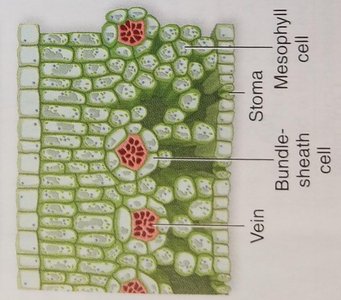
Photosynthetic Reactions
Redox Reaction of Photosynthesis
Photosynthesis involves the oxidation of water and reduction of carbon dioxide, reversing the electron flow of cellular respiration. - Oxidation: Water loses electrons, forming O2. - Reduction: CO2 gains electrons, forming glucose.
Location of Photosynthetic Reactions
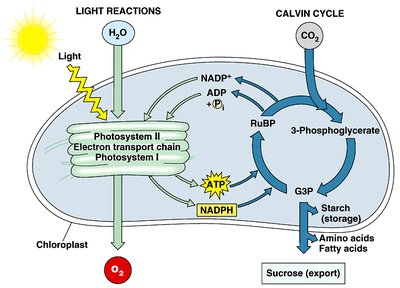
Photosynthesis occurs in two main stages: the light reactions and the Calvin cycle, each in distinct chloroplast regions. - Light Reactions: Occur in thylakoid membranes; produce ATP and NADPH. - Calvin Cycle: Occurs in stroma; uses ATP and NADPH to fix carbon. 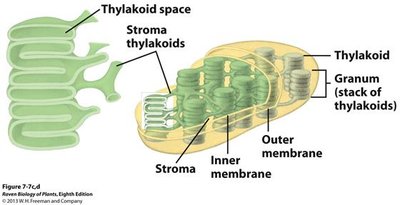
The Light Reactions
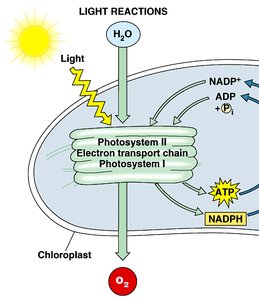
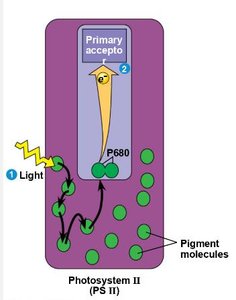
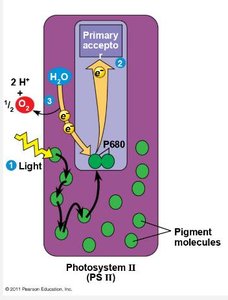
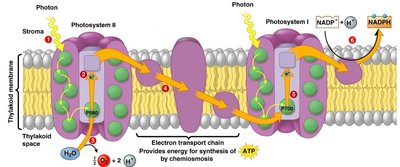
Light reactions require light and water, and involve four main complexes in the thylakoid membrane: Photosystem II, Electron Transport Chain, Photosystem I, and another Electron Transport Chain. - Photosystem II: Absorbs light, splits water, releases O2. - Electron Transport Chain: Transfers electrons, creates proton gradient. - Photosystem I: Absorbs light, transfers electrons to NADP+. - ATP and NADPH: Produced for use in Calvin cycle. 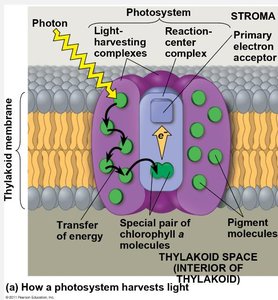
Linear vs Cyclic Electron Flow
- Linear Electron Flow (LEF): Involves both photosystems, produces ATP, NADPH, and O2. - Cyclic Electron Flow (CEF): Uses only Photosystem I, produces ATP but not NADPH or O2.
Comparison: Mitochondria vs Chloroplasts
Both organelles use proton gradients to drive ATP synthesis, but differ in energy sources and spatial organization.
Feature | Mitochondria | Chloroplasts |
|---|---|---|
Energy Source | Chemical (food) | Light |
Proton Gradient Location | Intermembrane space | Thylakoid space |
ATP Synthesis Location | Matrix | Stroma |
The Calvin Cycle (Light-Independent Reaction)
Phases of the Calvin Cycle
The Calvin cycle uses ATP and NADPH to fix carbon dioxide into glucose, occurring in three phases: carbon fixation, reduction, and regeneration of RuBP. - Phase 1: Carbon Fixation CO2 is added to RuBP by rubisco, forming a 6-carbon molecule. - Phase 2: Reduction The 6-carbon molecule splits into two 3-carbon PGALs, requiring ATP and NADPH. - Phase 3: Regeneration PGALs are converted back to RuBP, using ATP. 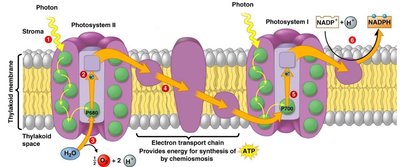
Summary Equation of the Calvin Cycle
Adaptations in Photosynthesis
Photorespiration and Rubisco Efficiency
Rubisco can bind O2 instead of CO2 under certain conditions, leading to photorespiration, which reduces photosynthetic efficiency. - Photorespiration: Occurs when CO2 is scarce; O2 is used, CO2 is released.
C3, C4, and CAM Plants
Plants have evolved mechanisms to minimize photorespiration and maximize carbon fixation.
Plant Type | Mechanism | Adaptation |
|---|---|---|
C3 | Direct CO2 fixation | Most common, less efficient in hot/dry climates |
C4 | Spatial separation | CO2 fixed in mesophyll, Calvin cycle in bundle sheath |
CAM | Temporal separation | CO2 fixed at night, Calvin cycle during day |
Photosynthetic Animals
Some animals, such as Elysia chlorotica slugs, can incorporate chloroplasts and perform photosynthesis for extended periods. 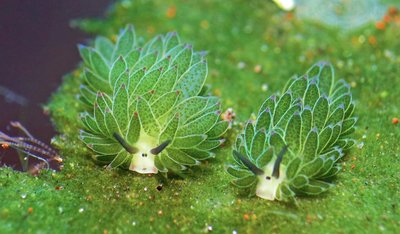
Summary
Photosynthesis is a complex, multi-step process essential for life, involving light absorption, electron transport, and carbon fixation. Adaptations in plants and even some animals highlight the diversity and importance of this process in biology. Key Terms: Photosynthesis, chlorophyll, Calvin cycle, photorespiration, C3/C4/CAM plants, electron transport chain, ATP, NADPH, rubisco.
