 Indietro
Photosynthesis: Mechanisms, Pigments, and Adaptations
Guida di studio - Note intelligenti
 Appunti personalizzati basati sui tuoi materiali, ampliati con definizioni chiave, esempi e contesto.
Photosynthesis: Overview and Key Concepts
Introduction to Photosynthesis
Photosynthesis is the process by which autotrophic organisms, such as plants and algae, convert sunlight into chemical energy stored in sugars. This process is fundamental for life on Earth, providing energy for heterotrophs and contributing to global carbon cycling.
Photosynthesis captures sunlight to reduce CO2 into sugar.
Autotrophs are self-feeders; many are photosynthetic.
Endosymbiosis theory explains the origin of chloroplasts from engulfed photosynthetic prokaryotes.
Photosynthesis vs. Cellular Respiration
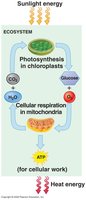
Photosynthesis and cellular respiration are complementary processes. Photosynthesis stores energy in glucose, while cellular respiration releases energy for cellular activities.
Photosynthesis: Converts sunlight, CO2, and water into glucose and O2.
Cellular Respiration: Breaks down glucose to produce ATP, releasing CO2 and water.
Structure and Function of Chloroplasts
Chloroplast Anatomy
Photosynthesis occurs in chloroplasts, which have a double membrane structure. The stroma is the site of the Calvin cycle, while thylakoids are the site of light-dependent reactions.
Stroma: Fluid matrix for the Calvin cycle.
Thylakoids: Membrane-bound compartments for light reactions.
Grana: Stacks of thylakoids for efficient light capture.
Chlorophyll: Green pigment that absorbs light energy.
Light and Photosynthetic Pigments
Properties of Light
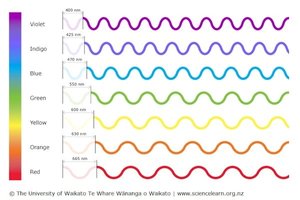
Light consists of photons, which are energy packets. The wavelength of light determines its energy and color.
Shorter wavelength = higher energy.
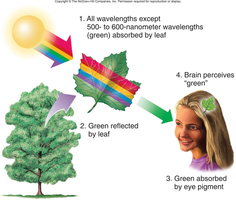
Pigments absorb specific wavelengths; reflected wavelengths determine color.
Photosynthetic Pigments
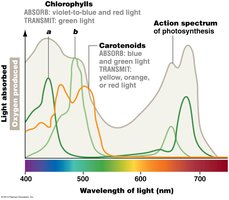
Chlorophylls and carotenoids are the main pigments involved in photosynthesis. They absorb light at specific wavelengths, driving the process.
Chlorophyll a: Absorbs blue-violet and red, reflects green.
Chlorophyll b: Absorbs blue and orange, reflects yellow-green.
Carotenoids: Absorb blue-green, reflect yellow and orange.
Structure of Chlorophyll
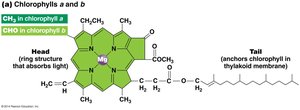
Chlorophyll molecules have a head region that absorbs light and a tail that anchors them in the thylakoid membrane.
Head: Contains a Mg2+ ring for light absorption.
Tail: Hydrophobic, anchors in membrane.
Photosynthesis: Light-Dependent and Light-Independent Reactions
Light-Dependent Reactions
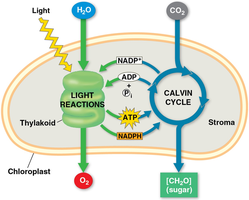
These reactions occur in the thylakoid membranes and require light. Water is split, releasing O2, and ATP and NADPH are produced.
H2O is split, O2 released.
Electrons transferred to NADP+ to form NADPH.
ATP produced by photophosphorylation.
Calvin Cycle (Light-Independent Reactions)
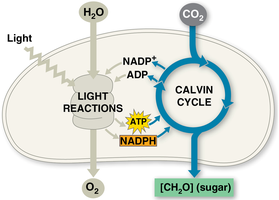
The Calvin cycle occurs in the stroma and uses ATP and NADPH to fix CO2 into sugars. It regenerates molecules needed for the next cycle.
Uses ATP and NADPH to convert CO2 to G3P (sugar).
Links light reactions to carbon fixation.
Photosystems and Electron Transport
Photosystems I and II
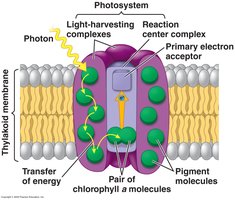
Photosystems are complexes of chlorophyll molecules that absorb light and transfer energy. Photosystem II splits water and passes electrons to Photosystem I, which produces NADPH.
Photosystem II: Splits water, releases O2, passes electrons to ETC.
Photosystem I: Uses electrons and light to make NADPH.
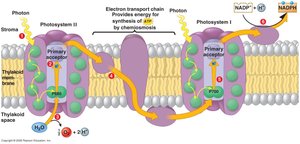
Photolysis and Chemiosmosis
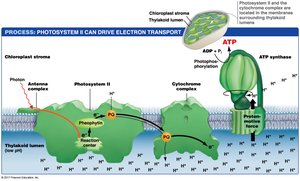
Photolysis is the splitting of water in Photosystem II. Chemiosmosis is the process by which protons flow through ATP synthase to produce ATP.
Water split into electrons, protons, and O2.
Proton gradient drives ATP synthesis.
ATP production is called photophosphorylation.
Calvin Cycle: Steps and Regulation
Three Steps of the Calvin Cycle
The Calvin cycle consists of fixation, reduction, and regeneration steps. Rubisco is the key enzyme for carbon fixation.
Fixation: CO2 + RuBP → 3-PGA.
Reduction: 3-PGA → G3P using ATP & NADPH.
Regeneration: G3P + ATP → RuBP.
Photorespiration and Adaptations
Photorespiration occurs when Rubisco binds O2 instead of CO2, reducing photosynthetic efficiency. C4 and CAM pathways minimize photorespiration in hot, dry environments.
C4 pathway: Separates CO2 fixation and Calvin cycle by space.
CAM pathway: Separates CO2 fixation and Calvin cycle by time.
Fate of Photosynthetic Sugars
Utilization of G3P
G3P produced in the Calvin cycle is used to form glucose and other organic molecules. Excess sugars are stored as starch.
Glucose and fructose form sucrose for transport.
Excess sucrose is stored as starch.
Starch is broken down at night for energy.
Photosynthesis and Global Climate
Impact of Rising CO2 and Temperature
Atmospheric CO2 and temperature changes affect C3 and C4 plants differently. Scientists are engineering C4 traits into C3 crops to improve yield and food security.
C4 plants are more heat-tolerant and use less water.
C3 plants may lose efficiency as temperatures rise.
Summary Table: Photosynthesis vs. Cellular Respiration
Process | Reactants | Products | Energy Flow |
|---|---|---|---|
Photosynthesis | CO2, H2O, Light | Glucose, O2 | Stores energy in glucose |
Cellular Respiration | Glucose, O2 | CO2, H2O, ATP | Releases energy for cellular work |
Key Equations
Photosynthesis:
Cellular Respiration:
