 Indietro
Photosynthesis: Mechanisms, Pigments, and Ecological Significance
Guida di studio - Note intelligenti
 Appunti personalizzati basati sui tuoi materiali, ampliati con definizioni chiave, esempi e contesto.
Photosynthesis: Overview and Importance
Definition and General Reaction
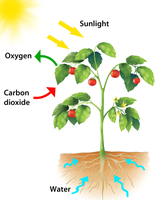
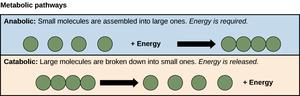
Photosynthesis is an anabolic reaction in which radiant energy from the sun is used to synthesize complex molecules from simple ones. This process occurs in the chloroplasts of green plants, algae, and some bacteria, and is essential for life on Earth.
Summary Reaction: Energy is applied to link carbon dioxide (CO2) and water (H2O) to produce glucose (C6H12O6) and oxygen (O2).
Requires: Chlorophyll and sunlight.
Equation:
Oxygen: Released as a by-product, replenishing atmospheric O2.
Chloroplast Structure and Location of Photosynthetic Reactions
Chloroplast Anatomy
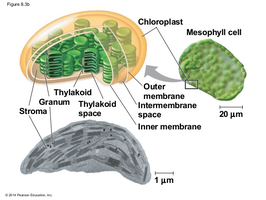
Chloroplasts are specialized organelles found in algae, moss, and green plants. They have a double membrane structure and contain internal stacks called grana, which are composed of thylakoids. The stroma is the fluid matrix surrounding the grana.
Outer membrane: Smooth surface.
Thylakoid: Inner membrane arranged in stacks (grana).
Stroma: Fluid matrix where light-independent reactions occur.
Photosynthetic Pigments
Types and Functions
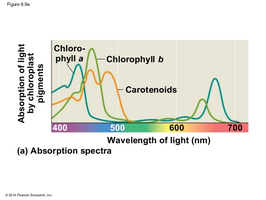
Photosynthetic pigments are organic molecules whose structure is altered by light, enabling them to absorb specific wavelengths. The primary pigment is chlorophyll a, with accessory pigments broadening the range of light absorbed.
Chlorophyll a: Absorbs blue and red light; reflects green.
Chlorophyll b: Absorbs blue and red light; reflects green.
Carotenoids: Absorb blue-green; reflect red, orange, yellow.
Xanthophyll: Absorb blue-green; reflect yellow, brown.
Accessory pigments: Expand the range of usable wavelengths for photosynthesis.
Pigment | Colors/Wavelengths Absorbed | Colors/Wavelengths Reflected |
|---|---|---|
Chlorophyll a | Blue & Red | Green |
Chlorophyll b | Blue & Red | Green |
Carotenoids | Blue-Green | Red, Orange, Yellow |
Xanthophyll | Blue-Green | Yellow, Brown |
Leaf Color Change and Photoperiod
Seasonal Pigment Changes
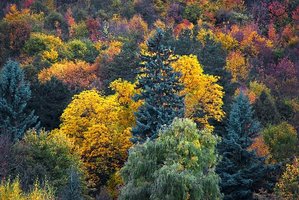
Leaf color changes in autumn are due to the reduction and eventual elimination of chlorophyll production, revealing carotenoids and xanthophylls. Photoperiod (the ratio of light to dark hours) triggers these changes, and temperature can intensify coloration.
Photoperiod: Number of light and dark hours in a 24-hour period.
Chlorophyll: Decomposed and recycled in fall.
Carotenoids & Xanthophyll: Become visible as chlorophyll fades.
Cellulose: Remains after pigments are gone, giving leaves a brown, crispy texture.

Nature of Light and Solar Radiation
Light Properties and Photosynthesis
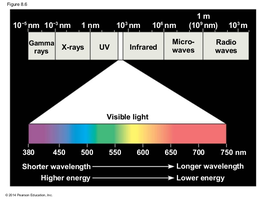
Light has both particle (photon) and wave (wavelength) properties. The visible spectrum is the range of wavelengths used in photosynthesis and perceived by humans. Shorter wavelengths (blue) have higher energy, while longer wavelengths (red) have lower energy.
Photon: Particle nature of light.
Wavelength: Wave nature, measured in nanometers (nm).
Visible spectrum: 380–750 nm; used in photosynthesis.
Chlorophyll absorption: Blue (~380 nm) and red (~750 nm) light.
Plant Grow Lights and Photosynthesis
Artificial Light Sources
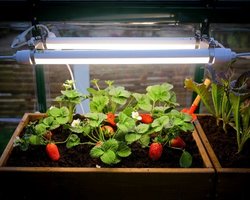
Plant grow lights are designed to emit blue and red wavelengths, which are most efficiently absorbed by chlorophyll a and b. These lights support photosynthesis in indoor and low-light environments.
Grow lights: Emphasize blue and red wavelengths for optimal plant growth.
Application: Used in agriculture, horticulture, and indoor gardening.


Spectra Relevant to Photosynthesis
Electromagnetic, Visible, and Absorption Spectra
Three spectra are important for understanding photosynthesis: the electromagnetic spectrum (all solar radiation), the visible spectrum (wavelengths used in photosynthesis), and absorption spectra (specific wavelengths absorbed by each pigment).
Electromagnetic spectrum: Full range of solar radiation.
Visible spectrum: Subset used in photosynthesis.
Absorption spectra: Unique to each pigment, determining which wavelengths are utilized.
Biochemistry of Photosynthesis
Light-Dependent and Light-Independent Reactions
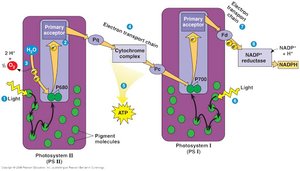
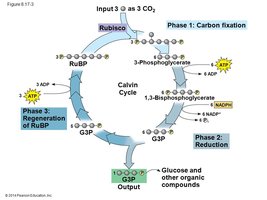
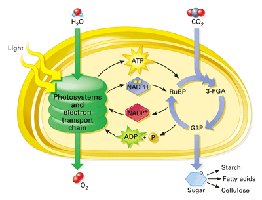
Photosynthesis consists of two sequential sets of reactions: light-dependent reactions (require light, occur on thylakoid membranes) and light-independent reactions (Calvin Cycle, occur in stroma).
Light-dependent reactions: Produce ATP, NADPH2, and O2.
Light-independent reactions: Use ATP and NADPH2 to fix carbon and synthesize glucose.
Summary and Ecological Significance
Photosynthesis in Ecosystems and Human Society
Photosynthesis is the foundation of energy flow in ecosystems, provides atmospheric oxygen, and supports global food supply. It is also crucial for agricultural productivity, industrial uses, and pharmaceutical development.
Energy flow: Basis for all producers (plants, algae).
Oxygen release: Essential for aerobic life.
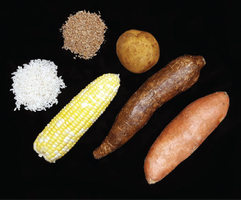
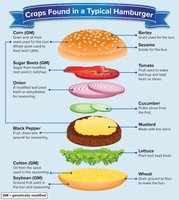
Agricultural crops: Cereal grains (corn, rice, wheat, etc.) are vital for civilization.
Industrial uses: Timber, oils, fossil fuels, and more.
Pharmaceuticals: Many early medicines derived from plants.

Additional info:
Photosynthetic pigments in cyanobacteria include phycobilins; green and purple bacteria use bacteriochlorophyll (without O2 release).
Photoperiod and temperature influence leaf color changes in autumn.
Herbicides may act as competitive inhibitors on enzymes in the electron transport chains of photosynthesis.
Ozone (O3) is formed from O2 released by photosynthesis in the upper atmosphere.
