 Indietro
Photosynthesis: Mechanisms, Pigments, and Energy Conversion
Guida di studio - Note intelligenti
 Appunti personalizzati basati sui tuoi materiali, ampliati con definizioni chiave, esempi e contesto.
Photosynthesis: Overview and Significance
Introduction to Photosynthesis
Photosynthesis is a fundamental biological process by which autotrophic organisms convert sunlight into chemical energy, producing carbohydrates and oxygen. This process is essential for sustaining life on Earth, as it forms the basis of most food chains and provides atmospheric oxygen.
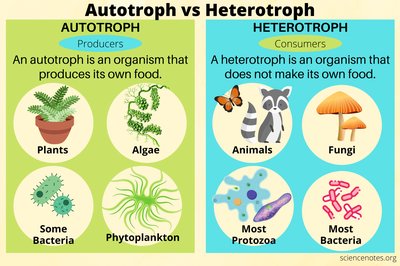
Autotrophs: Organisms that produce their own food via photosynthesis (e.g., plants, algae, some bacteria).
Heterotrophs: Organisms that obtain energy by consuming other organisms (e.g., animals, fungi, most bacteria).
Photosynthetic organisms include multicellular eukaryotes (plants, seaweeds), unicellular eukaryotes (e.g., Euglena), and prokaryotes (cyanobacteria, purple sulfur bacteria).
Photosynthesis Reaction and Electron Transfer
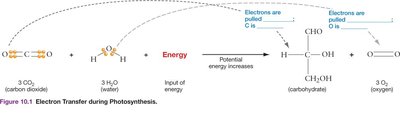
The overall photosynthetic reaction is the reverse of cellular respiration. It involves the conversion of carbon dioxide and water into carbohydrates and oxygen, using light energy.
General equation:
Electron transfer: Water is oxidized (loses electrons), and carbon dioxide is reduced (gains electrons).
Photosynthesis: Two Linked Sets of Reactions
Light-Dependent Reactions and Calvin Cycle
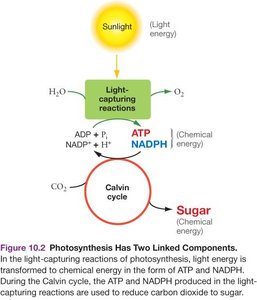
Photosynthesis consists of two interconnected stages: the light-dependent reactions and the Calvin cycle. These stages occur in different parts of the chloroplast and are tightly coordinated.
Light-dependent reactions: Occur in the thylakoid membranes; produce ATP and NADPH, and release O2 by splitting water.
Calvin cycle: Occurs in the stroma; uses ATP and NADPH to reduce CO2 and synthesize sugars.
Chloroplast Structure and Function
Organization of the Chloroplast
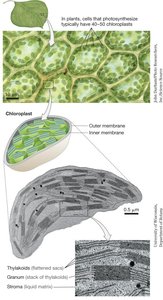
Photosynthesis takes place in chloroplasts, specialized organelles found in plant and algal cells. Chloroplasts contain internal membrane structures called thylakoids, which are organized into stacks known as grana.
Outer and inner membranes: Enclose the chloroplast.
Thylakoids: Flattened sacs where light-dependent reactions occur.
Grana: Stacks of thylakoids.
Stroma: Fluid matrix surrounding thylakoids; site of the Calvin cycle.
Photosynthetic Pigments and Light Absorption
Nature of Light and Pigment Function
Light is a form of electromagnetic radiation, characterized by wavelength and energy. Pigments in the thylakoid membranes absorb specific wavelengths of light, enabling photosynthesis.
Wavelength: Distance between two wave crests; shorter wavelengths have higher energy.
Photon: Discrete packet of light energy.
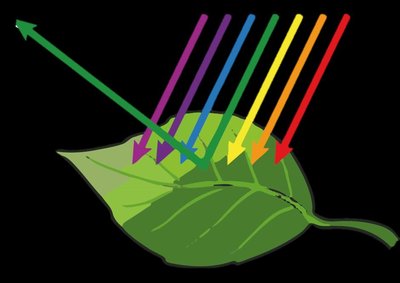
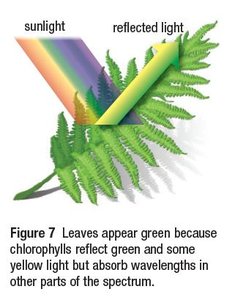
Pigments: Molecules that absorb certain wavelengths and reflect or transmit others; the reflected wavelengths determine the color observed.
The Electromagnetic Spectrum
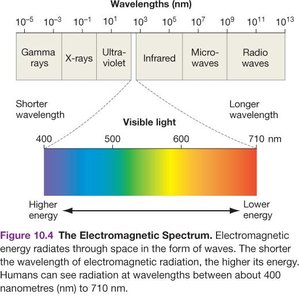
The electromagnetic spectrum encompasses all wavelengths of electromagnetic radiation. Photosynthetic pigments primarily absorb visible light (400–710 nm).
Visible light: The range humans can see; most effective for photosynthesis.
Energy relationship: (energy is inversely proportional to wavelength).
Pigment Types and Chromatography
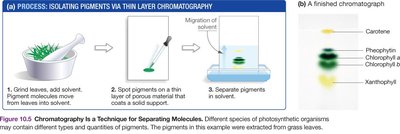
Plants contain several types of pigments, each with distinct absorption properties. Chromatography is used to separate and identify these pigments.
Chlorophylls (a and b): Absorb red and blue light; reflect green.
Carotenoids: Absorb blue and green light; reflect yellow, orange, and red.
Chromatography: Technique for separating pigments based on their solubility and migration in a solvent.
Absorption and Action Spectra
Each pigment has an absorption spectrum, indicating which wavelengths it absorbs. The action spectrum shows the rate of photosynthesis at each wavelength, correlating with pigment absorption.
Chlorophylls: Most effective at driving photosynthesis; absorb violet-to-blue and red light.
Carotenoids: Extend the range of light absorption and protect chlorophyll from damage.
Experimental Evidence: Engelmann's Experiment
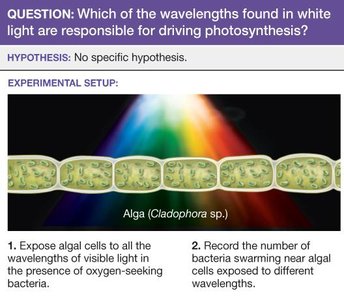
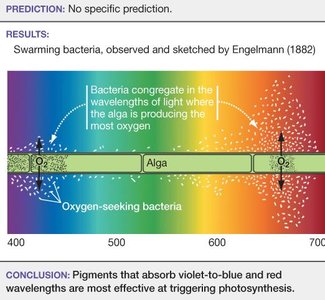
Engelmann's classic experiment demonstrated that photosynthesis is most effective at wavelengths absorbed by chlorophylls.
Setup: Algal cells exposed to different wavelengths; oxygen-seeking bacteria congregate where oxygen is produced.
Conclusion: Violet-to-blue and red wavelengths are most effective for photosynthesis.
Pigment Structure and Function
Chlorophyll and Carotenoid Structures
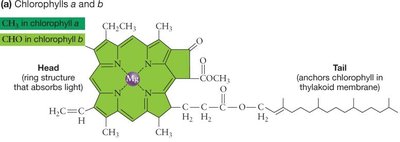
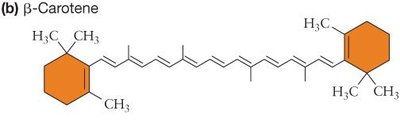
Chlorophyll molecules have a distinct structure with a hydrophobic tail and a ring-shaped head containing magnesium, which absorbs light. Carotenoids have long hydrocarbon chains and absorb different wavelengths.
Chlorophyll: Embedded in thylakoid membrane; absorbs light in the head region.
Carotenoids: Accessory pigments; protect chlorophyll and broaden absorption spectrum.
Light Absorption and Electron Excitation
Photon Absorption and Electron Excitation
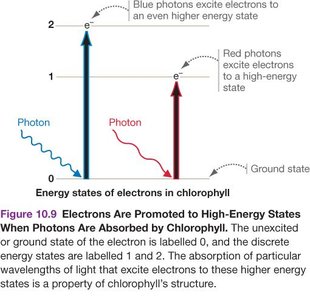
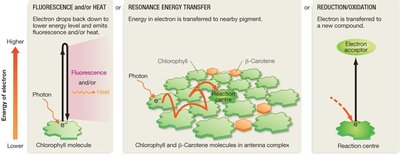
When chlorophyll absorbs photons, electrons are excited to higher energy states. The energy level depends on the wavelength of the absorbed photon.
Red photons: Excite electrons to one energy level higher.
Blue photons: Excite electrons to two energy levels higher.
Green photons: Not absorbed; reflected, giving plants their green color.
Photosystems and Energy Transfer
Photosystem Organization
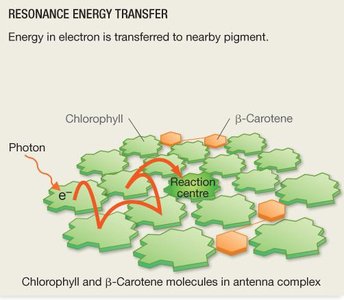
Chlorophyll molecules are organized into photosystems, which consist of an antenna complex and a reaction center. Energy is transferred among pigments via resonance energy transfer until it reaches the reaction center.
Antenna complex: Contains 200–300 pigment molecules; transfers energy, not electrons.
Reaction center: Specialized chlorophyll transfers excited electrons to an electron acceptor, converting light energy to chemical energy.
Resonance energy transfer: Energy is passed from one pigment to another without moving the electron.
Photosystems I and II: The Z Scheme
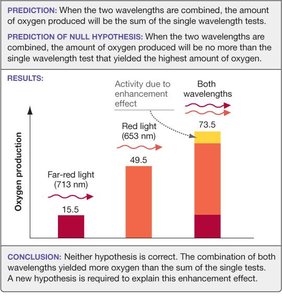
Discovery and Enhancement Effect
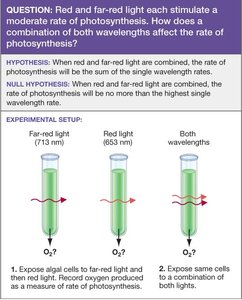
There are two types of photosystems: Photosystem I and Photosystem II. They work together to maximize photosynthetic efficiency, producing an enhancement effect when both are activated by their respective wavelengths.
Photosystem II: Uses 680 nm light; splits water, produces O2, and generates ATP.
Photosystem I: Uses 700 nm light; produces NADPH.
Enhancement effect: Combined activation increases photosynthesis beyond the sum of individual effects.
The Z Scheme: Electron Flow
The Z scheme describes the linear flow of electrons from water (via Photosystem II) to NADP+ (via Photosystem I), linking the two photosystems and maximizing energy conversion.
Electron flow: Water → Photosystem II → ETC → Photosystem I → NADP+
ATP production: Driven by proton gradient established by ETC.
NADPH production: Final electron acceptor in Photosystem I.
Summary Table: Photosynthetic Pigments
Pigment | Absorbed Wavelengths | Reflected/Transmitted Color | Function |
|---|---|---|---|
Chlorophyll a | Red, blue | Green | Main photosynthetic pigment |
Chlorophyll b | Red, blue | Green | Accessory pigment, broadens absorption |
Carotenoids | Blue, green | Yellow, orange, red | Accessory pigment, photoprotection |
Learning Objectives
Summarize the process of photosynthesis.
Analyze how pigment structure and organization allow cells to acquire energy from light.
Explain how photosystems use light energy to produce chemical energy.
