 Indietro
Photosynthesis: Mechanisms, Pigments, and Pathways
Guida di studio - Note intelligenti
 Appunti personalizzati basati sui tuoi materiali, ampliati con definizioni chiave, esempi e contesto.
Photosynthesis
Overview of Photosynthesis
Photosynthesis is the process by which plants, algae, and some bacteria convert solar energy into chemical energy, producing organic molecules from carbon dioxide and water. This process occurs primarily in chloroplasts and is essential for life on Earth, as it provides both food and oxygen.
Autotrophs: Organisms that produce their own organic molecules from inorganic sources (e.g., plants, algae).
Photoautotrophs: Use sunlight to drive the synthesis of organic compounds.
Heterotrophs: Obtain organic molecules by consuming other organisms; depend on autotrophs for food and oxygen.
Chloroplast Structure and Components
Photosynthesis occurs within specialized organelles called chloroplasts, which contain several key structures:
Mesophyll: Interior tissue of the leaf where most chloroplasts are found.
Stomata: Pores on the leaf surface that allow gas exchange (CO2 in, O2 out).
Stroma: Dense fluid inside the chloroplast, site of the Calvin cycle.
Thylakoids: Flattened sacs forming a third membrane system; site of light reactions.
Grana: Stacks of thylakoids.
Chlorophyll: Green pigment located in thylakoid membranes, essential for capturing light energy.
Photosynthesis Reaction and Redox Process
The overall chemical equation for photosynthesis is:
Photosynthesis is a redox process: H2O is oxidized, CO2 is reduced.
It is an endergonic process, requiring energy input from light.
Stages of Photosynthesis
Light Reactions
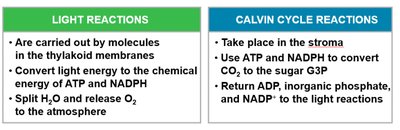
The light reactions occur in the thylakoid membranes and convert solar energy into chemical energy (ATP and NADPH), releasing O2 as a by-product.
Split H2O, releasing electrons, protons (H+), and O2.
Reduce NADP+ to NADPH.
Generate ATP from ADP by photophosphorylation.
Calvin Cycle (Dark Reactions)
The Calvin cycle occurs in the stroma and uses ATP and NADPH to convert CO2 into the sugar G3P (glyceraldehyde 3-phosphate).
Begins with carbon fixation (CO2 incorporated into organic molecules).
Reduces fixed carbon to carbohydrate using electrons from NADPH.
Regenerates the CO2 acceptor (RuBP).
Light and Pigments
Nature of Light
Light is electromagnetic energy, traveling in waves and as discrete particles called photons. The wavelength determines the energy of light; shorter wavelengths have higher energy.
Visible light (380–740 nm) drives photosynthesis.
Each photon has a fixed energy inversely related to its wavelength.
Measuring Light Absorption
A spectrophotometer measures a pigment’s ability to absorb various wavelengths.
An absorption spectrum plots light absorption versus wavelength.
An action spectrum shows the effectiveness of different wavelengths in driving photosynthesis.
Photosynthetic Pigments
Chloroplasts contain several pigments that absorb light energy:
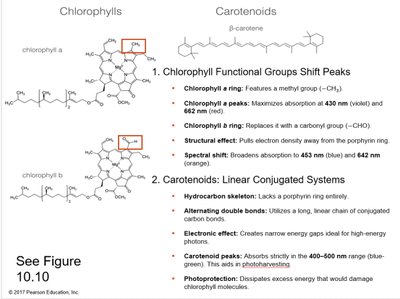
Chlorophyll a: Main pigment, directly involved in light reactions.
Chlorophyll b: Accessory pigment, broadens the spectrum of absorbed light.
Carotenoids: Accessory pigments (yellow/orange), absorb violet and blue-green light, protect chlorophyll from damage.
Key Points from Image:
Chlorophyll a and b differ in functional groups, shifting their absorption peaks.
Carotenoids have long conjugated systems, absorbing in the 400–500 nm range and protecting against photodamage.
Photosystems and Electron Flow
Photosystems
A photosystem consists of a reaction-center complex surrounded by light-harvesting complexes. There are two types:
Photosystem II (PS II): Best absorbs light at 680 nm (P680).
Photosystem I (PS I): Best absorbs light at 700 nm (P700).
Linear Electron Flow
The primary pathway for electron flow during the light reactions, involving both photosystems, produces ATP and NADPH.
Photon excites pigment in PS II; energy transferred to P680.
Excited electron from P680 transferred to primary electron acceptor (P680+).
Water is split, providing electrons, H+, and O2.
Electrons move down electron transport chain to PS I.
Proton gradient drives ATP synthesis (chemiosmosis).
Light excites P700 in PS I; electron transferred to acceptor.
Electrons passed to ferredoxin (Fd), then to NADP+ reductase.
NADP+ reduced to NADPH.
Cyclic Electron Flow
Involves only PS I; electrons cycle back to the cytochrome complex.
Produces ATP but not NADPH or O2.
Helps balance ATP/NADPH production.
ATP Synthesis: Chemiosmosis
Both chloroplasts and mitochondria use chemiosmosis to generate ATP.
In chloroplasts, protons are pumped into the thylakoid space and diffuse back into the stroma, driving ATP synthesis.
In mitochondria, protons are pumped into the intermembrane space and diffuse back into the matrix.
The Calvin Cycle
Phases of the Calvin Cycle
Carbon Fixation: CO2 attached to RuBP by rubisco, forming 3-phosphoglycerate.
Reduction: 3-phosphoglycerate is phosphorylated and reduced to G3P using ATP and NADPH.
Regeneration: Some G3P is used to regenerate RuBP, enabling the cycle to continue.
For one G3P, the cycle uses 3 CO2, 9 ATP, and 6 NADPH.
Photorespiration and Adaptations
Photorespiration
Occurs when rubisco adds O2 instead of CO2 to RuBP.
Consumes O2 and organic fuel, releases CO2, but does not produce ATP or sugar.
May protect plants from excess light energy when CO2 is low.
C4 and CAM Plants
C4 plants: Minimize photorespiration by incorporating CO2 into four-carbon compounds in mesophyll cells; Calvin cycle occurs in bundle-sheath cells.
CAM plants: Open stomata at night, fix CO2 into organic acids, which are used during the day for photosynthesis.
Summary Table: Light Reactions vs. Calvin Cycle
Light Reactions | Calvin Cycle Reactions |
|---|---|
|
|
Additional info: The energy captured by chloroplasts is stored in organic molecules, which provide energy and carbon skeletons for cellular processes. Excess sugars are stored as starch in various plant tissues.
