 Indietro
Photosynthesis: Mechanisms, Stages, and Adaptations
Guida di studio - Note intelligenti
 Appunti personalizzati basati sui tuoi materiali, ampliati con definizioni chiave, esempi e contesto.
Photosynthesis: Overview and Equation
Summary of Photosynthesis
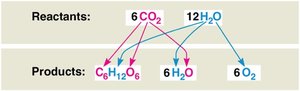
Photosynthesis is a complex, multi-step process by which plants, algae, and some bacteria convert light energy into chemical energy, producing glucose and oxygen from carbon dioxide and water. The overall chemical equation for photosynthesis is:
Equation:
Reactants: Carbon dioxide, water, and light energy
Products: Glucose, oxygen, and water
Tracking Atoms Through Photosynthesis
During photosynthesis, atoms from the reactants are rearranged to form the products. Carbon atoms from CO2 end up in glucose, while oxygen atoms from water are released as O2.
Redox Reactions in Photosynthesis
Photosynthesis as a Redox Process
Photosynthesis involves the transfer of electrons (redox reactions). Water is oxidized (loses electrons), and carbon dioxide is reduced (gains electrons) to form glucose. This process is endergonic, requiring an input of energy from light.
Oxidation: Water () loses electrons and forms oxygen ().
Reduction: Carbon dioxide () gains electrons to form glucose ().

Stages of Photosynthesis
The Two Main Stages
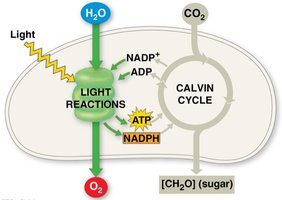
Photosynthesis occurs in two main stages: the light reactions and the Calvin cycle.
Light Reactions: Occur in the thylakoid membranes; convert solar energy to chemical energy (ATP and NADPH), split water, and release oxygen.
Calvin Cycle: Occurs in the stroma; uses ATP and NADPH to fix carbon dioxide and synthesize glucose.
Light and Pigments
Nature of Light
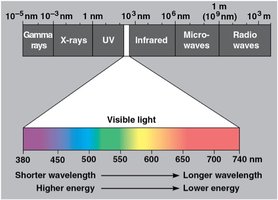
Light is a form of electromagnetic energy that travels in waves and behaves as particles called photons. The electromagnetic spectrum includes all wavelengths of electromagnetic radiation, but only visible light (about 380–740 nm) drives photosynthesis.
Shorter wavelengths: Higher energy
Longer wavelengths: Lower energy
Photosynthetic Pigments
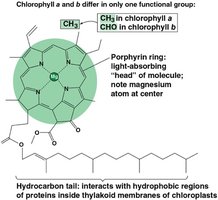
Pigments are molecules that absorb specific wavelengths of light. The main pigments in chloroplasts are chlorophyll a, chlorophyll b, and carotenoids. Each pigment absorbs light at different wavelengths, broadening the spectrum of light that can be used for photosynthesis.
Chlorophyll a: Main pigment; directly involved in light reactions.
Chlorophyll b: Accessory pigment; broadens the absorption spectrum.
Carotenoids: Accessory pigments; absorb excess light and provide photoprotection.
Light Absorption and Excitation
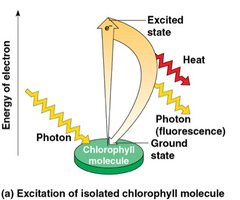
When pigments absorb photons, electrons are excited from a ground state to a higher energy state. This excited state is unstable, and energy is transferred to other molecules or released as heat and fluorescence.
Photosystems and Electron Flow
Photosystems: Structure and Function
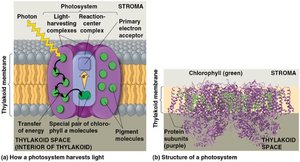
A photosystem consists of a reaction-center complex surrounded by light-harvesting complexes. There are two types: Photosystem II (PS II, P680) and Photosystem I (PS I, P700). These systems work together to drive the light reactions.
Light-harvesting complex: Collects and transfers energy to the reaction center.
Reaction center: Contains a special pair of chlorophyll a molecules and a primary electron acceptor.
Linear Electron Flow
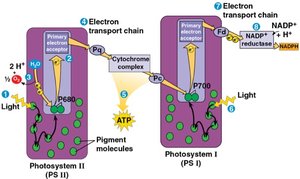
Linear electron flow is the primary pathway during the light reactions, involving both photosystems. It produces ATP and NADPH by transferring electrons from water to NADP+ through a series of redox reactions.
Water is split, providing electrons and releasing O2.
Electrons move through the electron transport chain, generating a proton gradient used to produce ATP (photophosphorylation).
Electrons finally reduce NADP+ to NADPH.
The Calvin Cycle
Phases of the Calvin Cycle
The Calvin cycle uses ATP and NADPH from the light reactions to fix CO2 and produce sugar. It occurs in three main phases:
Carbon Fixation: CO2 is attached to ribulose bisphosphate (RuBP) by the enzyme rubisco, forming 3-phosphoglycerate.
Reduction: ATP and NADPH are used to convert 3-phosphoglycerate into glyceraldehyde 3-phosphate (G3P), a sugar.
Regeneration: Some G3P is used to regenerate RuBP, enabling the cycle to continue.
For net synthesis of one G3P, the cycle must turn three times, fixing three molecules of CO2.
Adaptations in Photosynthesis
Photorespiration and C4/CAM Pathways
Photorespiration occurs when rubisco binds O2 instead of CO2, reducing photosynthetic efficiency. Plants in hot, arid climates have evolved adaptations to minimize photorespiration:
C4 Plants: Use PEP carboxylase to fix CO2 into a four-carbon compound in mesophyll cells, which is then transported to bundle-sheath cells for the Calvin cycle. Examples: corn, sugarcane.
CAM Plants: Open stomata at night to fix CO2 into organic acids, which release CO2 for the Calvin cycle during the day. Examples: succulents, cacti.
Comparison Table: C3, C4, and CAM Photosynthesis
Feature | C3 Plants | C4 Plants | CAM Plants |
|---|---|---|---|
Initial CO2 Fixation | 3-phosphoglycerate (3C) | Oxaloacetate (4C) | Organic acids (4C) |
Key Enzyme | Rubisco | PEP carboxylase | PEP carboxylase (night) |
Adaptation | None | Spatial separation of steps | Temporal separation of steps |
Examples | Rice, wheat | Corn, sugarcane | Cacti, succulents |
Summary
Photosynthesis is essential for life, converting solar energy into chemical energy and producing oxygen.
It involves light reactions (producing ATP and NADPH) and the Calvin cycle (fixing CO2 into sugar).
Plants have evolved various adaptations to optimize photosynthesis under different environmental conditions.
