 Indietro
Lecture 16
Guida di studio - Note intelligenti
 Appunti personalizzati basati sui tuoi materiali, ampliati con definizioni chiave, esempi e contesto.
Photosynthesis: Overview and Importance
Definition and General Equation
Photosynthesis is an anabolic process by which plants, algae, and some bacteria convert light energy into chemical energy, producing sugars that serve as fuel for cellular activities. The process is essential for life on Earth, as it forms the basis of most food chains and is responsible for the release of oxygen into the atmosphere.
General Equation:
Direct Product: The immediate product is a three-carbon sugar (G3P), not glucose.
Location: Occurs in the chloroplast of plant cells.

Tracking Atoms Through Photosynthesis
Reactants and Products
Photosynthesis involves the transformation of carbon dioxide and water into glucose and oxygen, with the help of light energy. The process can be tracked by following the movement of atoms through the reaction.
Reactants: 6 CO2, 12 H2O
Products: C6H12O6, 6 H2O, 6 O2
Water Splitting: Chloroplasts split H2O, releasing O2 and incorporating hydrogen electrons into sugar molecules.
Photosynthesis as a Redox Process
Electron Flow and Energy Transformation
Photosynthesis is a redox process that reverses the direction of electron flow compared to cellular respiration. Water is oxidized, and carbon dioxide is reduced, with light energy driving this endergonic reaction.
Oxidation: H2O loses electrons (is oxidized).
Reduction: CO2 gains electrons (is reduced).
Energy Source: Light provides the energy required for these transformations.

The Two Stages of Photosynthesis
Light Reactions and Calvin Cycle
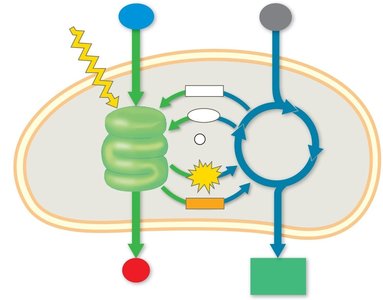
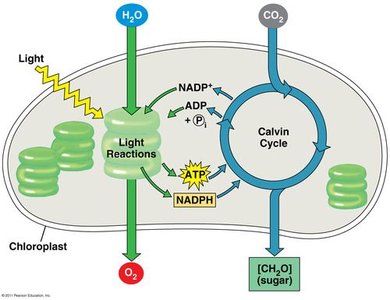
Photosynthesis consists of two interconnected stages: the light reactions and the Calvin cycle. Each stage occurs in a specific location within the chloroplast and has distinct functions.
Light Reactions: Occur in the thylakoid membranes; convert light energy to chemical energy (ATP and NADPH).
Calvin Cycle: Occurs in the stroma; uses ATP and NADPH to synthesize sugars from CO2.
Light Reactions: Mechanism and Steps
Location and Function
The light reactions take place in the thylakoid membrane and lumen of the chloroplast. Their primary function is to convert light energy into chemical energy in the form of ATP and NADPH, which are then used in the Calvin cycle.
Photosystem II (PSII): Uses light energy to create high-energy electrons for the electron transport chain (ETC) and replaces electrons by splitting water.
Electron Transport Chain (ETC): Uses high-energy electrons from PSII to pump H+ into the lumen.
ATP Synthase: Uses the H+ gradient in the lumen to synthesize ATP from ADP and inorganic phosphate.
Photosystem I (PSI): Uses light energy to create high-energy electrons for NADP+ reductase.
NADP+ Reductase: Transfers high-energy electrons to NADP+, forming NADPH.
Step | Location | Reactants | Products |
|---|---|---|---|
PSII | Thylakoid membrane | Light, H2O | High-energy e-, O2, H+ |
ETC | Thylakoid membrane | High-energy e-, H+ from stroma | Low-energy e-, H+ in lumen |
ATP Synthase | Thylakoid membrane | H+ gradient, ADP | ATP |
PSI | Thylakoid membrane | Low-energy e-, light | High-energy e- |
NADP+ Reductase | Thylakoid membrane | High-energy e-, NADP+ | NADPH |
Calvin Cycle: Mechanism and Steps
Location and Function
The Calvin cycle occurs in the stroma of the chloroplast and is responsible for synthesizing sugars from carbon dioxide using the energy and reducing power provided by ATP and NADPH from the light reactions.
Stage 1: Carbon Fixation - CO2 is attached to ribulose bisphosphate (RuBP) by the enzyme Rubisco, forming 3-phosphoglycerate (3PG).
Stage 2: Reduction - 3PG is reduced to glyceraldehyde-3-phosphate (G3P) using ATP and NADPH.
Stage 3: Regeneration - Some G3P is used to regenerate RuBP, enabling the cycle to continue.
Stage | Reactants | Products | Enzyme |
|---|---|---|---|
Carbon Fixation | CO2, RuBP | 3PG | Rubisco |
Reduction | 3PG, ATP, NADPH | G3P, ADP, NADP+ | Multiple |
Regeneration | G3P, ATP, NADPH | RuBP, ADP, NADP+ | Multiple |
Key Terms and Concepts
Chloroplast: Organelle where photosynthesis occurs; contains thylakoids and stroma.
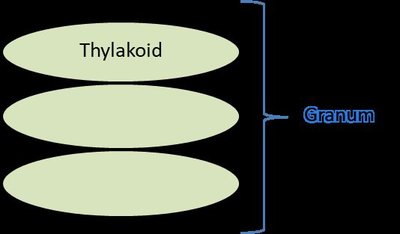
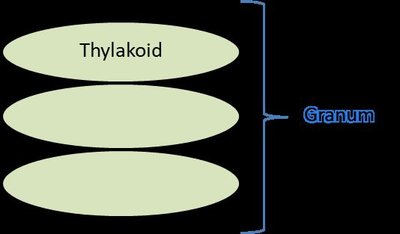
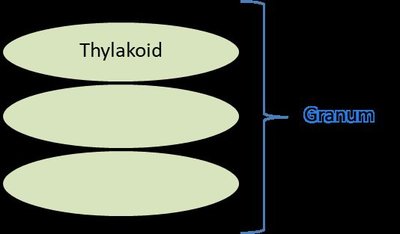
Thylakoid: Membranous structure within chloroplast; site of light reactions.
Granum: Stack of thylakoids.
Stroma: Fluid-filled space in chloroplast; site of Calvin cycle.
ATP: Adenosine triphosphate; energy currency of the cell.
NADPH: Electron carrier used in biosynthetic reactions.
G3P: Glyceraldehyde-3-phosphate; direct product of the Calvin cycle.
RuBP: Ribulose bisphosphate; molecule regenerated in the Calvin cycle.
Rubisco: Enzyme that catalyzes carbon fixation.
Summary Table: Photosynthesis Stages
Stage | Location | Reactants | Products | Purpose |
|---|---|---|---|---|
Light Reactions | Thylakoid membrane | Light, H2O | ATP, NADPH, O2 | Convert light energy to chemical energy |
Calvin Cycle | Stroma | CO2, ATP, NADPH | G3P (sugar), ADP, NADP+ | Synthesize sugars from CO2 |
Preparation for Exams
Practice drawing and explaining the concept maps for both the light reactions and Calvin cycle.
Be able to list the reactants and products of each step and state the purpose of each part.
Understand the location and function of each component within the chloroplast.
