 Indietro
Photosynthesis: Mechanisms, Structure, and Adaptations
Guida di studio - Note intelligenti
 Appunti personalizzati basati sui tuoi materiali, ampliati con definizioni chiave, esempi e contesto.
Photosynthesis Overview
Introduction to Photosynthesis
Photosynthesis is the fundamental process by which autotrophic organisms convert light energy into chemical energy, sustaining nearly all life on Earth. The overall equation for oxygenic photosynthesis is: - Key Point 1: Oxygenic photosynthesis is performed by cyanobacteria, seven groups of algae, and all land plants. - Key Point 2: The process provides both energy (glucose) and oxygen for heterotrophic organisms.
Leaf and Chloroplast Structure
Leaf Anatomy and Chloroplast Organization
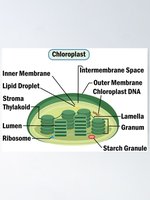
The leaf is the primary site of photosynthesis, containing specialized cells and organelles. Chloroplasts are the organelles where photosynthesis occurs, featuring a double membrane, stroma, and thylakoid membranes. - Key Point 1: The thylakoid membranes contain the photosynthetic pigments and are the site of light-dependent reactions. - Key Point 2: The stroma is the site of the Calvin cycle (light-independent reactions). 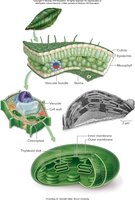
Stages of Photosynthesis
Light-Dependent and Light-Independent Reactions
Photosynthesis consists of two main stages: light-dependent reactions and carbon fixation (Calvin cycle). - Light-dependent reactions: Require light, occur in thylakoid membranes, produce ATP and NADPH. - Calvin cycle (light-independent reactions): Occur in the stroma, use ATP and NADPH to fix CO2 into organic molecules. 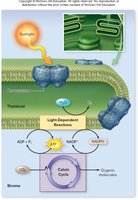
Pigments and Light Absorption
Types and Functions of Pigments
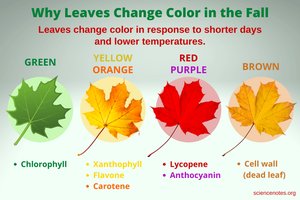
Pigments are molecules that absorb light energy in the visible range, enabling photosynthesis. - Key Point 1: Chlorophylls are the main pigments in green plants; chlorophyll a is primary, chlorophyll b is accessory. - Key Point 2: Carotenoids absorb additional wavelengths and act as antioxidants. - Key Point 3: The energy of a photon is inversely proportional to its wavelength. 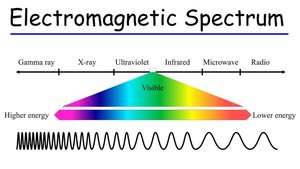
Light-Dependent Reactions
Mechanism and Photosystems
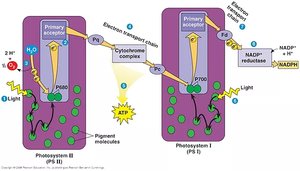
Light-dependent reactions occur in the thylakoid membrane and involve two photosystems (PSII and PSI). - Key Point 1: Photosystem II (P680) and Photosystem I (P700) work together in a noncyclic electron flow to produce ATP and NADPH. - Key Point 2: The process includes photon capture, charge separation, electron transport, and chemiosmosis. 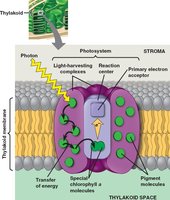
Cyclic Photophosphorylation
Some bacteria use cyclic electron flow, producing only ATP. - Key Point: Cyclic photophosphorylation does not produce NADPH or O2. 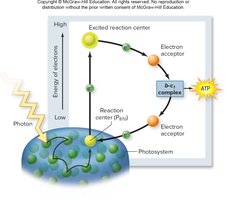
Chemiosmosis and ATP Synthesis
ATP Production in Chloroplasts
Chemiosmosis uses the electrochemical gradient generated by electron transport to synthesize ATP via ATP synthase. - Key Point 1: Protons flow from the thylakoid space to the stroma through ATP synthase. - Key Point 2: The stroma contains enzymes for the Calvin cycle.
Calvin Cycle (Carbon Fixation)
Phases and Mechanism
The Calvin cycle uses ATP and NADPH to fix CO2 into organic molecules. It consists of three phases: carbon fixation, reduction, and regeneration of RuBP. - Phase 1: Carbon fixation: RuBP combines with CO2 to form PGA. - Phase 2: Reduction: PGA is reduced to G3P. - Phase 3: Regeneration: G3P is used to regenerate RuBP. - Key Point: Three turns produce one G3P; six turns produce enough carbon for one glucose. 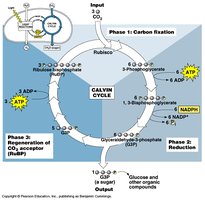
Output of Calvin Cycle
- Key Point 1: Glucose is not a direct product; G3P is the immediate product. - Key Point 2: 2 G3P molecules combine to form glucose, which can be stored as starch.
Chloroplasts and Mitochondria
Comparison of Energy Pathways
Chloroplasts and mitochondria both generate ATP, but through different processes. - Key Point 1: Chloroplasts use light energy; mitochondria use chemical energy from glucose. - Key Point 2: Both organelles utilize electron transport chains and chemiosmosis. 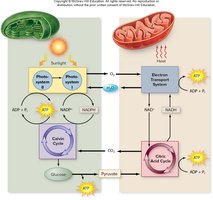
Photorespiration
Rubisco and Competing Pathways
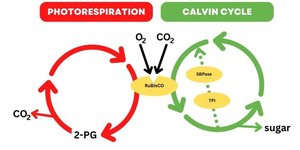
Rubisco can catalyze both carboxylation (addition of CO2) and oxygenation (addition of O2), leading to photorespiration. - Key Point 1: Photorespiration is favored in hot, dry conditions when stomata are closed. - Key Point 2: Photorespiration reduces the efficiency of photosynthesis by consuming O2 and releasing CO2. 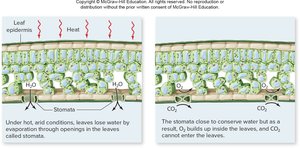
Types of Photosynthesis: C3, C4, and CAM
C3 Photosynthesis
C3 plants use only the Calvin cycle for carbon fixation. - Key Point: Most plants are C3; photorespiration can be problematic in hot, dry climates.
C4 Photosynthesis
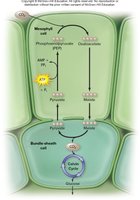
C4 plants use a spatial separation to minimize photorespiration. - Key Point 1: CO2 is initially fixed by PEP carboxylase in mesophyll cells, forming a 4-carbon compound. - Key Point 2: The compound is transported to bundle-sheath cells, where CO2 is released for the Calvin cycle. - Key Point 3: C4 pathway requires more ATP but is advantageous in hot, dry climates. 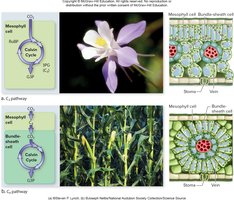
CAM Photosynthesis
CAM plants use a temporal separation to minimize photorespiration. - Key Point 1: Stomata open at night, allowing CO2 fixation by PEP carboxylase and storage as organic acids. - Key Point 2: During the day, stomata close and CO2 is released from organic acids for the Calvin cycle. - Key Point 3: CAM is common in succulents and plants in arid environments. 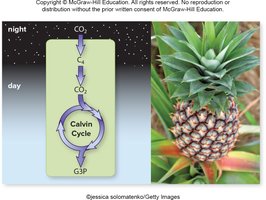
Summary Table: Types of Photosynthesis
Type | Initial CO2 Fixation | Adaptation | Example Plants |
|---|---|---|---|
C3 | RuBP (Calvin cycle) | None | Wheat, rice |
C4 | PEP carboxylase (mesophyll) | Spatial separation | Corn, sugarcane |
CAM | PEP carboxylase (night) | Temporal separation | Cacti, pineapple |
Additional info: C4 and CAM pathways evolved to reduce photorespiration and increase water-use efficiency in challenging environments. ----------------------------------------
