 Indietro
Photosynthesis: Mechanisms, Structures, and Adaptations
Guida di studio - Note intelligenti
 Appunti personalizzati basati sui tuoi materiali, ampliati con definizioni chiave, esempi e contesto.
Photosynthesis: Overview and Importance
Definition and Role in Biology
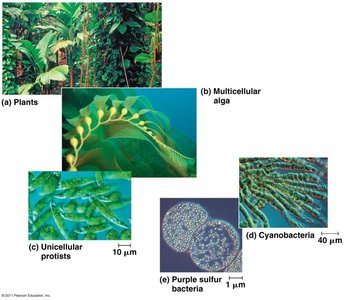
Photosynthesis is the process by which light energy is converted into chemical energy, stored in sugars or other organic compounds. This process forms the foundation for almost all life on Earth, providing both food and oxygen for heterotrophic organisms.
Autotrophs: 'Self-feeders' that synthesize organic compounds from CO2 and H2O using photosynthesis. Also called producers.
Heterotrophs: 'Other-feeders' that rely on consuming other organisms for energy. Includes consumers and decomposers.
Photosynthesis provides the organic molecules and O2 required for cellular respiration in heterotrophs.
Chloroplast Structure and Function
Site of Photosynthesis
Photosynthesis occurs in the chloroplasts of autotrophic eukaryotes and in chlorophyll-containing prokaryotes. In plants, leaves are the major site of photosynthesis.
Chloroplast: Organelle specialized for capturing solar energy and converting it to chemical energy (sugars).
Chloroplasts are found in the cells of the palisade mesophyll layer of leaves.
Internal Structure of the Chloroplast
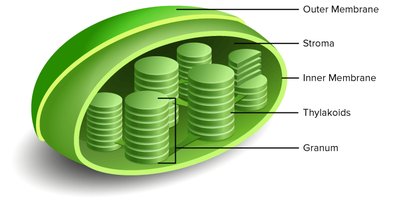
Outer/Inner Membrane: Double membrane surrounds the organelle.
Stroma: Semi-fluid interior where the Calvin cycle occurs.
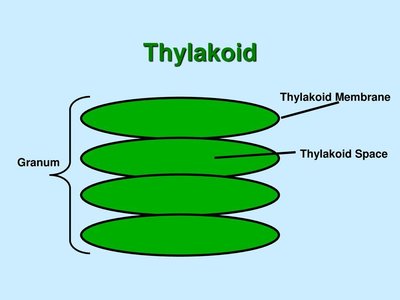
Thylakoids: Flattened membrane sacs that contain chlorophyll and other pigments; site of light-dependent reactions.
Granum: Stack of thylakoids; grana is the plural form.
Chlorophyll: Pigment molecules in the thylakoid membrane that drive photosynthesis.
Leaf Structure and Adaptations
Leaf Anatomy
Leaves are adapted for efficient photosynthesis and gas exchange.
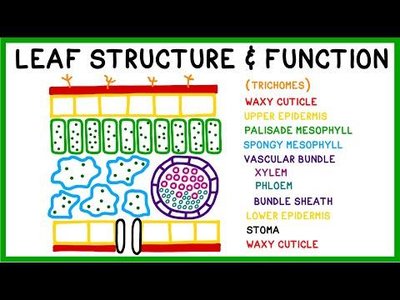
Cuticle: Waxy coating that prevents water loss.
Palisade Mesophyll: Contains most chloroplasts; main site of photosynthesis.
Spongy Mesophyll: Loosely packed cells for gas exchange.
Stoma (pl. stomata): Openings for gas exchange, regulated by guard cells.
The Photosynthesis Equation
Overall Chemical Reaction
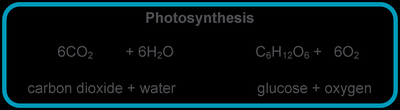
The process of photosynthesis can be summarized by the following equation:
6 CO2 + 6 H2O → C6H12O6 + 6 O2
In LaTeX format:
Stages of Photosynthesis
Light-Dependent Reactions
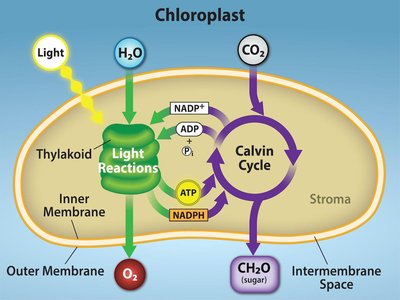
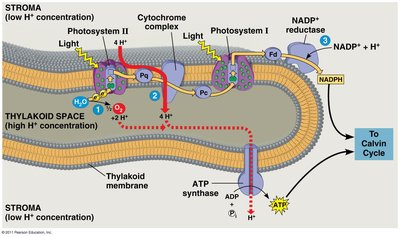
These reactions require sunlight and occur in the thylakoid membranes. Their main goal is to capture solar energy and convert it into chemical energy in the form of ATP and NADPH.
Water molecules are split, releasing O2 as a byproduct.
H+ ions and electrons are used to generate ATP and NADPH.
Light-Independent Reactions (Calvin Cycle)
These reactions do not require light and occur in the stroma. The Calvin cycle uses ATP and NADPH to convert CO2 into glucose.
CO2 is fixed into organic molecules.
ATP and NADPH provide energy and reducing power.

Light Absorption and Pigments
Pigments and Light Absorption
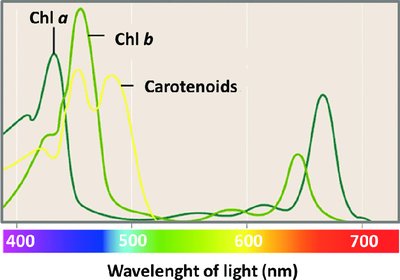
Pigments are substances that absorb visible light. The main photosynthetic pigments are:
Chlorophyll a: Main pigment, absorbs blue-violet and red light.
Chlorophyll b: Accessory pigment, broadens the spectrum of absorbed light.
Carotenoids: Accessory pigments, absorb excess light and provide photoprotection.
Absorption and Action Spectra
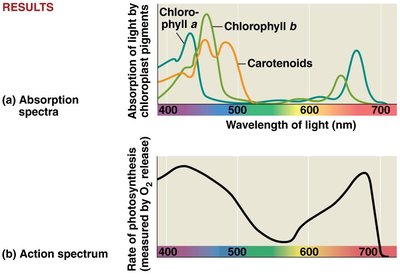
The absorption spectrum shows the wavelengths of light absorbed by each pigment, while the action spectrum shows the rate of photosynthesis at each wavelength.
Plants use multiple pigments to maximize light absorption.
Carotenoids are revealed in autumn when chlorophyll breaks down.
Mechanisms of Light Reactions
Photosystems and Electron Transport
Light reactions occur via two main pathways in the thylakoid membrane:
Non-cyclic pathway: Involves both Photosystem II (PS II) and Photosystem I (PS I). Produces ATP, NADPH, and O2.
Cyclic pathway: Involves only PS I. Produces extra ATP but no NADPH or O2.

ATP Synthesis and Chemiosmosis
As electrons move through the electron transport chain, H+ ions are pumped into the thylakoid lumen, creating a concentration gradient. ATP synthase uses this gradient to produce ATP, a process called chemiosmosis.
ATP synthase is an enzyme that synthesizes ATP from ADP and inorganic phosphate.
The Calvin Cycle (Light-Independent Reactions)
Stages of the Calvin Cycle
The Calvin cycle occurs in the stroma and uses ATP and NADPH to fix carbon dioxide into sugars. It consists of three main stages:
Carbon Fixation: CO2 combines with RuBP (ribulose bisphosphate) to form a 6-carbon compound, catalyzed by the enzyme Rubisco.
Reduction: The 6-carbon compound splits into two 3-carbon molecules (3-PGA), which are reduced to G3P using ATP and NADPH.
Regeneration of RuBP: Some G3P molecules are used to regenerate RuBP, allowing the cycle to continue.
It takes six turns of the cycle to produce one glucose molecule.
Photorespiration and Plant Adaptations
Photorespiration
Photorespiration occurs when O2 levels are high and CO2 levels are low, often due to closed stomata in dry environments. This process consumes ATP without producing sugars, reducing photosynthetic efficiency.
C3 plants: Undergo normal photosynthesis but are susceptible to photorespiration.
Adaptations for Dry Environments
C4 Plants: Spatial separation of light reactions and the Calvin cycle; adapted to minimize photorespiration.
CAM Plants: Temporal separation; stomata open at night to reduce water loss and photorespiration.
Example: Corn (C4 plant) and cacti (CAM plant) are adapted to hot, dry climates.
Summary Table: Comparison of Photosynthetic Pathways
Pathway | Main Adaptation | Example Plants |
|---|---|---|
C3 | Standard photosynthesis; susceptible to photorespiration | Wheat, rice |
C4 | Spatial separation of steps; reduces photorespiration | Corn, sugarcane |
CAM | Temporal separation; stomata open at night | Cacti, succulents |
Additional info: The enzyme Rubisco is the most abundant protein on Earth and is responsible for carbon fixation in the Calvin cycle.
