 Indietro
Photosynthesis: Mechanisms, Structures, and Adaptations
Guida di studio - Note intelligenti
 Appunti personalizzati basati sui tuoi materiali, ampliati con definizioni chiave, esempi e contesto.
Photosynthesis: The Circle of Life
Introduction to Photosynthesis
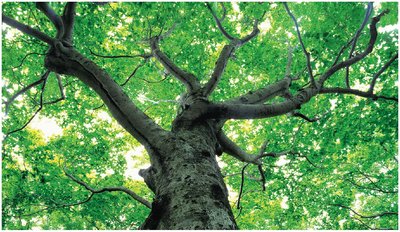
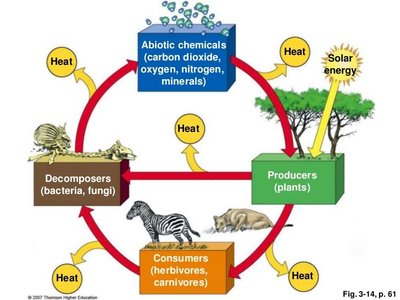
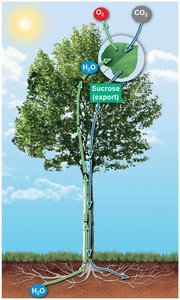
Photosynthesis is the process by which solar energy is converted into chemical energy within chloroplasts. This process sustains almost all life on Earth, either directly or indirectly, by providing organic molecules and oxygen.
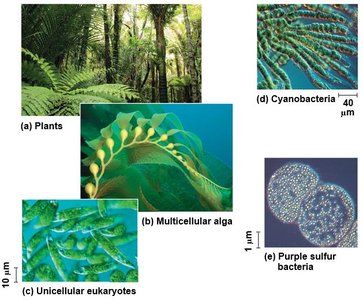
Autotrophs: Organisms that produce their own organic molecules from CO2 and other inorganic substances. They are the primary producers in ecosystems.
Photoautotrophs: Use light energy to drive the synthesis of organic compounds (e.g., plants, algae, cyanobacteria).
Chemoautotrophs: Obtain energy by oxidizing inorganic substances (e.g., hydrogen sulfide at hydrothermal vents).
Heterotrophs: Obtain organic material by consuming other organisms or their byproducts (includes decomposers).
The Photosynthesis Equation and Redox Nature
Overall Chemical Reaction
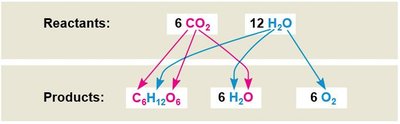
Photosynthesis is a complex series of reactions summarized by the following equation:
The overall chemical change is the reverse of cellular respiration.
CO2 is reduced to glucose; H2O is oxidized to O2.

Chloroplast Structure and Function
Leaf and Chloroplast Anatomy
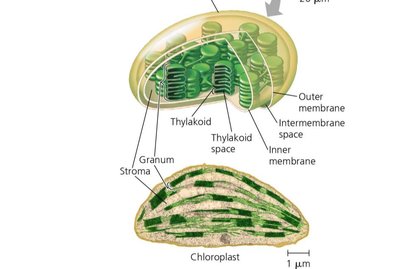
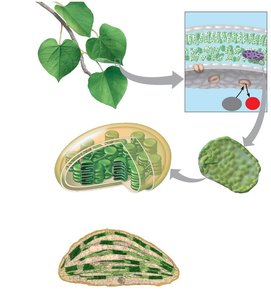
Photosynthesis primarily occurs in the leaves, specifically within chloroplasts located in the mesophyll cells. CO2 enters and O2 exits through stomata. Chloroplasts have a double membrane and contain thylakoids, which are stacked into grana and surrounded by stroma.
Stomata: Pores for gas exchange.
Thylakoids: Membranous sacs where light reactions occur.
Stroma: Fluid surrounding thylakoids, site of the Calvin cycle.
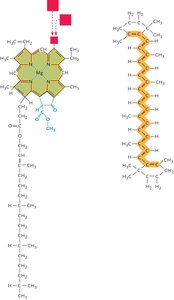
Chlorophyll: Green pigment in thylakoid membranes responsible for capturing light energy.
Stages of Photosynthesis
Light Reactions and Calvin Cycle
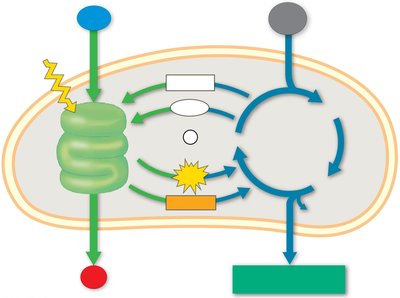
Photosynthesis consists of two main stages: the light reactions and the Calvin cycle.
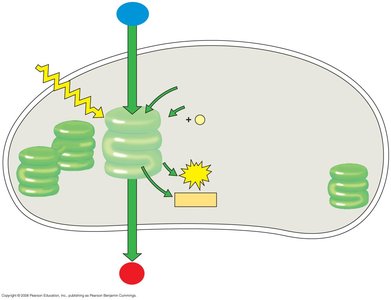
Light Reactions (in thylakoids):
Split H2O, releasing O2
Reduce NADP+ to NADPH
Generate ATP from ADP by photophosphorylation
Calvin Cycle (in stroma):
Forms sugar from CO2 using ATP and NADPH
Begins with carbon fixation
Is an anabolic, endergonic process
Light and Photosynthetic Pigments
Nature of Light
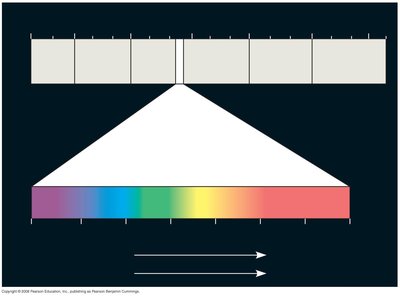
Light is electromagnetic energy that travels in waves. The visible spectrum (380–750 nm) is used in photosynthesis. Light also behaves as particles called photons, whose energy is inversely proportional to wavelength.
Photosynthetic Pigments
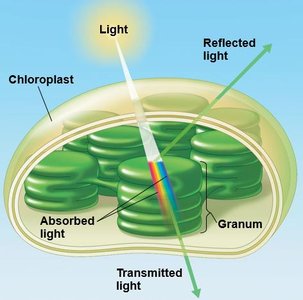
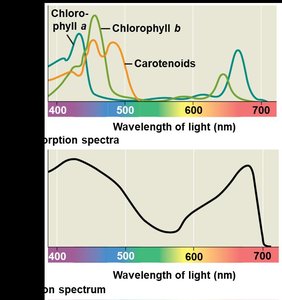
Pigments absorb visible light; different pigments absorb different wavelengths. Chlorophyll a is the main pigment, while chlorophyll b and carotenoids broaden the spectrum and provide photoprotection.
Absorption spectrum: Graph of light absorption versus wavelength.
Action spectrum: Profiles effectiveness of different wavelengths in driving photosynthesis.
Excitation of Chlorophyll and Photosystems
Excitation and Fluorescence
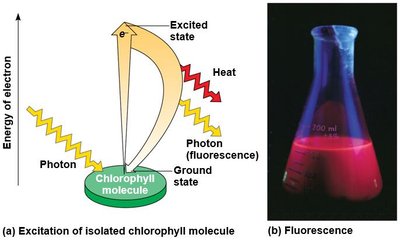
When pigments absorb light, electrons are excited to a higher energy state. As they return to the ground state, energy is released as heat or fluorescence.
Photosystems
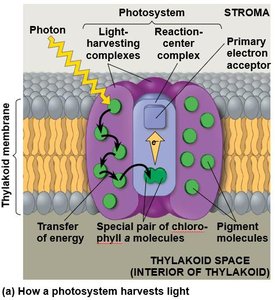
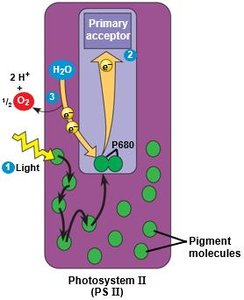
Photosystems are complexes in the thylakoid membrane consisting of a reaction-center complex surrounded by light-harvesting complexes. They transfer energy to chlorophyll a, which can transfer excited electrons to a primary electron acceptor—the first step of the light reactions.
Light Reactions: Linear and Cyclic Electron Flow
Linear Electron Flow
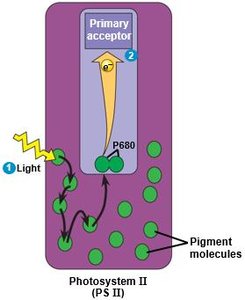
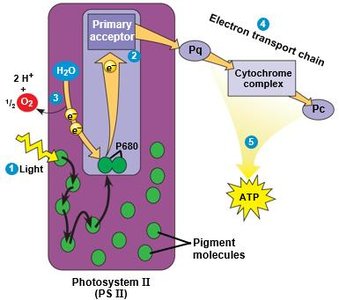
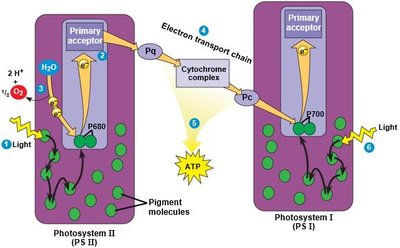
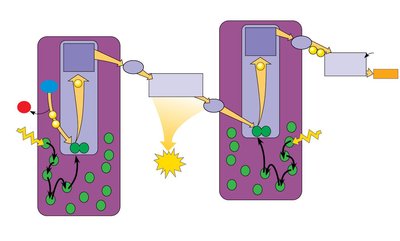
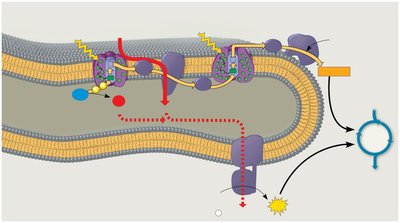
Linear electron flow involves both photosystem II (PS II) and photosystem I (PS I), producing ATP and NADPH. The process includes nine steps, from photon absorption to NADPH formation.
Photon excites pigment in PS II; energy is transferred to P680.
Excited electron from P680 is transferred to the primary electron acceptor (P680+).
H2O is split, electrons reduce P680+, O2 is released.
Electrons fall down the electron transport chain to PS I, creating a proton gradient.
ATP is produced by chemiosmosis.
Light excites P700 in PS I; electron is transferred to its primary acceptor.
P700+ accepts electron from PS II via the electron transport chain.
Electrons fall down another electron transport chain to ferredoxin (Fd).
NADP+ reductase catalyzes the formation of NADPH.
Cyclic Electron Flow
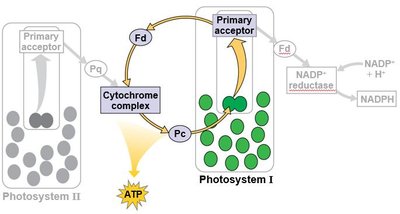
Cyclic electron flow involves only PS I and produces ATP but not NADPH or O2. It helps balance the ATP/NADPH ratio required by the Calvin cycle.
ATP Synthesis: Chemiosmosis in Chloroplasts
Comparison with Mitochondria
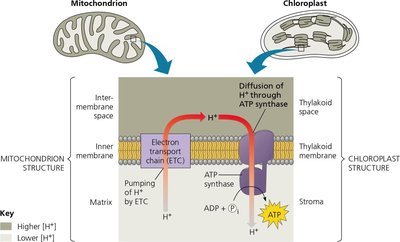
Both mitochondria and chloroplasts use chemiosmosis to generate ATP, but chloroplasts use light energy to drive the process, while mitochondria use chemical energy from food.
The Calvin Cycle
Phases of the Calvin Cycle
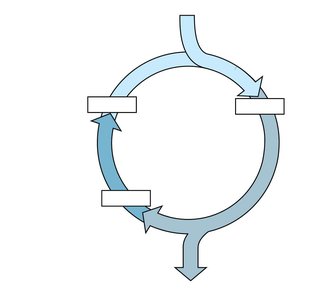
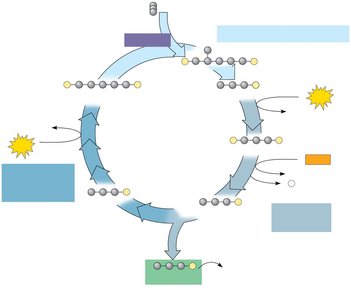
The Calvin cycle is anabolic, building sugars from CO2 using ATP and NADPH. It consists of three phases:
Carbon Fixation: CO2 is attached to RuBP by rubisco, forming 3-phosphoglycerate.
Reduction: ATP and NADPH convert 3-phosphoglycerate to G3P.
Regeneration of RuBP: ATP is used to regenerate RuBP from G3P.
For one net G3P, the cycle must fix three CO2 molecules.
Net synthesis of one G3P requires 3 CO2, 9 ATP, and 6 NADPH.
Photorespiration and Adaptations
Photorespiration
Photorespiration occurs when rubisco adds O2 instead of CO2 to RuBP, leading to the consumption of O2 and release of CO2 without producing ATP or sugar. This process is wasteful and can significantly reduce photosynthetic output, especially in hot, dry conditions when stomata are closed.
C4 and CAM Plants: Alternative Pathways
C4 and CAM plants have evolved mechanisms to minimize photorespiration and conserve water.
C4 Plants: Incorporate CO2 into four-carbon compounds in mesophyll cells using PEP carboxylase, which has a higher affinity for CO2 than rubisco. These compounds are transported to bundle-sheath cells, where CO2 is released for the Calvin cycle.
CAM Plants: Open stomata at night to fix CO2 into organic acids, which release CO2 during the day for the Calvin cycle. This temporal separation allows CAM plants to survive in arid environments.
Pathway | CO2 Fixation | Adaptation | Example |
|---|---|---|---|
C3 | Directly by rubisco in Calvin cycle | Most common; susceptible to photorespiration | Wheat, rice |
C4 | PEP carboxylase in mesophyll; Calvin cycle in bundle-sheath | Spatial separation; reduces photorespiration | Corn, sugarcane |
CAM | At night in vacuoles; Calvin cycle during day | Temporal separation; conserves water | Pineapple, succulents |
Key Terms and Concepts
Photosynthesis: Conversion of light energy to chemical energy in plants, algae, and some bacteria.
Chloroplast: Organelle where photosynthesis occurs.
Autotroph: Organism that produces its own food.
Heterotroph: Organism that consumes other organisms for food.
Stomata: Leaf pores for gas exchange.
Stroma: Fluid inside chloroplasts.
Chlorophyll: Green pigment capturing light energy.
Wavelength: Distance between wave crests of light.
Absorption spectrum: Range of wavelengths absorbed by a pigment.
Action spectrum: Effectiveness of different wavelengths in driving a process.
