 Indietro
Photosynthesis: Mechanisms, Structures, and Adaptations
Guida di studio - Note intelligenti
 Appunti personalizzati basati sui tuoi materiali, ampliati con definizioni chiave, esempi e contesto.
Photosynthesis: Overview and Importance
Photosynthesis Feeds the Biosphere
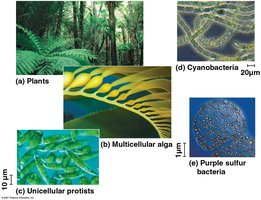
Photosynthesis is the fundamental process by which solar energy is converted into chemical energy within chloroplasts, sustaining nearly all life on Earth. Autotrophs are organisms that produce their own food from inorganic sources, serving as the primary producers in ecosystems. Most plants, algae, certain protists, and some prokaryotes are photoautotrophs, using sunlight to synthesize organic molecules from carbon dioxide.
Autotrophs: "Self-feeders" that do not rely on other organisms for food.
Photoautotrophs: Use sunlight to make organic molecules.
Heterotrophs: Obtain organic material by consuming other organisms; include consumers and decomposers.
Fossil fuels are ancient stores of solar energy, formed from the remains of organisms.
Example: Plants, algae, cyanobacteria, and purple sulfur bacteria are all capable of photosynthesis.
Chloroplast Structure and Function
Chloroplasts: The Site of Photosynthesis
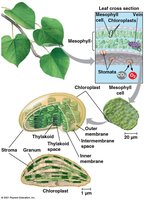
Chloroplasts are specialized organelles found mainly in the mesophyll cells of leaves. Their structural organization enables the complex chemical reactions of photosynthesis.
Mesophyll: Interior tissue of the leaf where most photosynthesis occurs.
Stomata: Microscopic pores for gas exchange (CO2 in, O2 out).
Veins: Transport water and sugars throughout the plant.
Chloroplast Envelope: Double membrane surrounding the stroma (dense fluid).
Thylakoids: Membranous sacs forming stacks called grana; contain chlorophyll.
Photosynthesis: Chemical Equation and Redox Process
Summary Equation and Atom Tracking
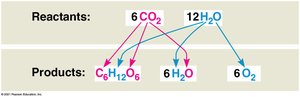
The overall process of photosynthesis can be summarized by the following equation:
Photosynthesis is the reverse of cellular respiration.
Chloroplasts split water, releasing O2 and incorporating hydrogen into sugar molecules.
Redox Reactions in Photosynthesis
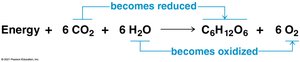
Photosynthesis is a redox process: water is oxidized, and carbon dioxide is reduced. The process is endergonic, requiring energy input from light.
H2O is oxidized to O2.
CO2 is reduced to form glucose.
Stages of Photosynthesis
Light Reactions and Calvin Cycle
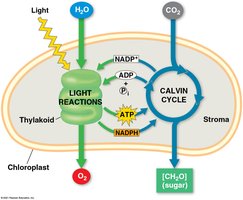
Photosynthesis consists of two main stages: the light reactions and the Calvin cycle.
Light Reactions: Occur in thylakoids; split water, release O2, reduce NADP+ to NADPH, and generate ATP by photophosphorylation.
Calvin Cycle: Occurs in stroma; uses ATP and NADPH to convert CO2 into sugar.
Carbon fixation is the initial step of the Calvin cycle.
Light and Pigments
Electromagnetic Spectrum and Visible Light
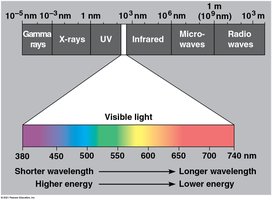
Light is electromagnetic energy, traveling in waves. The electromagnetic spectrum includes all wavelengths, but only visible light (380–740 nm) drives photosynthesis.
Shorter wavelengths have higher energy per photon.
Photons are discrete particles of light energy.
Pigments and Light Absorption
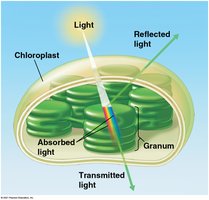
Different pigments absorb specific wavelengths of light. Chlorophyll absorbs violet-blue and red light, reflecting green.
Chlorophyll a: Main pigment for light reactions.
Chlorophyll b: Accessory pigment, broadens absorption spectrum.
Carotenoids: Accessory pigments, absorb violet and blue-green light, provide photoprotection.
Absorption and Action Spectra
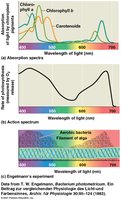
A spectrophotometer measures pigment absorption. The absorption spectrum shows which wavelengths are absorbed, while the action spectrum indicates which wavelengths are most effective for photosynthesis.
Violet-blue and red light are most effective for photosynthesis.
Accessory pigments broaden the usable spectrum.
Excitation of Chlorophyll and Photosystems
Excitation and Fluorescence
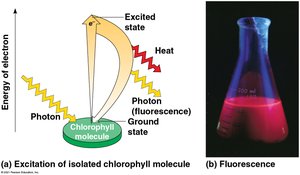
When chlorophyll absorbs light, electrons are excited to a higher energy state. In isolation, excited electrons return to the ground state, releasing energy as heat or fluorescence.
Fluorescence is the emission of light as electrons return to the ground state.
Photosystems: Structure and Function
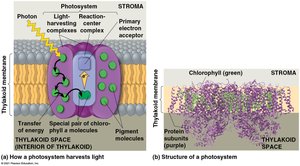
A photosystem consists of a reaction-center complex surrounded by light-harvesting complexes. The reaction center contains a special pair of chlorophyll a molecules and a primary electron acceptor.
Light-harvesting complexes transfer energy to the reaction center.
Photosystem II (PS II) absorbs 680 nm; Photosystem I (PS I) absorbs 700 nm.
Electron Flow in Light Reactions
Linear Electron Flow
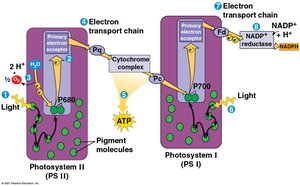
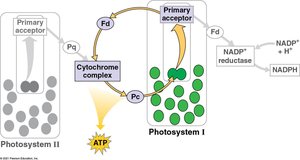
Linear electron flow is the primary pathway in light reactions, involving both photosystems and producing ATP and NADPH.
Photon excites pigment in PS II; energy transferred to P680.
P680 transfers excited electron to primary acceptor.
Water is split, electrons reduce P680+, O2 is released.
Electrons move through electron transport chain, creating proton gradient for ATP synthesis.
PS I receives electrons, transfers them to NADP+ to form NADPH.
Energy Changes in Light Reactions
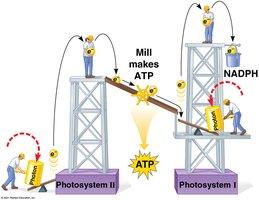
Light reactions use solar energy to generate ATP and NADPH, which are used in the Calvin cycle. The energy changes of electrons can be illustrated by a mechanical analogy.
Cyclic Electron Flow
Cyclic electron flow involves only PS I and produces ATP without generating NADPH or O2. It is an alternative pathway, especially in some photosynthetic bacteria.
Electrons cycle back to cytochrome complex, generating ATP.
No NADPH or O2 produced.
Chemiosmosis and ATP Synthesis
Comparison of Chloroplasts and Mitochondria
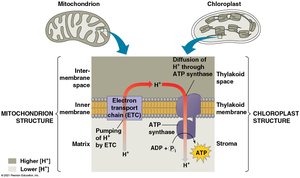
Both chloroplasts and mitochondria generate ATP by chemiosmosis, using electron transport chains to pump protons across membranes.
ATP synthase couples proton diffusion to ATP production.
Chloroplasts use light energy; mitochondria use chemical energy from food.
Spatial organization differs, but mechanisms are similar.
The Calvin Cycle
Phases of the Calvin Cycle
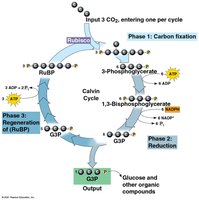
The Calvin cycle is an anabolic pathway that uses ATP and NADPH to convert CO2 into sugar. It consists of three phases: carbon fixation, reduction, and regeneration of the CO2 acceptor (RuBP).
Phase 1: Carbon Fixation - CO2 binds to RuBP, catalyzed by rubisco.
Phase 2: Reduction - 3-phosphoglycerate is converted to G3P using ATP and NADPH.
Phase 3: Regeneration - G3P is used to regenerate RuBP, requiring ATP.
For one G3P, the cycle consumes 9 ATP and 6 NADPH.
Adaptations in Carbon Fixation
C3, C4, and CAM Pathways
Plants have evolved different mechanisms to optimize carbon fixation and minimize water loss, especially in hot, arid climates.
C3 Plants: Use rubisco for initial CO2 fixation; susceptible to photorespiration.
C4 Plants: Incorporate CO2 into a four-carbon compound; spatially separate steps to minimize photorespiration.
CAM Plants: Fix CO2 at night, store it as organic acids, and use it during the day; temporally separate steps.
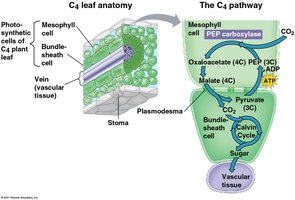
Example: Sugarcane and corn are C4 plants; succulents use CAM pathway.
Additional info: Rising CO2 levels and climate change may alter the distribution and efficiency of C3 and C4 plants, impacting agriculture and food security.
----------------------------------------
