 Indietro
Photosynthesis: Mechanisms, Structures, and Ecological Roles Part 1
Guida di studio - Note intelligenti
 Appunti personalizzati basati sui tuoi materiali, ampliati con definizioni chiave, esempi e contesto.
Photosynthesis: Feeding the Biosphere
Autotrophs and Heterotrophs
Photosynthesis is the process by which autotrophic organisms convert light energy into chemical energy, sustaining nearly all life on Earth. Autotrophs are 'self-feeders' that synthesize organic molecules from CO2 and inorganic substances, while heterotrophs depend on these organic compounds for nutrition.
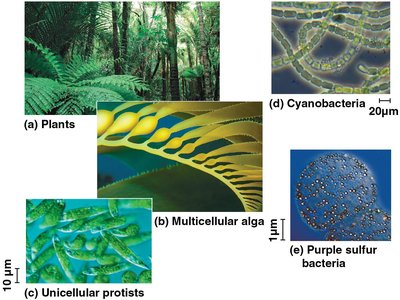
Autotrophs: Primary producers; include plants, algae, some protists, and prokaryotes.
Photoautotrophs: Use light energy to drive synthesis of organic compounds.
Heterotrophs: Consumers and decomposers; rely on autotrophs for food and oxygen.
Examples: Plants, algae, cyanobacteria, unicellular protists, purple sulfur bacteria.
Ecological Importance
Autotrophs: Form the base of the food chain, supporting all heterotrophic life.
Heterotrophs: Consumers (animals) and decomposers (fungi, bacteria) recycle nutrients.
Fossil Fuels: Store ancient solar energy captured by photoautotrophs.
Photosynthesis: Location and Structure
Chloroplasts: The Site of Photosynthesis
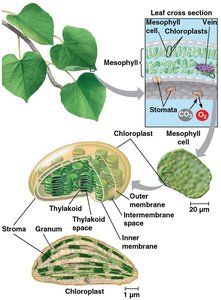
Photosynthesis occurs primarily in the leaves of plants, within specialized organelles called chloroplasts. The structural organization of chloroplasts enables the complex reactions of photosynthesis.
Mesophyll cells: Contain most chloroplasts; located in the inner leaf tissue.
Stomata: Pores for gas exchange (CO2 in, O2 out).
Veins: Transport water to leaves and export sugars.
Chloroplast Structure
Double membrane: Outer and inner membranes surround the chloroplast.
Stroma: Fluid-filled space where the Calvin cycle occurs.
Thylakoids: Flattened sacs forming internal membrane system; site of light reactions.
Grana: Stacks of thylakoids.
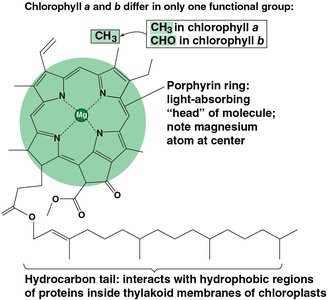
Chlorophyll: Green pigment in thylakoid membranes; absorbs light energy.
Overview of Photosynthesis
Photosynthesis Equation
The overall process of photosynthesis can be summarized by the following equation:
Glucose (C6H12O6): Main product; direct product is a three-carbon sugar.
Reverse of cellular respiration: Photosynthesis builds sugars, while respiration breaks them down.
Stages of Photosynthesis
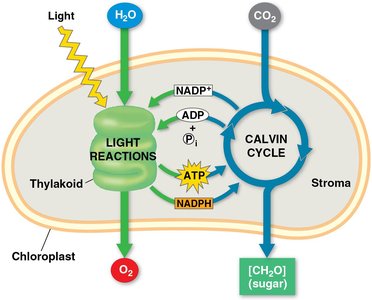
Light Reactions: Convert solar energy to chemical energy (ATP, NADPH); occur in thylakoids.
Calvin Cycle: Uses ATP and NADPH to reduce CO2 to sugar; occurs in stroma.
Light Reactions
Key Functions
Water splitting: Produces electrons, protons, and O2 (released).
Electron transport: Transfers electrons and hydrogen ions.
NADP+ reduction: Forms NADPH (electron carrier).
ATP formation: By photophosphorylation ().
Products: ATP and NADPH used in Calvin cycle.
The Calvin Cycle
Location and Purpose
Occurs in stroma: Fluid-filled space of chloroplast.
Purpose: Synthesize sugars from CO2 using ATP and NADPH.
Inputs: CO2, ATP, NADPH.
Key Steps
Carbon Fixation: Incorporates CO2 into organic molecules.
Reduction: Fixed carbon gains electrons (from NADPH).
Regeneration: RuBP (starting molecule) is regenerated using ATP.
Nature of Light and Photosynthetic Pigments
Light Energy
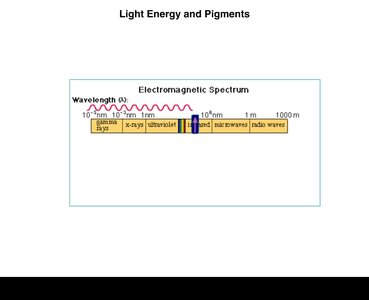
Light: Consists of photons, each with a fixed energy inversely related to wavelength.
Shorter wavelengths: Higher energy per photon.
Pigments: Light Receptors
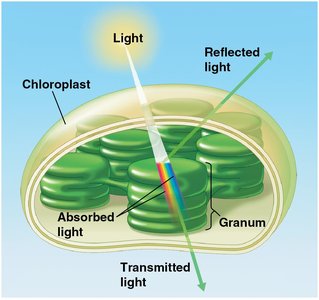
Pigments: Substances that absorb visible light; different pigments absorb different wavelengths.
Chlorophyll: Absorbs violet-blue and red light; reflects green (leaves appear green).
Absorbed wavelengths: Used for photosynthesis; reflected/transmitted wavelengths are not.
Types of Photosynthetic Pigments
Chlorophyll a: Main pigment; absorbs red and violet-blue wavelengths.
Chlorophyll b: Accessory pigment; broadens absorption spectrum.
Carotenoids: Accessory pigments; absorb violet and blue-green light, appear yellow/orange.
Summary Table: Photosynthetic Organisms
Type | Example | Key Feature |
|---|---|---|
Plant | Ferns, trees | Multicellular, terrestrial |
Multicellular Alga | Seaweed | Multicellular, aquatic |
Unicellular Protist | Euglena | Single-celled, aquatic |
Cyanobacteria | Blue-green algae | Prokaryotic, aquatic |
Purple Sulfur Bacteria | Chromatium | Prokaryotic, aquatic, sulfur metabolism |
Key Exam Questions
Where does photosynthesis take place? Chloroplast
Where do light reactions occur? Thylakoid membranes
Where does the Calvin cycle occur? Stroma
Most important chlorophyll molecule? Chlorophyll a
Wavelengths absorbed best by chlorophyll a? Red and violet-blue
Wavelength least absorbed by chlorophyll a? Green
