 Indietro
Photosynthesis: Mechanisms, Structures, and Significance
Guida di studio - Note intelligenti
 Appunti personalizzati basati sui tuoi materiali, ampliati con definizioni chiave, esempi e contesto.
Photosynthesis: Overview and Importance
Big Idea and Biological Significance
Photosynthesis is the fundamental process by which plants, algae, and certain bacteria convert solar energy into chemical energy, producing sugars that sustain nearly all life on Earth. This process not only provides energy for autotrophs but also supports heterotrophs, directly or indirectly, through the food web.
Autotrophs: Organisms that produce their own food from inorganic substances (e.g., plants, algae, cyanobacteria).
Heterotrophs: Organisms that obtain organic molecules by consuming other organisms.
Photoautotrophs: Autotrophs that use sunlight to synthesize organic compounds.
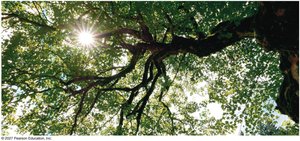
Example: Plants use photosynthesis to build their tissues and provide food for other organisms, such as moth larvae.
Photosynthesis Feeds the Biosphere
Autotrophs and Heterotrophs
Autotrophs are the primary producers in ecosystems, sustaining themselves and other organisms by generating organic molecules from carbon dioxide and other inorganic substances. Heterotrophs rely on these producers for their energy and carbon needs.
Decomposers: Special heterotrophs that consume dead organic material or waste.
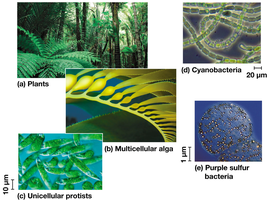
Example: Photosynthesis occurs in plants, multicellular algae, unicellular protists, cyanobacteria, and purple sulfur bacteria.
Photosynthesis: Chemical Equation and Redox Process
Photosynthesis Equation and Atom Tracking
The overall process of photosynthesis can be summarized by the following chemical equation:
Equation:
Photosynthesis is the reverse of cellular respiration in terms of reactants and products.
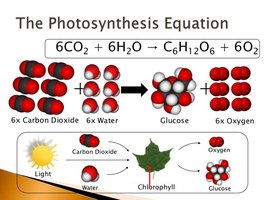
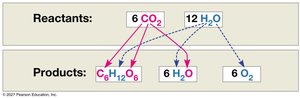
Redox Process: Photosynthesis involves the oxidation of water and reduction of carbon dioxide. It is an endergonic process, requiring energy input from light.
Water is split, providing electrons and protons for sugar synthesis and releasing oxygen as a by-product.

Chloroplast Structure and Function
Sites of Photosynthesis in Plants
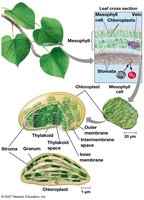
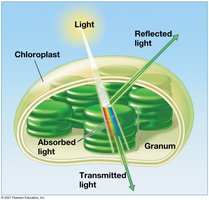
Photosynthesis primarily occurs in the leaves, specifically within the mesophyll cells. Chloroplasts are the organelles responsible for this process, containing specialized structures for light absorption and chemical reactions.
Stomata: Microscopic pores for gas exchange.
Veins: Transport water and sugars.
Stroma: Dense fluid inside chloroplasts.
Thylakoids: Membranous sacs, often stacked as grana, where light reactions occur.
Chlorophyll: Green pigment in thylakoid membranes.
Stages of Photosynthesis
Light Reactions and Calvin Cycle
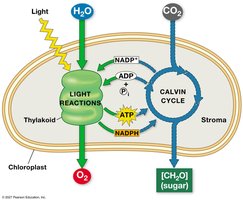
Photosynthesis consists of two main stages: the light reactions and the Calvin cycle. These stages cooperate to convert light energy into chemical energy and synthesize sugars.
Light Reactions (in thylakoids): Split water, release oxygen, reduce NADP+ to NADPH, and generate ATP by photophosphorylation.
Calvin Cycle (in stroma): Uses ATP and NADPH to fix carbon dioxide and produce sugars.
The Nature of Sunlight
Electromagnetic Spectrum and Light Energy
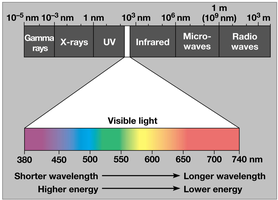
Light is a form of electromagnetic energy, traveling in waves. The visible spectrum (380–740 nm) is crucial for photosynthesis, as pigments absorb specific wavelengths to drive the process.
Photon: A discrete particle of light energy.
Shorter wavelengths have higher energy per photon.
Photosynthetic Pigments: Light Receptors
Pigment Types and Light Absorption
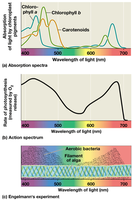
Pigments absorb visible light, with different pigments absorbing different wavelengths. Chlorophyll a is the primary pigment, while chlorophyll b and carotenoids are accessory pigments that broaden the spectrum and provide photoprotection.
Chlorophyll a: Main pigment for light reactions.
Chlorophyll b: Accessory pigment.
Carotenoids: Accessory pigments, absorb violet and blue-green light, and protect against excess light.
Photosystems and Light Harvesting
Structure and Function of Photosystems
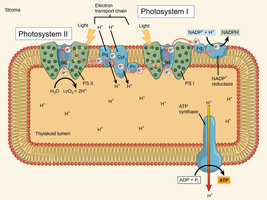
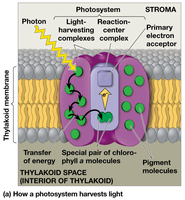
A photosystem consists of a reaction-center complex surrounded by light-harvesting complexes. The reaction center contains a special pair of chlorophyll a molecules and a primary electron acceptor. There are two types of photosystems: Photosystem II (P680) and Photosystem I (P700).
Light-harvesting complex: Transfers energy to the reaction center.
Primary electron acceptor: Accepts excited electrons from chlorophyll a.
Light Reactions: Linear Electron Flow
Mechanism and Steps
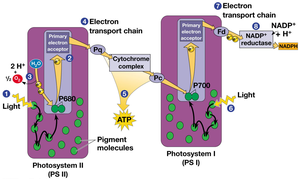
Linear electron flow is the primary pathway during light reactions, involving both photosystems and resulting in the production of ATP and NADPH. The process includes the splitting of water, electron transport, and formation of a proton gradient for ATP synthesis.
Electrons from water are transferred to P680, then through an electron transport chain to P700, and finally to NADP+.
ATP is generated by chemiosmosis as protons flow through ATP synthase.
Calvin Cycle: Sugar Synthesis
Phases and Key Steps
The Calvin cycle uses ATP and NADPH from the light reactions to fix carbon dioxide and produce glyceraldehyde 3-phosphate (G3P), a sugar. The cycle consists of three phases: carbon fixation, reduction, and regeneration of RuBP.
Phase 1: Carbon Fixation – CO2 is attached to RuBP by rubisco, forming 3-phosphoglycerate.
Phase 2: Reduction – 3-phosphoglycerate is converted to G3P using ATP and NADPH.
Phase 3: Regeneration – G3P molecules are rearranged to regenerate RuBP, using additional ATP.
Equation: For net synthesis of one G3P, the cycle consumes 9 ATP and 6 NADPH.
Photosynthesis: Essential for Life
Energy Storage and Ecological Impact
Photosynthesis stores solar energy in organic compounds, providing energy and carbon skeletons for cellular metabolism. Plants store excess sugar as starch in various tissues, supporting growth and reproduction.
Sugar produced in chloroplasts is used for energy and biosynthesis.
Excess sugar is stored as starch in roots, tubers, seeds, and fruits.
Summary Table: Comparison of Photosynthesis and Cellular Respiration
Process | Reactants | Products | Energy Source |
|---|---|---|---|
Photosynthesis | CO2, H2O, Light | Glucose, O2 | Solar Energy |
Cellular Respiration | Glucose, O2 | CO2, H2O, ATP | Chemical Energy (Glucose) |
Example: The cyclical relationship between photosynthesis and cellular respiration sustains life by recycling energy and matter.
