 Indietro
Photosynthesis: Mechanisms, Structures, and Significance
Guida di studio - Note intelligenti
 Appunti personalizzati basati sui tuoi materiali, ampliati con definizioni chiave, esempi e contesto.
Photosynthesis: Overview and Importance
Big Idea and General Equation
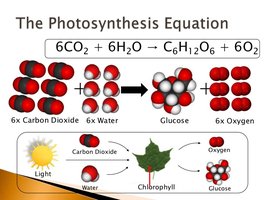
Photosynthesis is the process by which plants, algae, and certain prokaryotes convert solar energy into chemical energy, producing carbohydrates and oxygen from carbon dioxide and water. This process is fundamental for life on Earth, as it provides energy and organic molecules for nearly all living organisms.
Photosynthesis Equation:
Key Reactants: Carbon dioxide, water, and sunlight
Key Products: Glucose and oxygen
Biomass Origin: The majority of plant biomass comes from carbon dioxide in the air, not soil, water, or sunlight directly.
Photosynthesis Feeds the Biosphere
Autotrophs and Heterotrophs
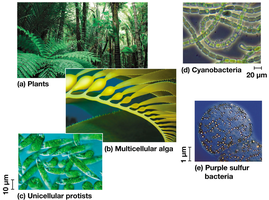
Photosynthesis sustains the biosphere by nourishing organisms directly (autotrophs) or indirectly (heterotrophs).
Autotrophs: "Self-feeders" that produce organic molecules from inorganic sources; includes plants, algae, and some bacteria.
Photoautotrophs: Use sunlight to synthesize organic molecules.
Heterotrophs: Obtain organic material by consuming other organisms or decomposing organic matter.
Chloroplasts: The Sites of Photosynthesis
Structure and Function
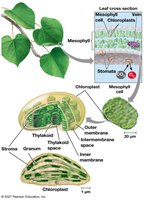
Chloroplasts are specialized organelles found mainly in the mesophyll cells of leaves. Their structure is optimized for the chemical reactions of photosynthesis.
Stomata: Microscopic pores for gas exchange (CO2 in, O2 out).
Stroma: Dense fluid inside chloroplasts where the Calvin cycle occurs.
Thylakoids: Membranous sacs containing chlorophyll; site of light reactions.
Grana: Stacks of thylakoids.
Photosynthesis: Chemical Changes and Redox Reactions
Tracking Atoms and Redox Processes
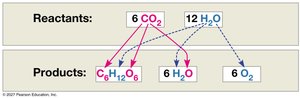
Photosynthesis is a redox process, reversing the electron flow of cellular respiration. Water is oxidized, releasing electrons and oxygen, while carbon dioxide is reduced to form glucose.
Water Splitting: Chloroplasts split water into hydrogen and oxygen, incorporating hydrogen electrons into sugar molecules.
Redox Summary: CO2 is reduced, H2O is oxidized.
Endergonic Process: Requires energy input from light.

The Two Stages of Photosynthesis
Light Reactions and Calvin Cycle
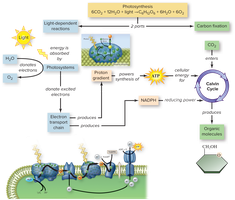
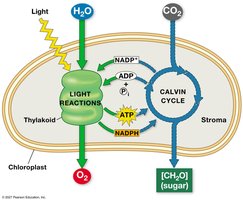
Photosynthesis occurs in two main stages: the light reactions and the Calvin cycle. These stages cooperate to convert light energy into chemical energy and synthesize sugars.
Light Reactions: Occur in thylakoids; split water, release O2, produce ATP and NADPH.
Calvin Cycle: Occurs in stroma; uses ATP and NADPH to fix carbon and produce G3P (a sugar).
Carbon Fixation: Incorporation of CO2 into organic molecules.
The Nature of Sunlight
Electromagnetic Spectrum and Photons
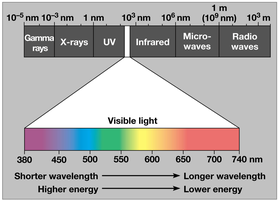
Light is electromagnetic energy, traveling in waves and consisting of photons. The visible spectrum (380–740 nm) is used in photosynthesis.
Wavelength: Distance between wave crests; shorter wavelengths have higher energy.
Photons: Discrete energy packets; energy inversely related to wavelength.
Photosynthetic Pigments: Light Receptors
Types and Functions
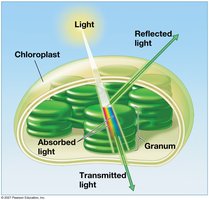
Pigments absorb specific wavelengths of light, driving photosynthesis. Chlorophylls and carotenoids are the main pigments in chloroplasts.
Chlorophyll a: Main pigment; absorbs red and blue light.
Chlorophyll b: Accessory pigment; broadens absorption spectrum.
Carotenoids: Accessory pigments; absorb blue and green light, provide photoprotection.
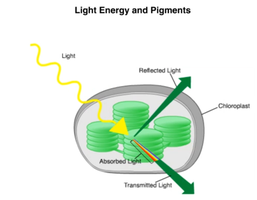
Absorption vs. Reflection: Leaves appear green because chlorophyll absorbs violet-blue and red light, reflecting green.
Photosystems and Electron Flow
Structure and Function
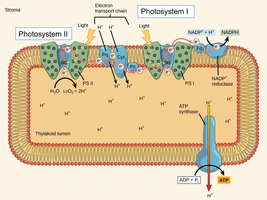
Photosystems are complexes in the thylakoid membrane that capture light energy and initiate electron transfer. There are two types: Photosystem II (P680) and Photosystem I (P700).
Reaction Center: Special pair of chlorophyll a molecules and primary electron acceptor.
Light-Harvesting Complex: Pigments bound to proteins, transferring energy to reaction center.
Linear Electron Flow: Main pathway; produces ATP and NADPH.
Cyclic Electron Flow: Alternative pathway; produces ATP only.
Organization of the Thylakoid Membrane
Electron Transport and Chemiosmosis
Electron transport chains in the thylakoid membrane create a proton gradient, driving ATP synthesis via chemiosmosis. This process is similar to mitochondrial ATP production but uses light energy.
Photosystem II: Splits water, releases O2, initiates electron transport.
Photosystem I: Receives electrons, reduces NADP+ to NADPH.
ATP Synthase: Uses proton gradient to synthesize ATP.
The Calvin Cycle
Phases and Output
The Calvin cycle uses ATP and NADPH to fix carbon dioxide and produce G3P, a three-carbon sugar. The cycle has three phases: carbon fixation, reduction, and regeneration of RuBP.
Phase 1: Carbon Fixation - CO2 binds to RuBP, catalyzed by rubisco.
Phase 2: Reduction - 3-phosphoglycerate is converted to G3P using ATP and NADPH.
Phase 3: Regeneration - G3P is used to regenerate RuBP, enabling the cycle to continue.
Output: G3P is used to synthesize glucose, sucrose, and starch.
Photosynthesis and Cellular Respiration: Comparison
Energy Flow and Chemiosmosis
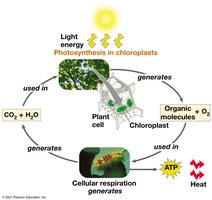
Both chloroplasts and mitochondria use electron transport chains and chemiosmosis to generate ATP, but they differ in energy sources and products.
Photosynthesis: Light energy drives electron flow; produces ATP and NADPH for sugar synthesis.
Cellular Respiration: Chemical energy from food drives electron flow; produces ATP for cellular work.
Electron Sources: Water in photosynthesis; organic molecules in respiration.
Electron Acceptors: NADP+ in photosynthesis; O2 in respiration.
Summary: Photosynthesis is Essential for Life
Photosynthesis stores solar energy in organic compounds, providing energy and carbon skeletons for all living cells. Plants store excess sugar as starch in various structures, supporting growth and reproduction.
Energy Storage: Sunlight is converted to chemical energy in sugars.
Carbon Skeletons: Used to synthesize other organic molecules.
Starch Storage: Roots, tubers, seeds, and fruits.
