Indietro
Lecture 14: Photosynthesis: Structure, Function, and Adaptation
Guida di studio - Note intelligenti
 Appunti personalizzati basati sui tuoi materiali, ampliati con definizioni chiave, esempi e contesto.
Photosynthesis: Structure, Function, and Adaptation
Introduction to Photosynthesis
Photosynthesis is the process by which plants, algae, and some bacteria convert solar energy into chemical energy, sustaining nearly all life on Earth. This process not only produces organic molecules used for energy but also releases oxygen as a by-product.
Photosynthesis Equation: The overall reaction can be summarized as:
Importance: Photosynthesis nourishes the biosphere directly (autotrophs) and indirectly (heterotrophs).
The Nature of Light
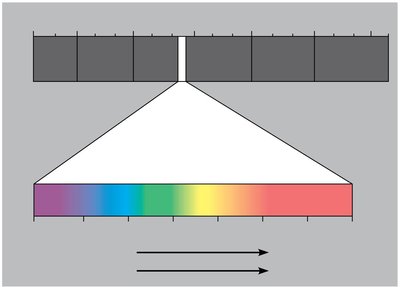
Light is a form of electromagnetic energy, also known as electromagnetic radiation. It travels in waves, and the distance between wave crests is called the wavelength, which determines the energy and type of electromagnetic radiation.
Electromagnetic Spectrum: The full range of electromagnetic radiation, with visible light being the portion that drives photosynthesis.
Photons: Light also behaves as discrete particles called photons, each carrying a quantum of energy.
Energy Flow in Ecosystems
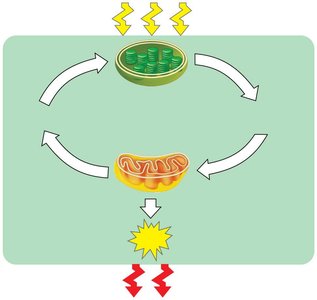
Photosynthesis and cellular respiration are interconnected processes that cycle energy and matter through ecosystems. Sunlight energy is captured by chloroplasts and converted into chemical energy, which is then used by mitochondria to generate ATP for cellular work.
Photosynthesis: Converts light energy into chemical energy (glucose and other organic molecules).
Cellular Respiration: Breaks down organic molecules to produce ATP, releasing CO2 and H2O.
Structure of the Chloroplast
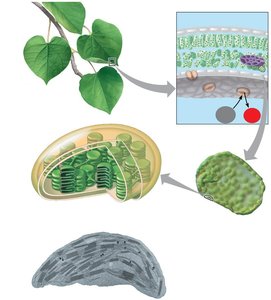
Chloroplasts are the organelles where photosynthesis occurs. They are mainly found in the mesophyll cells of leaves and contain several key structures:
Stroma: The dense fluid within the chloroplast.
Thylakoids: Flattened sacs that contain chlorophyll and are the site of the light reactions. Thylakoids are often stacked into grana.
Stomata: Microscopic pores on the leaf surface that allow gas exchange (CO2 in, O2 out).
Photosynthetic Pigments
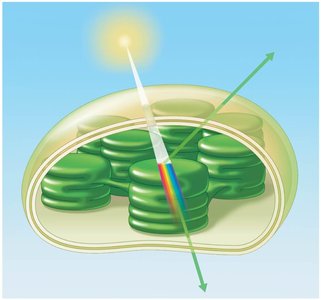
Pigments are substances that absorb visible light. Different pigments absorb different wavelengths, and those not absorbed are reflected or transmitted, giving leaves their green color.
Chlorophyll a: The main photosynthetic pigment.
Chlorophyll b: An accessory pigment that broadens the spectrum of light used for photosynthesis.
Carotenoids: Accessory pigments that function in photoprotection by absorbing excess light.
Absorption and Action Spectra
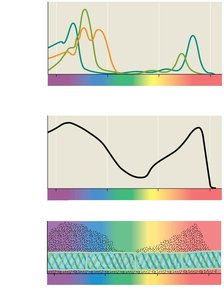
The absorption spectrum is a graph showing how much light is absorbed by a pigment at each wavelength. The action spectrum shows the effectiveness of different wavelengths in driving photosynthesis.
Best Wavelengths: Violet-blue and red light are most effective for photosynthesis.
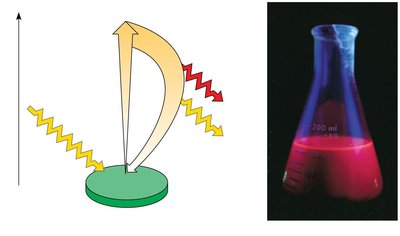
Excitation of Chlorophyll by Light
When chlorophyll absorbs light, its electrons are elevated to an excited state. As these electrons return to the ground state, energy is released as fluorescence (light and heat).
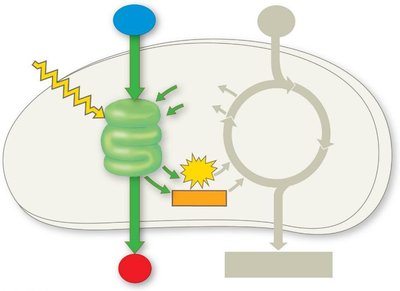
Overview of Photosynthesis Reactions
Photosynthesis consists of two main stages: the light reactions and the Calvin cycle (dark reactions).
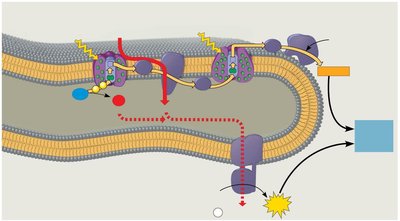
Light Reactions: Occur in the thylakoid membranes, use light energy to split water, release O2, and generate ATP and NADPH.
Calvin Cycle (Dark Reactions): Occur in the stroma, use ATP and NADPH to convert CO2 into sugar (G3P).
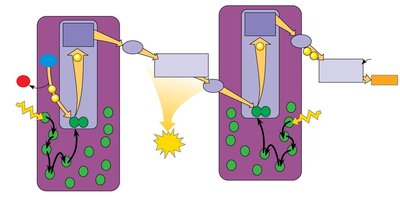
Photosystems and Electron Flow
Photosystems are complexes of proteins and pigments that harvest light and drive electron flow. There are two types:
Photosystem II (PS II): Functions first, best at absorbing 680 nm (P680).
Photosystem I (PS I): Functions second, best at absorbing 700 nm (P700).
Linear Electron Flow: Produces ATP and NADPH by transferring electrons from water to NADP+.
Organization of the Thylakoid Membrane
The thylakoid membrane contains the components of the light reactions, including the photosystems, electron transport chain, and ATP synthase. The movement of electrons helps generate a proton gradient used to produce ATP.
Adaptations to Climate: Photorespiration and C4/CAM Plants
On hot, dry days, plants close their stomata to conserve water, which limits CO2 intake and can lead to photorespiration—a process that consumes O2 and releases CO2 without producing ATP or sugar.
Photorespiration: Occurs when rubisco adds O2 instead of CO2 to the Calvin cycle, reducing photosynthetic efficiency.
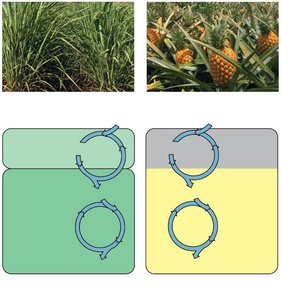
C4 Plants: Minimize photorespiration by spatially separating carbon fixation and the Calvin cycle.
CAM Plants: Minimize water loss by temporally separating carbon fixation (night) and the Calvin cycle (day).
Summary Table: Light Reactions vs. Calvin Cycle
Light Reactions | Calvin Cycle (Dark Reactions) |
|---|---|
Occur in thylakoid membranes | Occur in stroma |
Convert light energy to ATP and NADPH | Use ATP and NADPH to convert CO2 to G3P (sugar) |
Split H2O, release O2 | Return ADP, Pi, and NADP+ to light reactions |