 Indietro
Photosynthesis: Structure, Function, and Mechanisms
Guida di studio - Note intelligenti
 Appunti personalizzati basati sui tuoi materiali, ampliati con definizioni chiave, esempi e contesto.
Photosynthesis
Overview of Photosynthesis
Photosynthesis is the process by which autotrophic organisms, such as plants, convert light energy from the sun into chemical energy stored in glucose. This process is fundamental for life on Earth, as it provides energy and organic molecules for heterotrophs and releases oxygen into the atmosphere.
Autotrophs: Organisms that produce their own food using sunlight (e.g., plants, algae).
Heterotrophs: Organisms that obtain energy by consuming other organisms.
General Equation:
Key Components: Sunlight, water, carbon dioxide, chloroplasts.
Example: Green plants use photosynthesis to produce glucose and oxygen.
Parts of the Leaf and Photosynthetic Structures
The leaf is the primary site of photosynthesis in plants. It contains specialized structures that facilitate the absorption of light and exchange of gases.
Stoma (plural: stomata): Pores on the leaf surface that allow gas exchange (CO2 in, O2 out).
Chloroplast: Organelle where photosynthesis occurs; contains thylakoids and stroma.
Thylakoid: Membrane-bound compartment inside chloroplasts; site of light reactions.
Mesophyll: Leaf tissue rich in chloroplasts.
Photosynthetic Pigments
Pigments are molecules that absorb specific wavelengths of light. Chlorophyll is the main pigment in plants.
Chlorophyll a: Primary pigment involved in light absorption.
Chlorophyll b: Accessory pigment that broadens the spectrum of light absorbed.
Carotenoids: Accessory pigments that protect against photo-damage.
Photosystems and Light Reactions
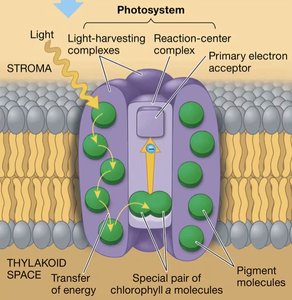
Photosystems are protein complexes in the thylakoid membrane that capture light energy and initiate the light-dependent reactions of photosynthesis.
Photosystem II (PSII): Absorbs light, splits water, releases O2, and transfers electrons.
Photosystem I (PSI): Absorbs light, facilitates NADP+ reduction to NADPH.
Light-Harvesting Complex: Collection of pigment molecules that funnel energy to the reaction center.
Reaction Center: Contains a special pair of chlorophyll a molecules that initiate electron transfer.
Primary Electron Acceptor: Molecule that receives excited electrons from the reaction center.
Electron Transport Chain: Series of proteins that transfer electrons, generating ATP and NADPH.
Light Reactions
The light reactions occur in the thylakoid membranes and convert solar energy into chemical energy (ATP and NADPH).
Water Splitting: Water is split to provide electrons and release O2.
ATP Formation: ATP is produced via chemiosmosis and the enzyme ATP synthase.
NADPH Formation: NADP+ is reduced to NADPH, a high-energy electron carrier.
Calvin Cycle (Dark Reactions)
The Calvin Cycle uses ATP and NADPH from the light reactions to fix carbon dioxide and synthesize glucose.
Carbon Fixation: CO2 is incorporated into organic molecules.
Reduction: ATP and NADPH are used to reduce 3-phosphoglycerate to G3P.
Regeneration: RuBP is regenerated to continue the cycle.
Types of Photosynthetic Pathways
Plants have evolved different pathways to adapt to environmental conditions.
C3 Plants: Use the Calvin Cycle directly; most common.
C4 Plants: Minimize photorespiration by spatial separation of steps.
CAM Plants: Minimize water loss by temporal separation of steps.
Summary Table: Photosynthesis Components
Component | Function |
|---|---|
Chloroplast | Site of photosynthesis |
Thylakoid | Light reactions occur here |
Stroma | Calvin Cycle occurs here |
Photosystem | Captures light energy |
ATP & NADPH | Energy carriers for Calvin Cycle |
Stoma | Gas exchange |
Key Equations
Overall Photosynthesis:
Light Reactions:
Additional info:
Some content was inferred and expanded for clarity, including definitions, examples, and pathway comparisons, to ensure completeness and academic quality.
