 Indietro
Photosynthesis: Structure, Function, and Mechanisms
Guida di studio - Note intelligenti
 Appunti personalizzati basati sui tuoi materiali, ampliati con definizioni chiave, esempi e contesto.
Photosynthesis Overview
Introduction to Photosynthesis
Photosynthesis is the fundamental process by which plants, algae, and some bacteria convert solar energy into chemical energy, storing it in the bonds of glucose. This process is essential for life on Earth, as it provides the energy base for most ecosystems and produces oxygen as a byproduct. - Key Point 1: Photosynthesis converts solar energy into chemical potential energy through carbon fixation. - Key Point 2: The process is summarized by a deceptively simple equation, but involves complex biochemical steps. - Example: Most plants appear green because they reflect green light, which is not absorbed by their photosynthetic pigments. 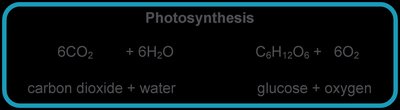
Photosynthesis Equation
The overall chemical equation for photosynthesis is: - Reactants: Carbon dioxide and water - Products: Glucose and oxygen
Phases of Photosynthesis
Light-Dependent and Light-Independent Reactions
Photosynthesis occurs in two main phases: the light-dependent reactions and the light-independent reactions (Calvin Cycle). These phases are reciprocally related, with the products of one serving as reactants for the other. - Light-dependent reactions: Occur on the thylakoid membrane; require light to produce ATP and NADPH. - Light-independent reactions: Occur in the stroma; use ATP and NADPH to fix carbon dioxide into glucose. - Reciprocal relationship: The products of the light-dependent reactions (ATP, NADPH) are used in the light-independent reactions, and vice versa. 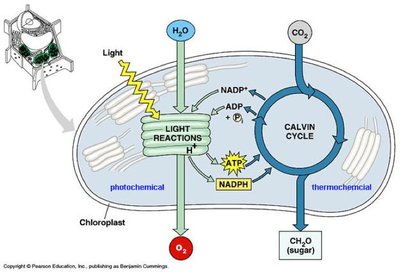
Prerequisite Knowledge for Photosynthesis
Oxidation-Reduction (Redox) Reactions
Redox reactions involve the simultaneous oxidation and reduction of two reactants, facilitating the transfer of electrons. Both photosynthesis and cellular respiration rely on redox reactions to shuttle electrons between endergonic (energy-requiring) and exergonic (energy-releasing) steps. - Oxidation: Loss of electrons, often accompanied by loss of hydrogen or carbon atoms, or gain of positive charge. - Reduction: Gain of electrons, often accompanied by gain of hydrogen or carbon atoms, or loss of positive charge. - Example: Electron carriers such as NADP+/NADPH are repeatedly oxidized and reduced during photosynthesis. 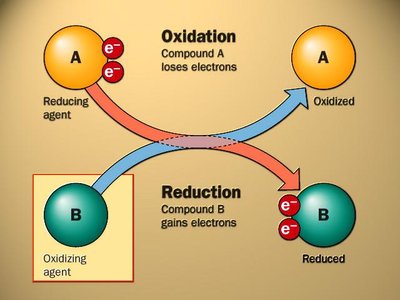
Electron Carriers in Photosynthesis
Electron carriers are molecules that shuttle high-energy electrons between the light-dependent and light-independent reactions. - Examples: NADP+/NADPH, NAD+/NADH, FADH/FADH2 - Function: Facilitate the transfer of electrons and energy within the chloroplast.
Hydrogen Ion and Atom Structure
- Hydrogen ion (H+): A proton, important for pH and acid-base chemistry. - Hydrogen atom: Consists of one proton and one electron.
Electrons and Energy
Photons of light can excite electrons, causing them to jump to higher energy orbitals. Electron carriers can capture these excited electrons, leaving behind ionized molecules. - Key Point: This principle is central to the light-dependent reactions of photosynthesis.
Chloroplast Structure and Function
Chloroplast Anatomy
Chloroplasts are the organelles where photosynthesis occurs. They contain specialized structures for each phase of the process. - Stroma: Site of the Calvin Cycle (light-independent reactions). - Thylakoid membrane: Site of light-dependent reactions; contains photosystem proteins and ATP synthase. - Lumen: Interior of the thylakoid, where proton gradients are established. 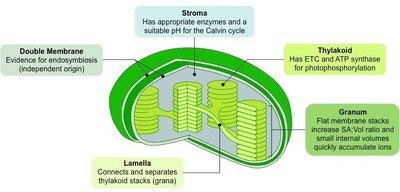
Thylakoid Membrane and Photosystem Proteins
The thylakoid membrane houses photosystem proteins, which contain chlorophyll molecules. - Photosystem proteins: Capture light energy and initiate electron transport. - ATP synthase: Enzyme that synthesizes ATP using the proton gradient across the thylakoid membrane.
Light and Pigments
Chlorophyll and Other Pigments
Chlorophyll is the primary pigment in photosynthesis, absorbing most wavelengths of light except green, which is reflected. - Chlorophyll: Absorbs violet, blue, and red light; reflects green light. - Other pigments: Carotenoids and phycobilins absorb different wavelengths, broadening the spectrum of light used for photosynthesis.
Light and Energy
Each color of light has a specific wavelength and energy level. - Violet light: Shortest wavelength, highest energy. - Red light: Longest wavelength, lowest energy.
Absorbance Spectra
Absorbance spectra show which wavelengths of light are absorbed by photosynthetic pigments. Peaks indicate absorbed light used for photosynthesis, while valleys indicate reflected light. 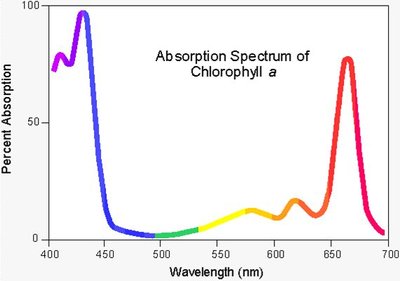
Summary Table: Photosynthesis Components
Component | Function |
|---|---|
Chlorophyll | Absorbs light energy, initiates electron transport |
Thylakoid Membrane | Site of light-dependent reactions |
Stroma | Site of Calvin Cycle (light-independent reactions) |
Electron Carriers | Transport electrons and energy |
ATP Synthase | Produces ATP from ADP and Pi |
Additional info:
- The notes expand on the basic points to provide context for college-level biology students, including definitions, examples, and explanations of key processes. - The images included are directly relevant to the explanation of photosynthesis, its phases, redox reactions, chloroplast structure, and absorbance spectra.
