 Indietro
Photosynthesis: Structure, Function, and Mechanisms
Guida di studio - Note intelligenti
 Appunti personalizzati basati sui tuoi materiali, ampliati con definizioni chiave, esempi e contesto.
Photosynthesis: Structure, Function, and Mechanisms
Concept 10.1 — Photosynthesis Converts Light Energy to Chemical Energy
Photosynthesis is the process by which plants, algae, and some bacteria convert light energy into chemical energy, producing organic molecules from inorganic carbon dioxide. This process is fundamental to life on Earth, providing the energy and organic matter required by most organisms.
Autotrophs: Organisms that make their own organic molecules. Photoautotrophs use light as their energy source (e.g., plants), while chemoautotrophs use energy from inorganic chemical reactions. Heterotrophs obtain energy and nutrients by consuming other organisms or organic matter. Humans are heterotrophs.
Direct Product of Photosynthesis: The Calvin cycle produces G3P (glyceraldehyde-3-phosphate), a three-carbon sugar. Plants use G3P to make glucose and other organic molecules, storing energy for cellular activities or releasing it during cellular respiration.
Source of Tree Mass: Most of a tree's mass comes from carbon dioxide in the air, which is used to build sugars and other organic molecules during photosynthesis.
Overall Equations: Photosynthesis: Cellular Respiration: These processes are complementary: photosynthesis stores energy, cellular respiration releases it.
Oxidation and Reduction: In photosynthesis, water is oxidized (loses electrons), and carbon dioxide is reduced (gains electrons). In cellular respiration, glucose is oxidized, and oxygen is reduced.
Source of Oxygen Released: Oxygen released by plants comes from water, not carbon dioxide. This was established using isotopic labeling experiments.
Endergonic Nature: Photosynthesis is endergonic, requiring energy input from sunlight to build energy-rich organic molecules.
Stages of Photosynthesis: Light reactions (in thylakoid membranes): Use light and water to produce ATP, NADPH, and oxygen. Calvin cycle (in stroma): Uses CO₂, ATP, and NADPH to produce G3P.
CO₂ Pathway: CO₂ enters the leaf through stomata, moves through air spaces, and reaches chloroplasts in mesophyll cells.
Stomata Function: Stomata allow water vapor to escape (transpiration). In hot, dry conditions, plants may close stomata to conserve water, limiting CO₂ intake and increasing photorespiration.
Chloroplast Structure
The chloroplast is the organelle where photosynthesis occurs. Its structure is specialized to maximize the efficiency of light capture and energy conversion.
Outer membrane: Protective covering.
Inner membrane: Regulates entry and exit of materials.
Intermembrane space: Space between outer and inner membranes.
Thylakoid: Flattened membrane sac where light reactions occur.
Granum: Stack of thylakoids.
Stroma: Fluid surrounding thylakoids; site of the Calvin cycle.
Thylakoid space: Interior of thylakoid; site of proton accumulation during light reactions.
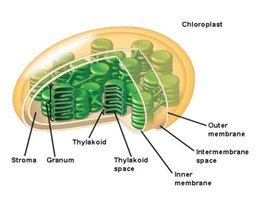
Folding of Thylakoid Membrane: Increases surface area for light reactions, allowing more photosystems and ATP synthase molecules to fit.
Mitochondrial Compartments Comparison: Thylakoid space corresponds to mitochondrial intermembrane space (proton accumulation), stroma corresponds to mitochondrial matrix (site of reactions).
Concept 10.2 — The Light Reactions
The light reactions convert solar energy into chemical energy, producing ATP and NADPH for use in the Calvin cycle.
Photon: A packet of light energy. Shorter wavelengths have more energy.
Leaf Color: Leaves appear green because chlorophyll absorbs red and blue light, reflecting and transmitting green light.
Absorption vs. Action Spectrum: Absorption spectrum: Wavelengths a pigment absorbs. Action spectrum: Wavelengths most effective at driving photosynthesis.
Alga and Aerobic Bacteria Experiment: Demonstrated that red and blue light are most effective for photosynthesis, using bacteria as indicators of oxygen production.
Accessory Pigments: Chlorophyll b: Absorbs additional wavelengths, transfers energy to chlorophyll a. Carotenoids: Absorb additional wavelengths, protect against excess light.
Chlorophyll Fluorescence: In solution, energy is released as heat and light; in thylakoids, energy is transferred to the reaction center.
Photosystem Structure: Light-harvesting complexes: Pigments that absorb light and transfer energy. Reaction-center complex: Special chlorophyll a molecules become excited. Primary electron acceptor: Receives excited electron.
Photosystem I vs. II: Photosystem II (PS II): Absorbs best at 680 nm, works first. Photosystem I (PS I): Absorbs best at 700 nm, works second.
Linear Electron Flow:
Light excites electrons in PS II.
Water splits, releasing O₂ and H⁺.
Electrons travel through electron transport chain to PS I.
Energy pumps H⁺ into thylakoid space.
Light re-energizes electrons in PS I.
Electrons reduce NADP⁺ to NADPH.
Products: ATP, NADPH, O₂.
Chloroplast Chemiosmosis: Protons accumulate in thylakoid space; ATP is produced as protons flow back into stroma through ATP synthase.
Chemiosmosis Comparison:
Feature
Mitochondria
Chloroplasts
Energy source
Electrons from respiration
Light energy
Acidic compartment
Intermembrane space
Thylakoid space
ATP released
Matrix
Stroma
Shared feature
ATP synthase & proton gradient
ATP synthase & proton gradient
Cyclic Electron Flow: Uses PS I only; electrons cycle back, producing extra ATP without NADPH or O₂. Useful for additional ATP needed by Calvin cycle.
Concept 10.3 — The Calvin Cycle
The Calvin cycle uses ATP and NADPH from the light reactions to fix carbon dioxide and produce G3P, a precursor for many organic molecules.
Misleading “Dark Reactions”: The Calvin cycle does not require light directly but depends on products of the light reactions, so it usually runs during daylight.
Three Phases:
Carbon fixation: CO₂ attaches to RuBP (catalyzed by rubisco), forming two 3-PGA molecules.
Reduction: ATP and NADPH convert 3-PGA to G3P.
Regeneration: ATP reforms RuBP so the cycle can continue.
Rubisco Abundance: Rubisco is slow, so plants need large amounts to fix enough CO₂.
Requirements for One G3P: 3 CO₂, 9 ATP, 6 NADPH (from light reactions).
Fate of G3P: Most G3P regenerates RuBP; only some leaves the cycle to build other molecules.
Coupling of Light Reactions and Calvin Cycle: Light reactions provide ATP and NADPH; Calvin cycle returns ADP, Pi, and NADP⁺. If light reactions stop, Calvin cycle soon halts.
Concept 10.4 — When the Usual Mechanism Fails
Photorespiration and alternative carbon fixation strategies help plants cope with environmental challenges, such as hot, dry conditions.
Photorespiration: Rubisco binds O₂ instead of CO₂, wasting energy and releasing fixed CO₂. More likely when stomata are closed in hot, dry conditions.
C4 Strategy: C4 plants fix CO₂ in mesophyll cells using PEP carboxylase, then transport four-carbon compounds to bundle-sheath cells for the Calvin cycle. This concentrates CO₂ around rubisco, reducing photorespiration. Example: Corn.
CAM Strategy: CAM plants open stomata at night to take in CO₂, storing it in organic acids. During the day, they release CO₂ for the Calvin cycle while stomata are closed. Example: Pineapple.
Separation of Carbon Fixation: C4 plants separate processes in space (mesophyll vs. bundle-sheath cells). CAM plants separate processes in time (night vs. day). Both strategies require extra energy but help conserve water and reduce photorespiration.
Plant Macromolecule Synthesis
Plants use G3P to build carbohydrates, lipids, proteins, and nucleic acids. All four major macromolecule classes can be synthesized from CO₂, water, and minerals.
Key Vocabulary
Autotroph, Photoautotroph, Heterotroph, Mesophyll, Stoma/Stomata, Chloroplast, Thylakoid, Granum, Stroma, Thylakoid space, Light reactions, Calvin cycle, Photon, Wavelength, Absorption spectrum, Action spectrum, Chlorophyll a, Chlorophyll b, Carotenoid, Photosystem, Light-harvesting complex, Reaction-center complex, Primary electron acceptor, Photosystem I, Photosystem II, P680, P700, Linear electron flow, Cyclic electron flow, Photophosphorylation, NADP⁺, NADPH, Calvin cycle, Carbon fixation, RuBP, Rubisco, 3-PGA, G3P, Reduction, Regeneration, Photorespiration, C3 plant, C4 plant, PEP carboxylase, Bundle-sheath cell, Mesophyll cell, CAM plant
Additional info: Academic context was added to clarify the mechanisms, comparisons, and vocabulary for completeness and exam preparation.
