 Indietro
Photosynthesis: The Calvin Cycle and Carbon Fixation
Guida di studio - Note intelligenti
 Appunti personalizzati basati sui tuoi materiali, ampliati con definizioni chiave, esempi e contesto.
Photosynthesis
Introduction to the Calvin Cycle
The Calvin cycle is the set of light-independent reactions in photosynthesis that convert atmospheric carbon dioxide into carbohydrate molecules, providing long-term energy storage for plants. While ATP and NADPH produced in the light reactions are short-lived, the carbohydrates formed in the Calvin cycle can be stored or transported throughout the plant.
The Calvin Cycle
Overview of the Calvin Cycle
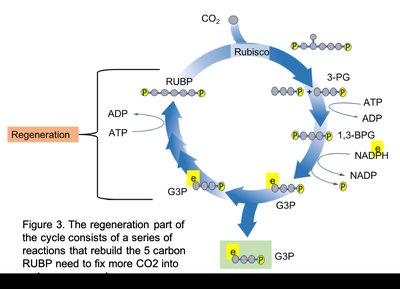
The Calvin cycle occurs in the stroma of the chloroplast and is responsible for carbon fixation. It can be divided into three main phases: carbon fixation, reduction, and regeneration. The cycle is continuous, with molecules entering and leaving based on the cell's needs.
Carbon Fixation: Atmospheric CO2 enters the leaf through stomata and diffuses into the chloroplast stroma, where it is covalently bonded to ribulose-1,5-bisphosphate (RUBP) by the enzyme Rubisco.
Reduction: The resulting 3-phosphoglycerate (3-PG) molecules are phosphorylated and reduced to form glyceraldehyde-3-phosphate (G3P), a high-energy three-carbon sugar.
Regeneration: Some G3P molecules are used to regenerate RUBP, allowing the cycle to continue.
Phase 1: Carbon Fixation
Carbon fixation is the process by which CO2 is attached to RUBP, a five-carbon compound, by the enzyme Rubisco. This reaction forms a highly unstable six-carbon intermediate that immediately splits into two molecules of 3-phosphoglycerate (3-PG).
Rubisco: The most abundant protein in photosynthetic tissues, Rubisco catalyzes the fixation of CO2 and regulates the rate of sugar production.
Misconception: Oxygen is not released during carbon fixation; O2 is only produced during the light reactions from the splitting of water.
Phase 2: Reduction of 3-Phosphoglycerate
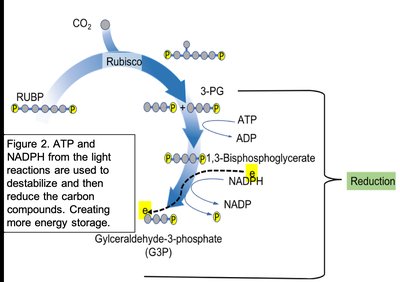
The two 3-PG molecules formed in carbon fixation are converted into high-energy G3P molecules through phosphorylation and reduction. ATP and NADPH from the light reactions provide the necessary energy and electrons for these transformations.
Phosphorylation: 3-PG is phosphorylated by ATP to form 1,3-bisphosphoglycerate (1,3-BPG).
Reduction: 1,3-BPG is reduced by NADPH to form G3P, which contains more stored energy.
Key Equation:
Phase 3: Regeneration of RUBP
To sustain the Calvin cycle, a portion of the G3P produced is used to regenerate RUBP. This process involves a complex series of reactions that rearrange carbon atoms and require additional ATP input.
Regeneration: Ensures a continuous supply of RUBP for ongoing carbon fixation.
ATP Use: ATP from the light reactions is used to transfer phosphates during regeneration.
Connections Between the Calvin Cycle and Light Reactions
The Calvin cycle is dependent on the products of the light reactions—ATP and NADPH. Without light, these molecules are not produced, and the Calvin cycle cannot proceed. Thus, the cycle is indirectly dependent on light, even though it does not require light directly.
ATP and NADPH: Provide the energy and reducing power for the reduction and regeneration phases.
Proton Gradient: Light-driven movement of protons alters the pH of the stroma, affecting enzyme activity.
Regulation of Rubisco Activity by Light
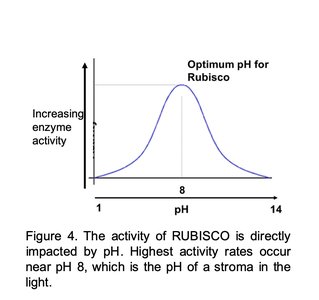
Light not only provides ATP and NADPH but also influences the activity of Rubisco through changes in stromal pH. When light is present, protons are pumped into the thylakoid lumen, increasing the pH of the stroma. This pH change alters hydrogen bonds in Rubisco, enhancing its ability to bind CO2 and RUBP, and thus increasing carbon fixation rates.
Optimum pH: Rubisco activity is highest near pH 8, which is typical of the stroma in the light.
Enzyme Regulation: Changes in pH modify the enzyme's structure and activity.
Summary
The Calvin cycle is tightly linked to the light reactions of photosynthesis. It occurs in the stroma, where Rubisco fixes CO2 to RUBP. ATP and NADPH from the light reactions are used to energize and reduce carbon compounds, while the movement of protons during the light reactions regulates Rubisco activity via pH changes. The end products are high-energy three-carbon sugars used throughout the plant.
Review Questions
How many RUBP molecules are needed to fix 3 CO2 molecules?
If 3 CO2 molecules are fixed, how many 3-PG molecules are produced?
How many G3P molecules would be needed to regenerate the number of RUBP needed to fix 3 CO2?
When the light reactions start occurring in the light, what happens to the pH of the stroma? A. It decreases B. It increases C. It does not change
When the pH changes in the stroma, what bonds within the Rubisco protein are likely to change? A. Hydrogen bonds B. Covalent bonds C. Ionic bonds D. Peptide bonds
Why is it not accurate to refer to the process of carbon fixation in photosynthesis as the dark reactions? Make sure to provide details to support your answer.
