 Indietro
Photosynthesis: The Light-Dependent Reactions and Calvin Cycle
Guida di studio - Note intelligenti
 Appunti personalizzati basati sui tuoi materiali, ampliati con definizioni chiave, esempi e contesto.
Photosynthesis Overview
Introduction to Photosynthesis
Photosynthesis is a fundamental biological process by which photoautotrophs, such as plants, convert solar energy into chemical energy stored in organic compounds. This process is essential for life on Earth, as it forms the basis of the ecological pyramid and supports nearly all living organisms.
Photoautotrophs use sunlight to synthesize organic compounds from carbon dioxide and water.
Organic compounds produced include carbohydrates like glucose.
Ecological importance: The biomass generated by producers sustains heterotrophs, which consume these compounds for energy.
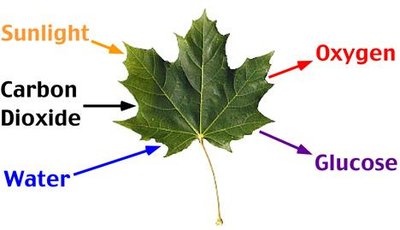
Photosynthetic Organs: Leaves
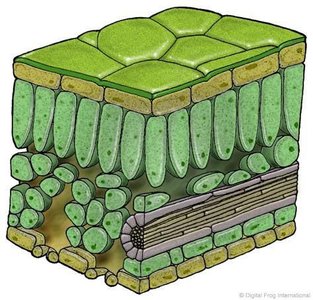
Leaves are the primary organs of photosynthesis in plants, optimized for light absorption and gas exchange.
Leaves have a large surface area to maximize sunlight absorption.
Key structures include the cuticle, upper and lower epidermis, palisade and spongy mesophyll, bundle sheath cells, and vascular tissues (xylem and phloem).
Chloroplast Structure
Chloroplasts: The Site of Photosynthesis
Photosynthesis occurs within chloroplasts, specialized organelles found in plant cells.
Chloroplasts have three membranes: outer, inner, and thylakoid membrane.
The thylakoid membrane forms stacks called grana.
Chlorophyll and other pigments are embedded in the thylakoid membrane.
Light and Pigments
Nature of Light
Light is a form of electromagnetic radiation with both wave and particle (photon) properties. Visible light consists of different wavelengths, each corresponding to a color.
Shorter wavelengths have higher energy.
Photosynthetic pigments absorb specific wavelengths of light.
Photosynthetic Pigments
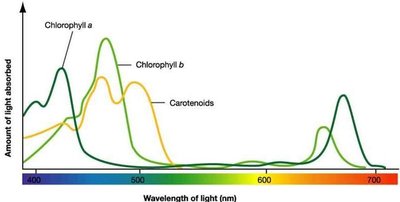
Pigments are molecules that absorb light energy. Different pigments absorb different wavelengths, allowing plants to utilize a broad spectrum of light.
Chlorophyll A: Primary pigment, absorbs blue-violet and red light.
Chlorophyll B: Accessory pigment, absorbs blue and red-orange light.
Carotenoids: Includes xanthophylls and carotenes, absorbs blue and green light.
Photosynthesis: The Overall Equation
General Equation
The net equation for photosynthesis is:
6 CO2 + 6 H2O + light → C6H12O6 + 6 O2
Stages of Photosynthesis
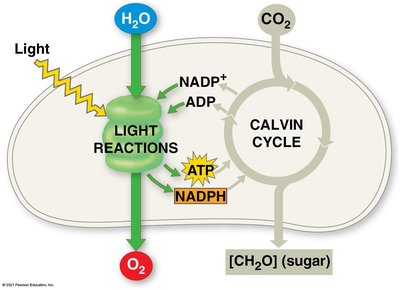
Photosynthesis occurs in two main stages:
Light Reactions (Light-Dependent Reactions): Occur in the thylakoid membrane, convert light energy to chemical energy (ATP and NADPH).
Calvin Cycle (Light-Independent Reactions): Occur in the stroma, use ATP and NADPH to fix carbon and produce organic compounds.
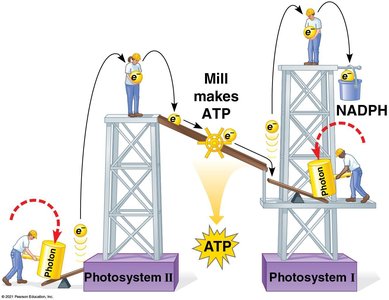
The Light-Dependent Reactions
Photosystems and Electron Transport
Light reactions utilize two photosystems:
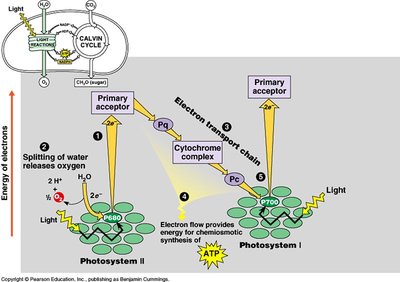
Photosystem II (PSII, P680): Absorbs light at 680 nm, initiates electron transport.
Photosystem I (PSI, P700): Absorbs light at 700 nm, produces NADPH.
Photosystems are clusters of pigment molecules and proteins.
Non-Cyclic Electron Flow
The main pathway for light reactions is non-cyclic electron flow:
PSII absorbs light, exciting an electron.
Electron is replaced by splitting water (photolysis), releasing O2.
Excited electron travels down the electron transport chain, creating a proton gradient (chemiosmosis).
PSI absorbs light, excites another electron, which reduces NADP+ to NADPH.
ATP is produced as protons flow back through ATP synthase.
Cyclic Electron Flow
Cyclic electron flow is an alternative pathway:
Only PSI is used; electrons are recycled.
ATP is produced, but NADPH and O2 are not.
Helps balance ATP/NADPH ratio for the Calvin Cycle.
Summary Table: Cyclic vs Non-Cyclic Electron Flow
Feature | Non-Cyclic Electron Flow | Cyclic Electron Flow |
|---|---|---|
Photosystems Used | PSII & PSI | PSI only |
Water Split? | Yes | No |
Oxygen Produced? | Yes | No |
NADPH Produced? | Yes | No |
ATP Produced? | Yes | Yes |
Electron Path | Linear | Cyclic |
The Calvin Cycle (Light-Independent Reactions)
Overview of the Calvin Cycle
The Calvin Cycle uses ATP and NADPH from the light reactions and CO2 from the atmosphere to produce organic compounds like glucose. It occurs in the stroma of chloroplasts.
Carbon fixation: Incorporation of CO2 into organic molecules.
Rubisco: The enzyme responsible for carbon fixation.
Steps of the Calvin Cycle
Carbon Fixation: 3 CO2 molecules are joined to 3 RuBP (5-carbon sugar) by Rubisco, forming three 6-carbon molecules.
Reduction: The 6-carbon molecules split into six 3-carbon molecules (G3P/PGAL), reduced by NADPH and rearranged using ATP.
Regeneration: Five G3P molecules are rearranged (using ATP) to regenerate three RuBP molecules, allowing the cycle to continue.
Product Formation: One G3P exits the cycle per three turns, combining to form glucose or other organic compounds.
Environmental Factors Affecting Photosynthesis
Light Intensity
Increasing light intensity increases the rate of photosynthesis up to a saturation point.
Beyond this point, further increases do not enhance the rate.
Temperature
Photosynthesis rate increases with temperature up to an optimum, then decreases as enzymes denature.
Oxygen Concentration and Photorespiration
High O2 concentration favors photorespiration, reducing photosynthetic efficiency.
Photorespiration occurs when Rubisco binds O2 instead of CO2, preventing glucose synthesis and consuming ATP.
Adaptations to Prevent Photorespiration
C3, C4, and CAM Plants
C3 plants: Perform light reactions and Calvin Cycle in mesophyll cells; susceptible to photorespiration.
C4 plants: Calvin Cycle occurs in bundle-sheath cells; CO2 is concentrated via the Hatch-Slack pathway, reducing photorespiration.
CAM plants: Open stomata at night to collect CO2, store it as organic acids, and use it during the day; adaptation for arid environments.
Summary Table: C3, C4, and CAM Photosynthesis
Plant Type | Location of Calvin Cycle | Adaptation | Photorespiration Risk |
|---|---|---|---|
C3 | Mesophyll cells | None | High |
C4 | Bundle-sheath cells | Hatch-Slack pathway | Low |
CAM | Mesophyll cells | Stomata open at night | Low |
