 Indietro
Photosynthesis: The Light Reactions and Calvin Cycle Part 2
Guida di studio - Note intelligenti
 Appunti personalizzati basati sui tuoi materiali, ampliati con definizioni chiave, esempi e contesto.
Photosystems and the Light Reactions
Structure and Function of Photosystems
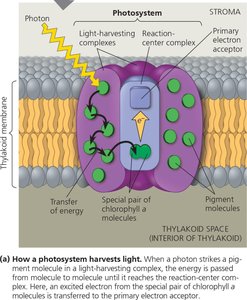
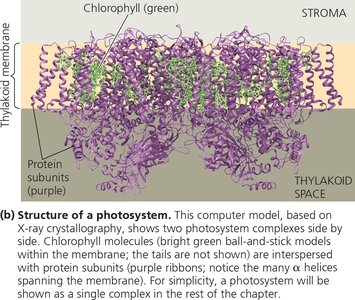
Photosystems are large complexes of proteins and pigments embedded in the thylakoid membrane of chloroplasts. They play a central role in capturing light energy and converting it into chemical energy during photosynthesis.
Photosystem Components: Each photosystem consists of a reaction-center complex and multiple light-harvesting complexes.
Light-Harvesting Complexes: Contain pigment molecules (chlorophyll a, chlorophyll b, carotenoids) bound to proteins. These pigments absorb photons and transfer the energy to the reaction center.
Reaction-Center Complex: Contains a special pair of chlorophyll a molecules and a primary electron acceptor. The reaction center is where the conversion of light energy to chemical energy begins.
Primary Electron Acceptor: Accepts excited electrons from chlorophyll a, becoming reduced in the process.
Types of Photosystems
There are two types of photosystems in the thylakoid membrane, each with a unique role in the light reactions:
Photosystem II (PS II): Also called P680, its reaction-center chlorophyll a absorbs light best at 680 nm.
Photosystem I (PS I): Also called P700, its reaction-center chlorophyll a absorbs light best at 700 nm.
Linear Electron Flow in the Light Reactions
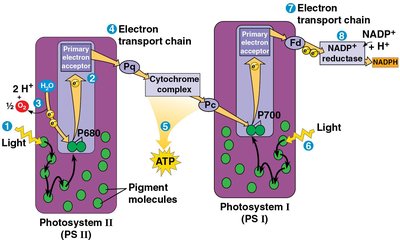
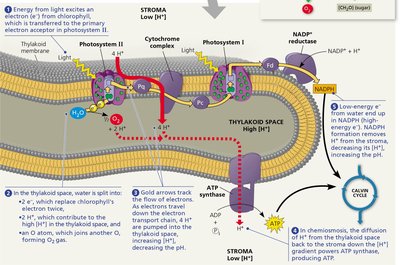
Linear electron flow is the primary pathway of electron movement during the light reactions, involving both photosystems and resulting in the production of ATP and NADPH.
Light Absorption in PS II: A photon excites pigment molecules, transferring energy to P680.
Electron Transfer: Excited electron from P680 is transferred to the primary electron acceptor, oxidizing P680 to P680+.
Water Splitting: An enzyme splits water, releasing electrons (to reduce P680+), protons (H+), and oxygen (O2).
Electron Transport Chain (ETC): Electrons move from PS II to PS I via plastoquinone (Pq), cytochrome complex, and plastocyanin (Pc), generating a proton gradient.
ATP Production: The proton gradient drives ATP synthesis via chemiosmosis.
Light Absorption in PS I: Light excites P700, transferring an electron to its primary acceptor. P700+ is reduced by electrons from PS II.
Second ETC: Electrons move to ferredoxin (Fd), then to NADP+ reductase.
NADPH Formation: NADP+ is reduced to NADPH, which is used in the Calvin cycle.
Chemiosmosis and ATP Synthesis
Comparison of Chloroplasts and Mitochondria
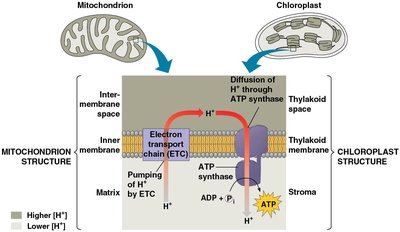
Both chloroplasts and mitochondria generate ATP by chemiosmosis, but differ in their sources of energy and electron donors.
Chloroplasts: Electrons come from water, and light energy drives ATP production (photophosphorylation).
Mitochondria: Electrons come from organic molecules, and chemical energy from food drives ATP production (oxidative phosphorylation).
ATP Synthase: In both organelles, ATP synthase couples the diffusion of protons down their gradient to the phosphorylation of ADP to ATP.
Proton Gradients and ATP Production
In Mitochondria: Protons are pumped into the intermembrane space; ATP is synthesized as protons flow back into the matrix.
In Chloroplasts: Protons are pumped into the thylakoid space; ATP is synthesized as protons flow back into the stroma.
ATP and NADPH: Both are produced on the stroma side of the thylakoid membrane, ready for use in the Calvin cycle.
The Calvin Cycle: Reducing CO2 to Sugar
Overview of the Calvin Cycle
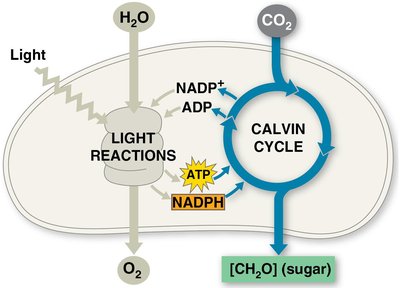
The Calvin cycle is an anabolic pathway that uses ATP and NADPH from the light reactions to convert CO2 into sugar. The main carbohydrate product is glyceraldehyde 3-phosphate (G3P).
Inputs: 3 CO2, 9 ATP, 6 NADPH (per net G3P produced)
Outputs: 1 G3P (net), 9 ADP, 6 NADP+, 8 Pi
Phases: Carbon fixation, reduction, regeneration of CO2 acceptor (RuBP)
Phases of the Calvin Cycle
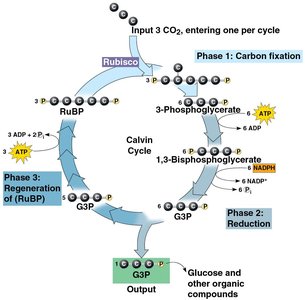
Phase 1: Carbon Fixation
CO2 is attached to ribulose bisphosphate (RuBP) by the enzyme rubisco.
The resulting 6-carbon intermediate splits into two molecules of 3-phosphoglycerate (3-PGA).
Phase 2: Reduction
Each 3-PGA is phosphorylated by ATP and reduced by NADPH to form glyceraldehyde 3-phosphate (G3P).
For every three CO2 fixed, six G3P are produced, but only one is a net gain; the rest are recycled.
Phase 3: Regeneration of RuBP
Five G3P molecules are rearranged to regenerate three RuBP, using three more ATP.
This allows the cycle to continue and accept more CO2.
Role of Light Reactions
The ATP and NADPH produced in the light reactions provide the energy and reducing power for the Calvin cycle. G3P produced can be used to synthesize glucose, sucrose, and other carbohydrates.
Summary Table: Comparison of Photophosphorylation and Oxidative Phosphorylation
Feature | Photophosphorylation (Chloroplasts) | Oxidative Phosphorylation (Mitochondria) |
|---|---|---|
Electron Source | Water (H2O) | Organic molecules (e.g., glucose) |
Energy Source | Light energy | Chemical energy from food |
Final Electron Acceptor | NADP+ | O2 |
Location of Proton Gradient | Thylakoid space | Intermembrane space |
ATP Synthase Location | Thylakoid membrane | Inner mitochondrial membrane |
Key Equations
Overall Light Reaction:
Overall Calvin Cycle (for one G3P):
Additional info:
The Calvin cycle is sometimes called the "dark reactions," but it requires the products of the light reactions and thus only occurs in the light.
Rubisco is the most abundant enzyme on Earth and is responsible for the initial step of carbon fixation.
