 Indietro
Photosynthesis: The Process That Feeds the Biosphere
Guida di studio - Note intelligenti
 Appunti personalizzati basati sui tuoi materiali, ampliati con definizioni chiave, esempi e contesto.
Photosynthesis: Overview and Importance
Introduction to Photosynthesis
Photosynthesis is a fundamental biological process that converts solar energy into chemical energy, sustaining nearly all life on Earth. It is the mechanism by which autotrophs manufacture carbohydrates, providing food and oxygen for heterotrophs.
Photosynthesis Equation:
Autotrophs: Organisms that produce organic molecules from CO2 and other inorganic substances.
Heterotrophs: Organisms that obtain organic material from other organisms; consumers of the biosphere.
Photosynthesis vs. Cellular Respiration: Photosynthesis is essentially the reverse of cellular respiration.
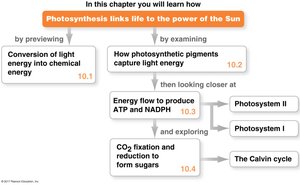
Photosynthesis: Two Linked Sets of Reactions
Light-Dependent and Light-Independent Reactions
Photosynthesis consists of two major sets of reactions: the light-dependent reactions and the Calvin cycle (light-independent reactions).
Light-Dependent Reactions: Occur in the thylakoid membranes; produce O2 from H2O, generate ATP and NADPH.
Calvin Cycle: Occurs in the stroma; uses ATP and NADPH to reduce CO2 and synthesize sugars.
Structure of the Chloroplast
Chloroplast Anatomy
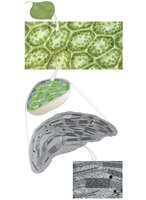
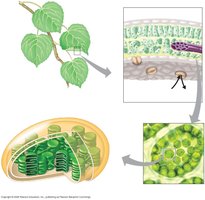
Photosynthesis occurs within chloroplasts, which are specialized organelles found in plant cells. Chloroplasts contain thylakoids, grana, and stroma, each playing a distinct role in the process.
Thylakoids: Flattened sacs where light-dependent reactions occur.
Grana: Stacks of thylakoids.
Stroma: Liquid matrix surrounding thylakoids; site of the Calvin cycle.
Photosynthetic Pigments: Light Receptors
Pigments and Light Absorption
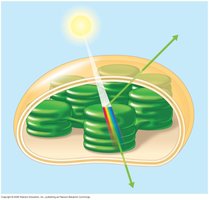
Thylakoid membranes contain pigments that absorb light energy. The most common pigment is chlorophyll, which reflects green light and is responsible for the color of plants.
Pigments: Substances that absorb visible light; different pigments absorb different wavelengths.
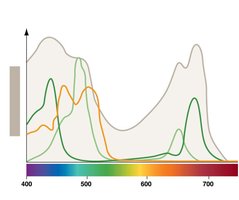
Chlorophylls: Main photosynthetic pigments; absorb red and blue light, reflect green.
Carotenoids: Accessory pigments; absorb blue and green light, reflect yellow, orange, and red.
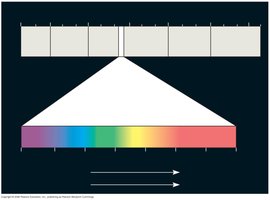
Absorption Spectra of Photosynthetic Pigments
Different pigments absorb different wavelengths, which determines the action spectrum of photosynthesis.
Chlorophyll a and b: Absorb violet-to-blue and red light; transmit green.
Carotenoids: Absorb blue and green; transmit yellow, orange, or red.
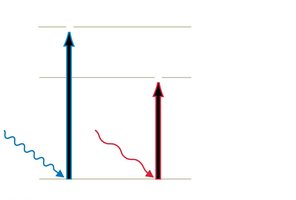
Light Energy and Electron Excitation
Photon Absorption and Electron States
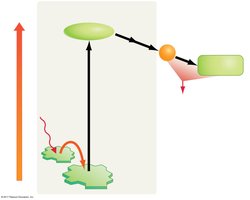
When pigments absorb photons, electrons are excited to higher energy states. Blue photons excite electrons to higher states than red photons.
Ground State: Lowest energy state of an electron.
Excited State: Higher energy state after photon absorption; unstable.
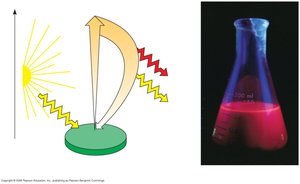
Fate of Excited Electrons
Excited electrons can return to the ground state, emitting fluorescence and/or heat, or transfer energy to nearby pigments (resonance energy transfer), or be transferred to an electron acceptor (reduction/oxidation).
Fluorescence: Emission of light as electrons return to ground state.
Resonance Energy Transfer: Energy transferred to another pigment molecule.
Reduction/Oxidation: Electron transferred to a new compound.
Photosystems: Organization of Pigments
Photosystem Structure and Function
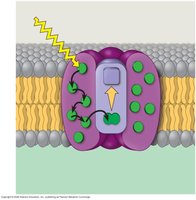
Chlorophyll molecules are organized into photosystems, which consist of an antenna complex and a reaction center. These structures capture and process excited electrons.
Antenna Complex: Group of pigment molecules that transfer energy to the reaction center.
Reaction Center: Site where excited electrons are transferred to a primary electron acceptor.
Photosystem I and II
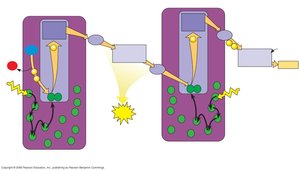
There are two types of photosystems: Photosystem I and Photosystem II. Both work together to enhance photosynthesis, especially when exposed to both red and far-red light.
Photosystem II: Initiates the light-dependent reactions by splitting water and producing O2.
Photosystem I: Transfers electrons to NADP+, forming NADPH.
Converting Light Energy into Chemical Energy
ATP and NADPH Production
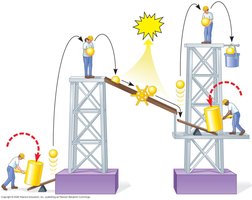
Protons flow through ATP synthase by chemiosmosis, forming ATP. The energy for ATP synthesis comes from light, a process called photophosphorylation.
Photophosphorylation: ATP synthesis driven by light energy.
NADPH: Electron carrier produced by Photosystem I.
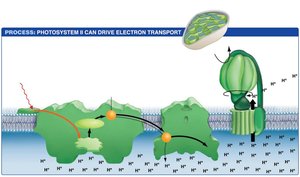
Water Splitting and Oxygen Production
Photosystem II splits water to replace electrons, producing oxygen as a byproduct.
Water Splitting Reaction:
The Calvin Cycle: Carbon Fixation and Sugar Production
Three Phases of the Calvin Cycle
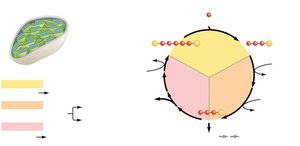
The Calvin cycle is a three-step process occurring in the stroma of chloroplasts. It fixes carbon dioxide, reduces it to sugar, and regenerates the CO2 acceptor.
Fixation: CO2 reacts with ribulose bisphosphate (RuBP), forming 3-phosphoglycerate (3PGA).
Reduction: 3PGA is phosphorylated by ATP and reduced by NADPH to produce glyceraldehyde 3-phosphate (G3P).
Regeneration: Remaining G3P is used to regenerate RuBP.
Role of Rubisco
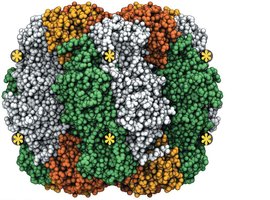
Rubisco (ribulose 1,5-bisphosphate carboxylase/oxygenase) is the enzyme responsible for CO2 fixation. It is the most abundant enzyme on Earth but is slow and inefficient, as it can also catalyze the addition of O2 (photorespiration).
Photorespiration: Occurs when O2 reacts with RuBP, releasing CO2 and consuming ATP.
Gas Exchange and Stomata
Stomata Function
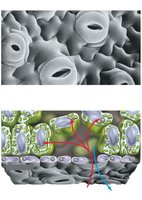
Plants have pores called stomata that allow gas exchange. Guard cells regulate the opening and closing of stomata, balancing water conservation and CO2 intake.
Cuticle: Waxy coating that prevents water loss but also restricts gas exchange.
Stomata: Pores for gas exchange; controlled by guard cells.
Alternative Carbon Fixation Pathways
C4 and CAM Pathways
Plants in hot, arid climates have evolved alternative mechanisms to minimize photorespiration and maximize carbon fixation.
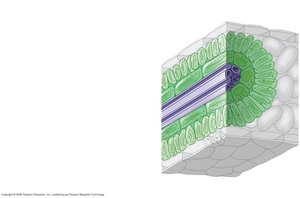
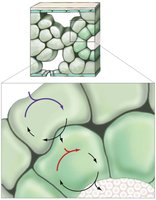
C4 Pathway: CO2 is fixed by PEP carboxylase in mesophyll cells, forming a four-carbon compound. This compound is transported to bundle-sheath cells, where CO2 is released for the Calvin cycle.
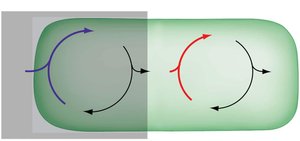
CAM Pathway: CO2 is fixed at night and stored as a four-carbon compound. During the day, CO2 is released for the Calvin cycle while stomata are closed.
Pathway | Carbon Fixation | Separation | Example Plants |
|---|---|---|---|
C3 | RuBP + CO2 (Rubisco) | None | Most plants |
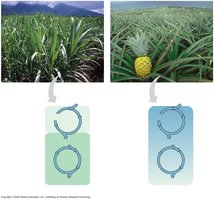
C4 | PEP carboxylase (mesophyll) → Rubisco (bundle-sheath) | Spatial | Sugarcane, maize |
CAM | PEP carboxylase (night) → Rubisco (day) | Temporal | Cacti, pineapple |
Summary: Photosynthesis is a complex, multi-step process essential for life, involving light capture, electron transport, ATP and NADPH production, carbon fixation, and adaptation to environmental conditions.
