 Indietro
Photosynthesis: The Process That Powers Life on Earth
Guida di studio - Note intelligenti
 Appunti personalizzati basati sui tuoi materiali, ampliati con definizioni chiave, esempi e contesto.
Photosynthesis: Overview and Importance
Introduction to Photosynthesis
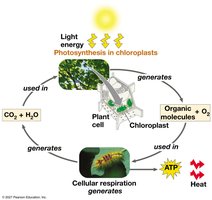
Photosynthesis is the process by which plants, algae, and some prokaryotes convert solar energy into chemical energy, producing organic molecules and oxygen from carbon dioxide and water. This process sustains almost all life on Earth, either directly or indirectly, by providing food and oxygen.
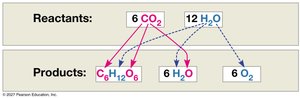
Photosynthesis Equation: The overall chemical reaction is summarized as:
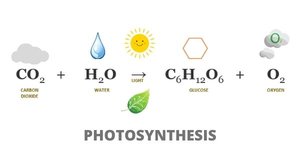
Significance: Photosynthesis feeds the biosphere, providing the organic molecules and oxygen essential for life.
Autotrophs and Heterotrophs
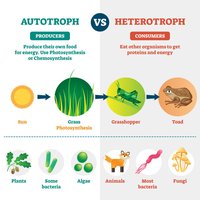
Producers vs. Consumers
Organisms are classified based on how they obtain energy and organic molecules:
Autotrophs: "Self-feeders" that produce their own food from inorganic substances. Most are photoautotrophs, using sunlight for energy.
Heterotrophs: Obtain organic molecules by consuming other organisms. Includes animals, fungi, and most bacteria.
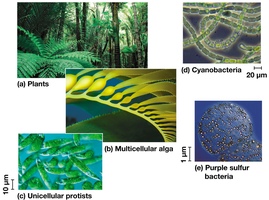
Examples of Photoautotrophs: Plants, multicellular algae, unicellular protists, cyanobacteria, and purple sulfur bacteria.
Chloroplasts: The Site of Photosynthesis
Structure and Function
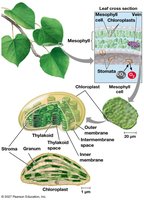
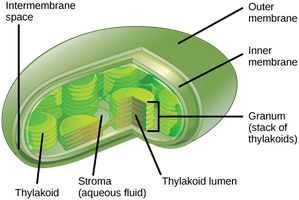
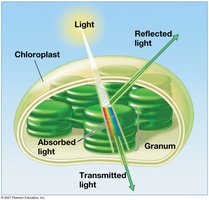
Photosynthesis occurs in chloroplasts, specialized organelles found mainly in the mesophyll cells of plant leaves. Chloroplasts contain an envelope of two membranes surrounding a dense fluid called the stroma. Inside are thylakoids, which may be stacked into grana, and contain chlorophyll, the pigment responsible for capturing light energy.
Stomata: Microscopic pores in leaves that allow gas exchange (CO2 in, O2 out).
Veins: Transport water and nutrients to leaves and carry sugars to other parts of the plant.
The Photosynthesis Equation and Redox Reactions
Tracking Atoms and Electron Flow
Photosynthesis is a redox process, reversing the electron flow of cellular respiration. Water is split, providing electrons and protons, and oxygen is released as a by-product. Carbon dioxide is reduced to form glucose.
Redox in Photosynthesis: CO2 is reduced, H2O is oxidized.
Endergonic Process: Requires energy input from light.

Stages of Photosynthesis
Light Reactions and the Calvin Cycle
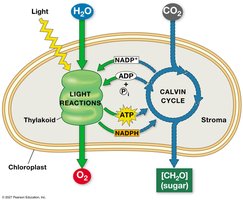
Photosynthesis consists of two main stages:
Light Reactions: Occur in the thylakoid membranes. Convert solar energy to chemical energy (ATP and NADPH), split water, and release oxygen.
Calvin Cycle: Occurs in the stroma. Uses ATP and NADPH to convert CO2 into glucose.
The Nature of Sunlight
Electromagnetic Spectrum and Visible Light
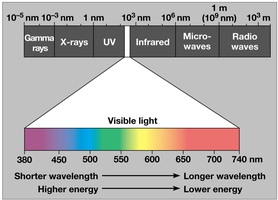
Sunlight is a form of electromagnetic energy. The electromagnetic spectrum includes all wavelengths of electromagnetic radiation, but only visible light (380–740 nm) is used in photosynthesis.
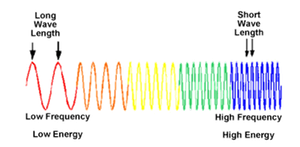
Wavelength: Distance between crests of waves; determines energy and color.
Photons: Discrete particles of light, each with a fixed amount of energy inversely related to wavelength.
Photosynthetic Pigments
Light Absorption and Pigment Types
Pigments are substances that absorb visible light. Different pigments absorb different wavelengths; those not absorbed are reflected or transmitted, giving plants their color.
Chlorophyll a: Main pigment in light reactions.
Chlorophyll b: Accessory pigment, broadens the spectrum of light used.
Carotenoids: Accessory pigments that protect against excess light.
Photosystems and Electron Flow
Photosystems I and II
Photosystems are complexes of proteins and pigments in the thylakoid membrane. They capture light energy and transfer excited electrons through an electron transport chain.
Photosystem II (P680): Best absorbs light at 680 nm.
Photosystem I (P700): Best absorbs light at 700 nm.
Linear Electron Flow: Involves both photosystems, produces ATP and NADPH.
Cyclic Electron Flow: Involves only Photosystem I, produces ATP but not NADPH or O2.
ATP and NADPH Production: Chemiosmosis
Comparison with Mitochondria
Both chloroplasts and mitochondria use chemiosmosis to generate ATP. In chloroplasts, the proton gradient is created across the thylakoid membrane, driving ATP synthesis as protons flow back into the stroma.
Photophosphorylation: ATP production using light energy in chloroplasts.
Oxidative Phosphorylation: ATP production using energy from food in mitochondria.
The Calvin Cycle
Carbon Fixation and Sugar Production
The Calvin cycle uses ATP and NADPH to convert CO2 into glyceraldehyde-3-phosphate (G3P), a sugar. The cycle has three phases: carbon fixation, reduction, and regeneration of the CO2 acceptor (RuBP).
Phase 1: Carbon Fixation: CO2 is attached to RuBP by the enzyme rubisco, forming 3-phosphoglycerate.
Phase 2: Reduction: ATP and NADPH are used to convert 3-phosphoglycerate into G3P.
Phase 3: Regeneration: Some G3P is used to regenerate RuBP, enabling the cycle to continue.
Photosynthesis: Summary and Importance
Review
Photosynthesis stores solar energy in organic molecules, providing food and oxygen for nearly all life. Plants store excess sugar as starch in various organs. The cooperation of light reactions and the Calvin cycle is essential for the conversion of light energy into chemical energy.
