Indietro
Photosynthesis: Using Light to Make Food (Campbell Essential Biology, Ch. 7)
Guida di studio - Note intelligenti
 Appunti personalizzati basati sui tuoi materiali, ampliati con definizioni chiave, esempi e contesto.
Photosynthesis: Using Light to Make Food
Introduction to Photosynthesis
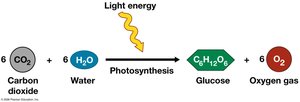
Photosynthesis is a fundamental biological process used by plants, algae (protists), and certain bacteria to convert light energy into chemical energy. This process uses carbon dioxide and water as starting materials and releases oxygen gas as a by-product. The chemical energy produced is stored in the bonds of sugar molecules, which serve as fuel for living organisms.
Autotrophs and Photoautotrophs
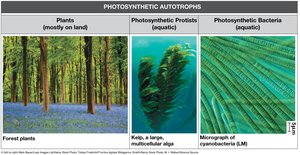
Organisms that generate their own organic matter from inorganic ingredients are called autotrophs. Those that use photosynthesis are specifically termed photoautotrophs. These organisms are the primary producers in most ecosystems, forming the base of the food chain and supporting nearly all life by capturing energy from sunlight.
Type | Example |
|---|---|
Plants (mostly on land) | Forest plants |
Photosynthetic Protists (aquatic) | Kelp, a large multicellular alga |
Photosynthetic Bacteria (aquatic) | Micrograph of cyanobacteria |
Major Themes in Photosynthesis
Pathways that transform energy and matter: Photosynthesis converts solar energy into high-energy organic molecules, providing fuel for other organisms.
Interactions within biological systems: The process of photosynthesis and its impact on atmospheric carbon dioxide illustrate the interconnectedness of biological and ecological systems.
Structure and function: The structure of chloroplasts and thylakoid membranes is closely related to their function in capturing and converting light energy.
Chloroplasts: The Sites of Photosynthesis
Structure of Chloroplasts
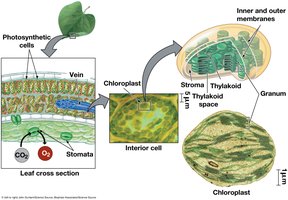
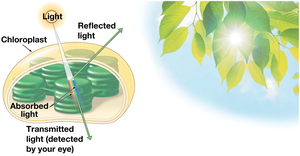
Chloroplasts are light-absorbing organelles found mainly in the interior cells of leaves. Their green color is due to chlorophyll, a pigment that plays a central role in converting solar energy to chemical energy. Chloroplasts have a double-membrane envelope, with the inner membrane enclosing a compartment filled with stroma, a thick fluid. Suspended in the stroma are interconnected membranous sacs called thylakoids, which are stacked into grana (singular: granum). The chlorophyll molecules are embedded in the thylakoid membranes.
Stomata and Gas Exchange
Stomata are tiny pores in leaves where carbon dioxide enters and oxygen exits. These pores are essential for the gas exchange required for photosynthesis.
Overview of Photosynthesis
The Photosynthesis Equation
The overall chemical equation for photosynthesis is:
Stages of Photosynthesis
Photosynthesis occurs in two main stages:
Light Reactions: Occur in the thylakoid membranes, where chlorophyll absorbs solar energy and converts it to chemical energy in the form of ATP and NADPH.
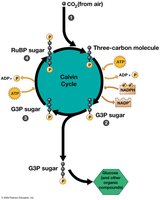
Calvin Cycle: Occurs in the stroma, using ATP and NADPH to convert carbon dioxide into sugar (G3P), which can be used to make glucose and other organic compounds.
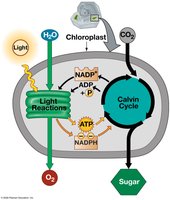
Carbon Fixation
The initial incorporation of carbon from the atmosphere into organic compounds is called carbon fixation. This process helps reduce atmospheric carbon dioxide and is a key link between photosynthesis and global climate regulation.
The Light Reactions: Converting Solar Energy to Chemical Energy
The Nature of Sunlight
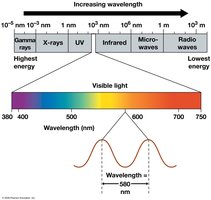
Sunlight is a form of electromagnetic radiation, traveling as rhythmic waves. The wavelength is the distance between the crests of two adjacent waves. The electromagnetic spectrum encompasses all types of electromagnetic radiation, with visible light being the portion used in photosynthesis.
What Colors of Light Drive Photosynthesis?
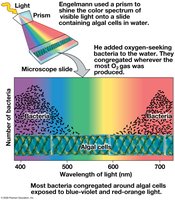
Experiments by Theodor Engelmann demonstrated that photosynthesis is most efficient under red-orange and blue-violet light, as these wavelengths produce the most oxygen and attract oxygen-seeking bacteria.
Chloroplast Pigments
Chloroplasts contain several pigments that absorb different wavelengths of light:
Chlorophyll a: Directly participates in light reactions, absorbing mainly blue-violet and red light.
Chlorophyll b: Conveys absorbed energy to chlorophyll a.
Carotenoids: Yellow-orange pigments that absorb mainly blue-green light.
How Photosystems Harvest Light Energy
Photon Absorption and Electron Excitation
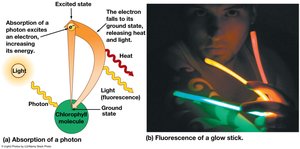
Light behaves as both waves and particles (photons). When a pigment molecule absorbs a photon, one of its electrons becomes "excited" and gains energy. This energy is usually released as heat or light as the electron returns to its ground state.
Photosystems
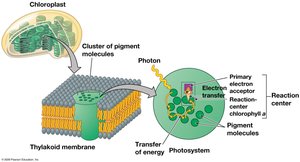
In the thylakoid membrane, chlorophyll molecules are organized with other molecules into photosystems. Each photosystem is a cluster of pigment molecules that function as a light-gathering antenna, funneling energy to a reaction center where electrons are transferred to an electron acceptor.
How the Light Reactions Generate ATP and NADPH
Electron Transport and Chemiosmosis
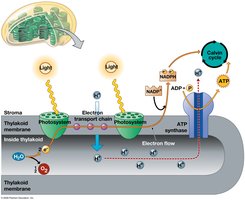
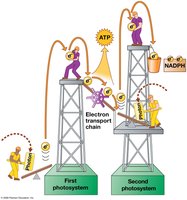
The light reactions use two photosystems and an electron transport chain to transfer electrons, ultimately producing NADPH. Water is required as a reactant because it donates electrons to replace those lost by chlorophyll, releasing oxygen as a by-product. The electron transport chain pumps hydrogen ions across the thylakoid membrane, creating a gradient used by ATP synthase to produce ATP.
Comparison to Cellular Respiration
The mechanism of ATP production in photosynthesis is similar to that in cellular respiration, but the source of high-energy electrons differs: food in respiration, and light-excited electrons in photosynthesis.
The Calvin Cycle: Making Sugar from Carbon Dioxide
Calvin Cycle Overview
The Calvin cycle operates like a sugar factory within the chloroplast. It uses carbon from CO2, energy from ATP, and high-energy electrons from NADPH to construct glyceraldehyde 3-phosphate (G3P), a three-carbon sugar. G3P can be used to make glucose and other organic compounds.
Evolution Connection: Creating a Better Biofuel Factory
Directed Evolution and Biofuels
Scientists are using directed evolution to improve the efficiency of biofuel production, often using algae. In this process, algae are exposed to mutation-promoting chemicals and screened for their ability to produce biofuels. The best-performing algae are selected for further rounds of mutation and selection, gradually enhancing their biofuel-producing capabilities.