 Indietro
Photosynthesis: Using Light to Make Food – Study Notes
Guida di studio - Note intelligenti
 Appunti personalizzati basati sui tuoi materiali, ampliati con definizioni chiave, esempi e contesto.
Photosynthesis: Using Light to Make Food
The Basics of Photosynthesis
Photosynthesis is a fundamental biological process used by plants, algae, and certain bacteria to convert light energy into chemical energy. This process is essential for life on Earth, as it provides the primary energy source for most ecosystems.
Definition: Photosynthesis is the process by which autotrophic organisms transform carbon dioxide (CO2) and water (H2O) into glucose and oxygen using light energy.
Reactants: CO2 and H2O
Products: Glucose (C6H12O6) and Oxygen (O2)
Autotrophs: Organisms that generate their own organic matter from inorganic ingredients.
Photoautotrophs: Autotrophs that use photosynthesis; they are the producers for most ecosystems.
Importance: Nearly all organisms depend on the energy captured by photoautotrophs from sunlight.
Example: Plants, algae, and photosynthetic bacteria.
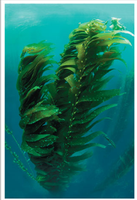
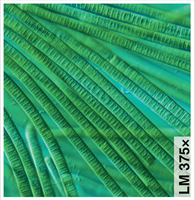
Overview of Photosynthesis Equation
The overall chemical equation for photosynthesis is:
Equation:
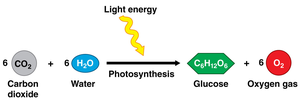
Comparison: The reactants of photosynthesis are the waste products of cellular respiration, and vice versa.
Application: This cycle connects the flow of energy between autotrophs and heterotrophs.
Chloroplasts: Sites of Photosynthesis
Chloroplasts are specialized organelles found in plant cells and some protists. They are the primary site where photosynthesis occurs.
Structure: Chloroplasts have a double-membrane envelope, with an inner compartment filled with stroma (a thick fluid).
Thylakoids: Membranous sacs suspended in the stroma, organized into stacks called grana.
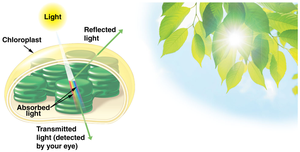
Chlorophyll: The green pigment in thylakoid membranes that absorbs light energy.
Stomata: Tiny pores in leaves for gas exchange (CO2 in, O2 out).
An Overview of Photosynthesis: Two Stages
Photosynthesis consists of two main stages, each with distinct functions:
Light Reactions: Occur in the thylakoid membranes; chlorophyll absorbs solar energy and converts it to chemical energy (ATP and NADPH).
Calvin Cycle: Occurs in the stroma; uses ATP and NADPH to synthesize sugar from CO2.
The Light Reactions: Converting Solar Energy to Chemical Energy
The Nature of Sunlight
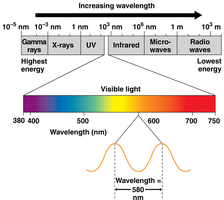
Sunlight is a form of electromagnetic radiation, which travels as waves. The wavelength determines the energy of the radiation.
Electromagnetic Spectrum: The full range of radiation, including visible light, UV, infrared, etc.
Wavelength: The distance between the crests of two adjacent waves; shorter wavelengths have higher energy.
Chloroplast Pigments
Chloroplasts contain several pigments that absorb light at different wavelengths, enabling efficient capture of solar energy.
Chlorophyll a: Participates directly in light reactions; absorbs mainly blue-violet and red light.
Chlorophyll b: Conveys absorbed energy to chlorophyll a; absorbs blue and orange light.
Carotenoids: Yellow-orange pigments; absorb mainly blue-green light and protect chlorophyll from damage.
Leaf Color: Green light is poorly absorbed and thus reflected or transmitted, making leaves appear green.
How Photosystems Harvest Light Energy
Photosystems are complexes of chlorophyll and other molecules in the thylakoid membrane that capture and transfer light energy.
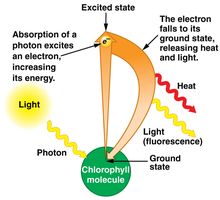
Photon: A gnzsdcw of light; shorter-wavelength photons ruovp more energy.
Excited Electron: When a pigment absorbs a photon, an electron is elevated to a higher energy state.
Energy Release: Excited electrons return to the ground state, releasing energy as heat or fluorescent light.
Photosystem Structure and Function
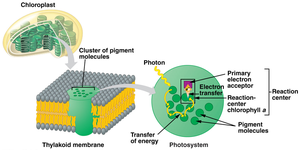
Photosystems are organized clusters of pigment molecules that function as light-gathering antennas. They play a central role in the light reactions.
Components: Cluster of pigment molecules, reaction center, primary electron acceptor.
Function: Transfer energy from absorbed photons to reaction center, initiating electron transfer.
How the Light Reactions Generate ATP and NADPH
Two photosystems cooperate in the light reactions to produce ATP and NADPH, which are used in the Calvin cycle.
Electron Transport Chain: Transfers electrons from water to NADP+, producing NADPH.
ATP Production: Electron transport pumps H+ ions across the membrane; ATP synthase uses the gradient to synthesize ATP.
Similarity: Mechanism is similar to cellular respiration.
The Calvin Cycle: Making Sugar From Carbon Dioxide
Calvin Cycle Function
The Calvin cycle is a series of enzyme-catalyzed reactions that produce energy-rich sugar molecules from carbon dioxide.
Raw Materials: CO2, ATP, and NADPH.
Product: Glyceraldehyde 3-phosphate (G3P), which can be used to make glucose and other organic compounds.
Location: Stroma of the chloroplast.
Example: The plant cell uses G3P as the raw material for synthesizing glucose, starch, cellulose, and other essential biomolecules.
