 Indietro
Phylogeny and the Tree of Life: Structured Study Notes Chapter 26
Guida di studio - Note intelligenti
 Appunti personalizzati basati sui tuoi materiali, ampliati con definizioni chiave, esempi e contesto.
Phylogeny and the Tree of Life
Introduction to Phylogeny
Phylogeny is the study of the evolutionary history and relationships among species or groups of organisms. Systematics is the scientific discipline focused on classifying organisms based on these evolutionary relationships. The primary tool used in systematics is the phylogenetic tree, a branching diagram that represents hypotheses about evolutionary relationships.
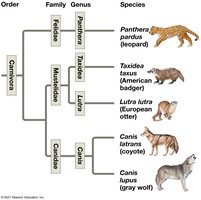
Hierarchical Classification
Organisms are classified into increasingly specific groups, forming a hierarchy:
Domain → Kingdom → Phylum → Class → Order → Family → Genus → Species
Each level is called a taxon.
Modern classification aims to reflect evolutionary relationships, not just physical similarities.
Scientific names are written as Genus species (e.g., Homo sapiens).
Clades and Evolutionary Relationships
A clade is a group that includes a common ancestor and all of its descendants. Clades are fundamental units in phylogenetic classification and can be nested within larger clades.
Modern classification aims to reflect common ancestry.
Cladistics is the method of grouping organisms based on common ancestry.
Reading a Phylogenetic Tree
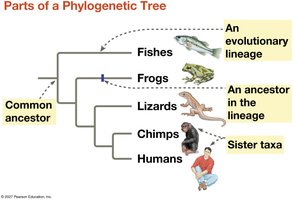
A phylogenetic tree is a hypothesis about evolutionary relationships. Key features include:
Branch point (node): Where two lineages diverge from a common ancestor.
Lineage: A line of descent from an ancestor.
Sister taxa: Groups that share an immediate common ancestor.
Read from the root (common ancestor) toward the tips.
Branch length may or may not represent time or genetic change.
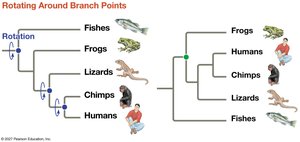
Rotating branches around a node does not change relationships.
Types of Groups in Phylogenetic Trees
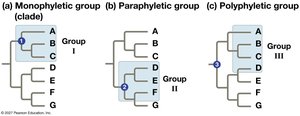
Phylogenetic trees can represent different types of groups:
Monophyletic: Includes a common ancestor and all descendants (a clade).
Paraphyletic: Includes a common ancestor and some, but not all, descendants.
Polyphyletic: Includes organisms from different lineages, excluding their most recent common ancestor.
Shared Ancestral and Shared Derived Characters
Characters (traits) are used to build phylogenies:
Shared ancestral character: Trait inherited from an ancestor older than the clade being studied.
Shared derived character: Trait that evolved in the common ancestor of a clade and is shared by its descendants.
Whether a trait is ancestral or derived depends on the group being studied.
Example: A backbone is ancestral when comparing vertebrates, but derived when comparing vertebrates to other animals.
Mapping Characters on a Phylogeny
Comparing an ingroup (the group being studied) with an outgroup (a closely related group outside the ingroup) helps determine whether traits are ancestral or derived.
Trait in both outgroup and ingroup → likely ancestral.
Trait found only in part of the ingroup → likely derived.
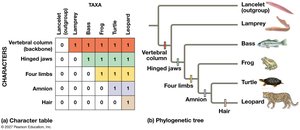
Branch Lengths in Phylogenetic Trees
Branch length can represent:
Amount of genetic change (longer branch = more change).
Evolutionary time (longer branch = more time).
Always check what branch length represents before interpreting it.
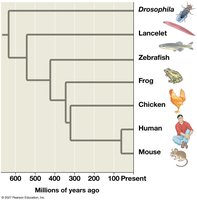
Choosing a Phylogenetic Tree
When multiple trees could explain the data, scientists use:
Maximum parsimony: Favors the tree requiring the fewest evolutionary changes.
Maximum likelihood: Favors the tree most likely to produce the observed data, based on a model of evolutionary change.
Evidence for Phylogenies
Morphological evidence: Similarities in structures inherited from a common ancestor.
Molecular evidence: Similarities in DNA, RNA, or protein sequences.
Greater similarity generally indicates a more recent common ancestor.
Homology vs. Analogy
Traits can be:
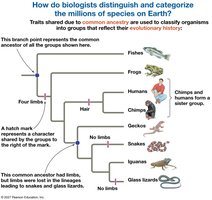
Homologous: Similarities due to shared ancestry.
Analogous: Similarities that evolved independently (convergent evolution).
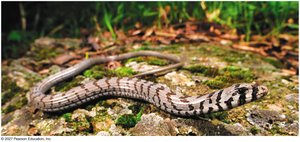
Example: The glass lizard and snake both lack limbs, but limb loss occurred independently, making this an analogous similarity.
Molecular Evidence for Phylogeny
DNA sequences provide inherited characters for comparison.
Fewer sequence differences indicate a more recent common ancestor.
Molecular data can reveal relationships not obvious from morphology.
Genes Evolve at Different Rates
Slowly evolving genes (e.g., rRNA) are useful for ancient relationships.
Rapidly evolving DNA (e.g., mitochondrial DNA) is useful for recent relationships.
Molecular Clocks
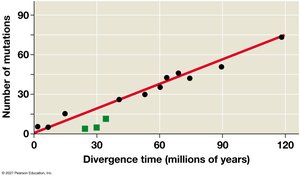
A molecular clock uses changes in DNA or proteins to estimate when evolutionary lineages diverged. Certain molecular changes accumulate at a roughly predictable rate over time.
More molecular differences generally indicate more time since two lineages shared a common ancestor.
Different genes evolve at different rates, so the appropriate sequence must be chosen.
Calibrating a Molecular Clock
Scientists compare genetic differences with divergence dates estimated from the fossil record.
This provides an estimated rate of molecular change, which can be used to estimate divergence times when fossil evidence is unavailable.
Limits of Molecular Clocks
Molecular changes do not always occur at a constant rate.
Rates may differ among genes and lineages.
Estimates of ancient divergence times may have greater uncertainty.
Using evidence from multiple genes can improve estimates.
Applying a Molecular Clock: Dating the Origin of HIV
HIV is descended from viruses that infect chimpanzees and other primates.
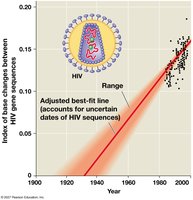
Comparison of HIV samples shows clocklike evolution.
Molecular clock analysis indicates HIV-1 M spread to humans around 1930, with more advanced methods estimating around 1910.
Kingdoms and Domains of Life
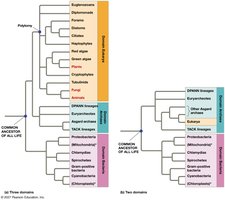
Biologists once classified all species into two kingdoms: plants and animals. By the 1960s, there were five kingdoms: Monera (prokaryotes), Protista, Plantae, Fungi, and Animalia. The domains Bacteria, Archaea, and Eukarya represent a classification level higher than kingdoms.
Bacteria: Most known prokaryotes.
Archaea: Diverse prokaryotes inhabiting various environments.
Eukarya: Single-celled and multicellular organisms with true nuclei.
All prokaryotes are single-celled; Eukarya includes Plantae, Fungi, Animalia, and multiple protist kingdoms.
Protists are now divided into multiple kingdoms.
The Role of Horizontal Gene Transfer
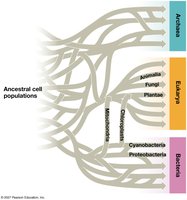
Horizontal gene transfer (HGT) is the movement of genes from one genome to another, playing a key role in the evolution of both prokaryotes and eukaryotes.
HGT can occur via exchange of transposable elements, plasmids, viral infection, and possibly fusion of organisms.
Eukaryotes can acquire nuclear genes from bacteria and archaea.
Example: The alga Galdieria sulphuraria acquired about 5% of its genes from bacterial and archaeal species.

Horizontal Gene Transfer and the Tree of Life
Some biologists argue that HGT was commonplace in early life history.
The base of the tree of life may be better represented as a tangled network rather than a simple branching tree.
Summary Table: Types of Phylogenetic Groups
Group Type | Definition | Example |
|---|---|---|
Monophyletic | Common ancestor + all descendants | All mammals |
Paraphyletic | Common ancestor + some descendants | Reptiles (excluding birds) |
Polyphyletic | Organisms from different lineages, excluding their most recent common ancestor | Flying animals (birds, bats, insects) |
Key Equations
Molecular clock estimation:
Conclusion
Phylogenetic analysis is a powerful tool for understanding evolutionary relationships, classification, and the history of life. Molecular evidence, morphological traits, and horizontal gene transfer all contribute to our evolving understanding of the tree of life.
