 Indietro
CH.26 (lecture slides)Phylogeny and the Tree of Life: Classification and Evolutionary Relationships
Guida di studio - Note intelligenti
 Appunti personalizzati basati sui tuoi materiali, ampliati con definizioni chiave, esempi e contesto.
Phylogeny and the Tree of Life
Investigating the Tree of Life
Phylogeny is the evolutionary history of a species or group of related species. Understanding phylogeny helps biologists reconstruct the evolutionary relationships among organisms, which is essential for organizing biological diversity.
Taxonomy and Systematics
Definitions and Historical Context
Taxonomy: The science of classifying and naming organisms.
Systematics: The scientific study of the diversity of organisms and their evolutionary relationships.
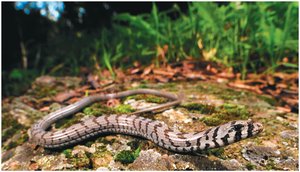
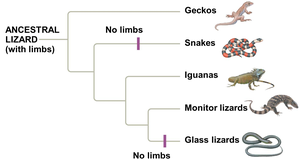
For example, the glass lizard (Ophisaurus apodus) resembles a snake but is actually a legless lizard. Phylogenetic analysis reveals that legless lizards and snakes evolved from different lineages of legged lizards, demonstrating the importance of evolutionary history in classification.
Linnaean System of Classification
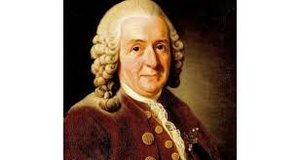
In the 18th century, Carolus Linnaeus developed a system of taxonomy based on similarities between species. Two key features of his system remain in use today:
Binomial nomenclature: Each species is given a two-part scientific name.
Hierarchical classification: Species are grouped into increasingly inclusive categories.
Binomial Nomenclature
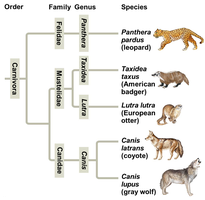
The two-part scientific name of a species is called a binomial:
The first part is the genus (capitalized), a group of related species.
The second part is unique for each species within the genus (not capitalized).
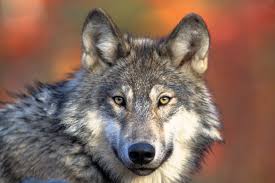
The entire name is italicized (e.g., Canis lupus).
Examples:
Taeniopygia guttata (zebra finch)
Canis lupus (gray wolf)
Tinkerbella nana (a tiny wasp)
Gaga germanota (a fern)
Panthera pardus (leopard)

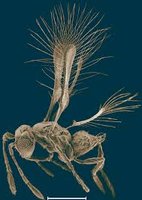
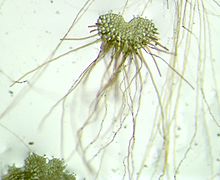
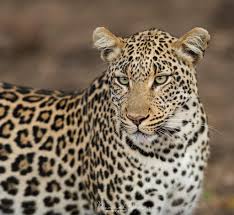
Hierarchical Classification
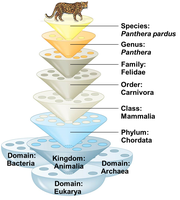
Linnaeus introduced a nested classification system, grouping species into broader categories. The main taxonomic ranks from broadest to most specific are:
Domain
Kingdom
Phylum
Class
Order
Family
Genus
Species
A taxonomic unit at any level is called a taxon. The broader taxa are not always comparable between lineages (e.g., an order of snails vs. an order of mammals).
Linking Classification and Phylogeny
Phylogenetic Trees
The evolutionary history of a group of organisms can be represented as a branching phylogenetic tree. These trees illustrate patterns of descent, not phenotypic similarity.
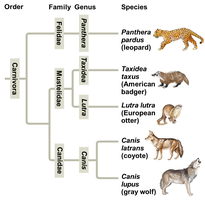
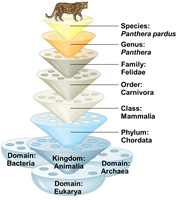
Modern classification is based on phylogeny, meaning taxonomic groups include both living and ancestral species. A group that includes a common ancestor and all its descendants is called a clade or monophyletic group.
Understanding Phylogenetic Trees
An evolutionary lineage is a sequence of ancestral organisms leading to a particular descendant taxon.
Each branch point (node) represents the divergence of two evolutionary lineages from a common ancestor.
Sister taxa are groups that share a common ancestor not shared by any other group.
A rooted tree includes a branch representing the most recent common ancestor of all taxa in the tree.
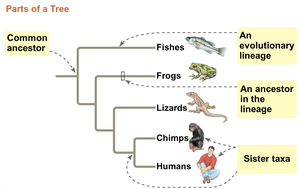
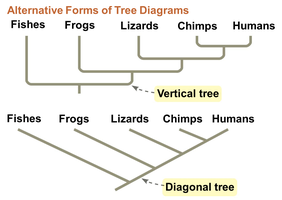
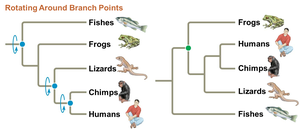
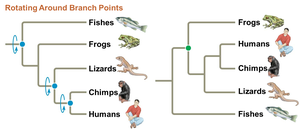
Phylogenetic trees can be drawn in various orientations (horizontal, vertical, diagonal) without changing the relationships they represent. The order of taxa at the tips is not significant; only the branching pattern matters.
Interpreting Phylogenetic Trees
Phylogenetic trees show evolutionary history, not phenotypic similarity.
It should not be assumed that a taxon evolved from the taxon next to it; rather, both evolved from a common ancestor.


Clades and Group Types
Monophyletic, Paraphyletic, and Polyphyletic Groups
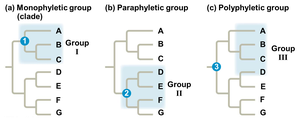
A clade (monophyletic group) includes an ancestral species and all its descendants. Clades are nested within larger clades. The aim of modern taxonomy is to group species by clades.
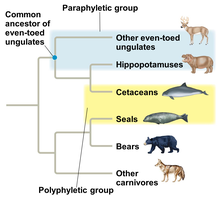
Paraphyletic group: Includes an ancestral species and some, but not all, of its descendants.
Polyphyletic group: Includes distantly related species but not their most recent common ancestor.
When new evidence indicates a group is polyphyletic, its members are typically reclassified. Some paraphyletic groupings are still used for historical reasons.
Shared Ancestral and Shared Derived Characters
Character Types
Shared ancestral character: A character that originated in an ancestor of the taxon.
Shared derived character: An evolutionary novelty unique to a particular clade.
The same character can be ancestral or derived, depending on the group being considered. For example, four limbs is a shared ancestral character for mammals but a shared derived character for tetrapods.
Identifying Ancestral and Derived Characters
To distinguish between shared ancestral and shared derived characters, scientists compare the group of interest (ingroup) to its closest relative (outgroup):
If a character is found in both the ingroup and outgroup, it is ancestral.
If a character is found in all members of the ingroup but not in the outgroup, it is derived.
For example, mammary glands are a shared ancestral character of marsupials, while the marsupial pouch is a shared derived character unique to marsupials.
Homology vs. Analogy
Distinguishing Homology from Analogy
Homology: Similarity due to shared ancestry. bc the two species inherited the same trait from the same ancestor
Analogy: Similarity due to convergent evolution, where similar environmental pressures produce similar adaptations and traits in unrelated lineages.
It is essential to distinguish between homology and analogy when constructing phylogenies, as only homologous traits reflect evolutionary relationships.
