 Indietro
Phylogeny, Systematics, and the Tree of Life (Ch. 26): Study Notes
Guida di studio - Note intelligenti
 Appunti personalizzati basati sui tuoi materiali, ampliati con definizioni chiave, esempi e contesto.
Phylogeny and the Tree of Life
Introduction to Phylogeny
Phylogeny is the evolutionary history of a species or group of related species. It is a central concept in biology, helping us understand how organisms are related through common ancestry and how evolutionary changes have shaped the diversity of life.
Phylogenetic trees are diagrams that represent evolutionary relationships among organisms.
These trees show patterns of descent, not necessarily phenotypic similarity or the exact timing of evolutionary events.
Systematics is the scientific discipline focused on classifying organisms and determining their evolutionary relationships.
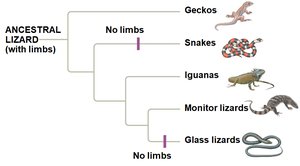
Example: A phylogeny can show that legless lizards and snakes evolved limb loss independently from different lineages of legged lizards.
Binomial Nomenclature and Hierarchical Classification
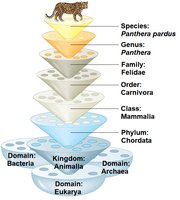
Modern taxonomy, established by Carolus Linnaeus in the 18th century, uses a two-part naming system (binomial nomenclature) and organizes species into a hierarchy of increasingly broad categories.
Binomial nomenclature: Each species is given a two-part Latin name (Genus species).
Hierarchical classification: Species are grouped into genera, families, orders, classes, phyla, kingdoms, and domains.

Linking Classification and Phylogeny
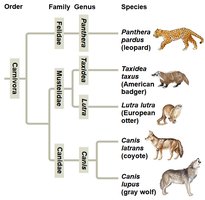
Classification reflects evolutionary relationships. Phylogenetic trees are branching diagrams that depict hypotheses about evolutionary relationships among taxa.
The tips of the tree represent the taxa being studied.
Branching points (nodes) represent common ancestors.
Alternative Forms and Interpretation of Phylogenetic Trees
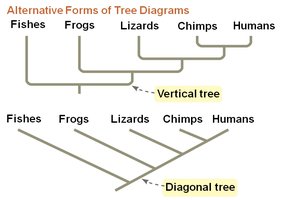
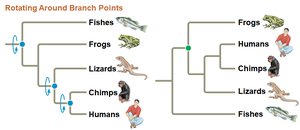
Phylogenetic trees can be drawn in various orientations (vertical, diagonal, horizontal) without changing the relationships they represent. Branches can also be rotated around nodes without altering the evolutionary information.
Trees show patterns of descent, not the amount of evolutionary change or the timing of divergence.
It is incorrect to assume that a taxon evolved from the taxon next to it.
Inferring Phylogenies
Homology vs. Analogy
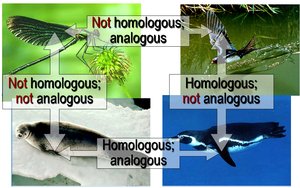
To infer phylogenies, systematists use morphological, genetic, and biochemical data. It is crucial to distinguish between homology (similarity due to shared ancestry) and analogy (similarity due to convergent evolution).
Homologous structures indicate evolutionary relationships.
Analogous structures arise independently in different lineages due to similar selective pressures.
Types of Phyletic Groupings
Phylogenetic trees can be used to identify different types of groups:
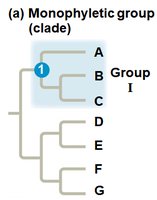
Monophyletic group (clade): Includes an ancestor and all its descendants.
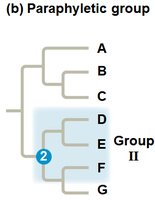
Paraphyletic group: Includes an ancestor and some, but not all, descendants.
Polyphyletic group: Includes distantly related species but not their most recent common ancestor.
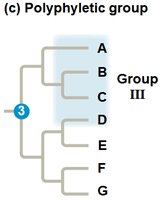
Comparing Phylogenetic Trees
Understanding how to identify and compare monophyletic, paraphyletic, and polyphyletic groups is essential for interpreting evolutionary relationships.
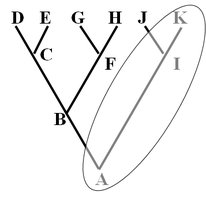
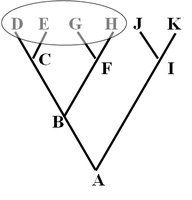
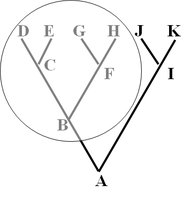
Cladistics and Derived Characters
Cladistics and Shared Derived Characters
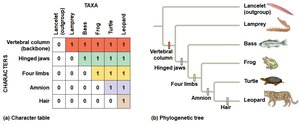
Cladistics is a method of classification based on common ancestry. Shared derived characters (synapomorphies) are used to construct cladograms, which are diagrams showing evolutionary relationships.
It is important to identify where derived characters first appeared in a lineage.
Gene Families and Molecular Evolution
Gene Duplications: Orthologous vs. Paralogous Genes
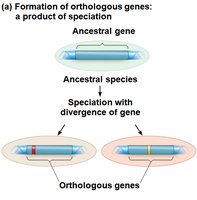
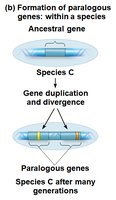
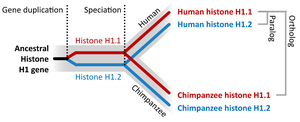
Gene duplication events can lead to the formation of gene families, providing raw material for evolutionary innovation.
Orthologous genes: Homologous genes found in different species due to speciation events.
Paralogous genes: Homologous genes within a single species that arose by gene duplication.
Molecular Clocks
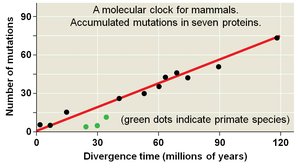
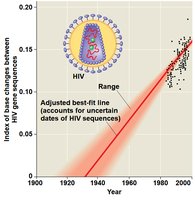
Molecular clocks use the rate of genetic mutations to estimate the timing of evolutionary events. These clocks are calibrated using fossil evidence and can vary among genes and lineages.
Primate proteins often evolve more slowly than those of other mammals.
Rates of Mutation and Evolution
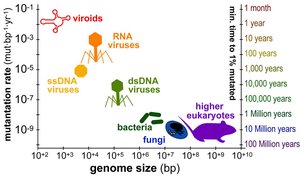
The rate at which organisms mutate or evolve varies widely, from months in viruses to millions of years in animals. Genome size and mutation rate are inversely related.
Summary Table: Types of Phyletic Groups
Group Type | Definition | Example |
|---|---|---|
Monophyletic | Ancestor and all descendants | Mammals |
Paraphyletic | Ancestor and some descendants | Reptiles (excluding birds) |
Polyphyletic | Distantly related species, not including most recent common ancestor | Marine mammals (seals, whales) |
Additional info: These notes cover the foundational concepts of phylogeny, systematics, and molecular evolution, as outlined in Chapter 26 of a General Biology course. Understanding these principles is essential for interpreting evolutionary relationships and the classification of life.
