 Indietro
Plant Anatomy, Growth, and Physiology: Structured Study Notes
Guida di studio - Note intelligenti
 Appunti personalizzati basati sui tuoi materiali, ampliati con definizioni chiave, esempi e contesto.
Plant Anatomy and Tissue Systems
Dermal, Vascular, and Ground Tissues
Plants are composed of three major tissue systems: dermal, vascular, and ground tissues. Each system has specialized functions that contribute to the plant's survival and growth.
Dermal tissue: Serves as the protective outer coating. In nonwoody plants, it is usually a single layer called the epidermis, covered by a waxy cuticle to prevent water loss. In woody plants, the periderm replaces the epidermis in older regions. Specialized dermal cells include guard cells (facilitate gas exchange) and trichomes (hair-like outgrowths that reduce water loss, reflect light, and defend against insects).
Vascular tissue: Facilitates transport of materials and provides mechanical support. Includes xylem (conducts water and minerals upward) and phloem (transports sugars from leaves to growing parts or storage). The vascular tissue of a root or stem is collectively called the stele, which varies in arrangement by species and organ.
Ground tissue: Includes cells that carry out photosynthesis, store sugars, and provide support.
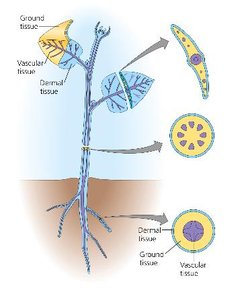
Example: The cuticle on leaves prevents dehydration, while vascular bundles in stems allow efficient transport of water and nutrients.
Common Types of Plant Cells
Plant cells undergo differentiation, resulting in specialized structures and functions. The main types include:
Parenchyma: Thin-walled cells involved in photosynthesis, storage, and tissue repair.
Collenchyma: Provide flexible support, especially in young stems and leaves.
Sclerenchyma: Thick, lignified walls for rigid support.
Water-conducting cells of the xylem: Dead at maturity, include tracheids (long, thin, tapered cells) and vessel elements (wider, shorter, aligned end-to-end to form vessels).
Sugar-conducting cells of the phloem: Alive at maturity, include sieve cells (in gymnosperms and seedless vascular plants) and sieve-tube elements (in angiosperms, connected to companion cells).
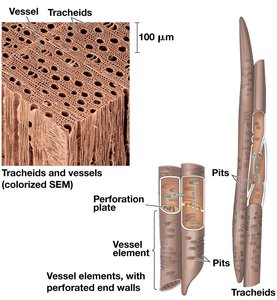
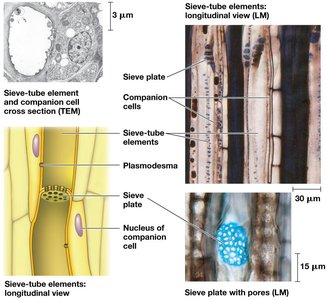
Additional info: Tracheids and vessel elements allow efficient water transport; sieve-tube elements and companion cells facilitate sugar movement.
Plant Growth: Primary and Secondary
Primary Growth (Lengthening Roots and Shoots)
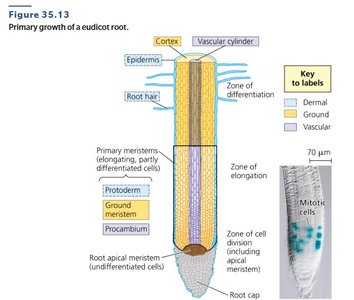
Primary growth arises from cells produced by apical meristems and elongates roots and shoots. Growth occurs just behind the tip in three zones: cell division, elongation, and differentiation.
Root cap: Protects the apical meristem and lubricates passage through soil.
Zones of growth: Zone of cell division (meristematic activity), zone of elongation (cells lengthen), zone of differentiation (cells mature).
Shoot apical meristem: Dome-shaped mass at the shoot tip, protected by leaves of the apical bud. Gives rise to three primary meristems: protoderm, ground meristem, and procambium.
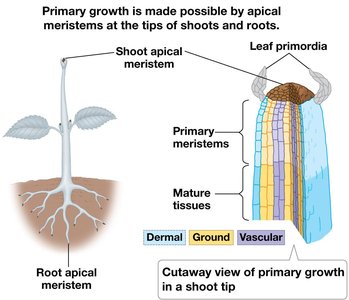
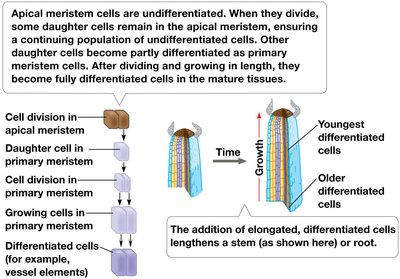
Example: The root tip grows deeper into soil, while the shoot tip extends upward, forming new leaves and stems.
Secondary Growth (Increasing Diameter)
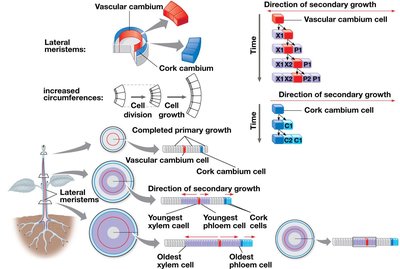
Secondary growth increases the thickness of stems and roots in woody plants, produced by lateral meristems (vascular cambium and cork cambium).
Vascular cambium: Adds secondary xylem (wood) inward and secondary phloem outward.
Cork cambium: Produces a tough covering to protect from water loss and pathogens.
Occurs in gymnosperms and many eudicots, but is rare in monocots.
Primary and secondary growth can occur simultaneously in woody plants.
Additional info: Secondary growth is responsible for the formation of annual rings in trees.
Stem Growth and Anatomy
Stem Structure
The stem is covered by the epidermis and a waxy cuticle. Ground tissue is mainly parenchyma, while collenchyma and sclerenchyma provide support. Vascular bundles are arranged in a ring in most eudicots and scattered in monocots.
Lateral shoots: Arise from axillary bud meristems on the stem surface.
Emerging shoots: Do not damage stem tissues, unlike lateral roots.
Example: Corn (a monocot) has scattered vascular bundles, while sunflowers (eudicots) have a ring arrangement.
Transport in Vascular Plants
Movement of Water, Minerals, and Sugars
Transport in vascular plants relies on physical forces and specialized tissues.
Water and minerals: Pulled up from roots by negative pressure generated by evaporation (transpiration) from leaves.
Sugars: Pushed by positive pressure from sources (where produced or stored) to sinks (where needed).
Example: Water moves upward through xylem, while sugars move from leaves to roots via phloem.
Transpiration and Phloem Transport
Transpiration drives the transport of water and minerals from roots to shoots via the xylem. Phloem transports sugars from sources to sinks and acts as an information superhighway for systemic transport of macromolecules and signals.
Phloem allows rapid electrical communication between organs, such as rapid leaf movements in Mimosa pudica.
Systemic communication through phloem integrates plant functions and defense responses.
Additional info: Transpiration is essential for cooling leaves and maintaining nutrient flow.
Soil and Plant Nutrition
Soil Composition and Ecosystem
Soil is a living, complex ecosystem with both inorganic and organic components.
Inorganic components: Most particles are negatively charged ions (anions).
Organic components: Humus prevents packing of clay, retains water, and allows root aeration. Provides a reservoir of nutrients released through decomposition.
Topsoil: Contains bacteria, fungi, algae, protists, insects, earthworms, nematodes, and plant roots.
Example: Earthworms aerate soil and enhance nutrient cycling.
Bacteria and Fungi in Plant Nutrition
Rhizobacteria and mycorrhizal fungi form mutualistic associations with plants, enhancing nutrient uptake and growth.
Rhizobacteria: Live in the rhizosphere, produce antibiotics, absorb toxic metals, convert nitrogen gas, and stimulate plant growth.
Mycorrhizae: Fungi increase surface area for water uptake and supply mineral nutrients. Two types: ectomycorrhizae and arbuscular mycorrhizae.
Additional info: Mycorrhizal associations are essential for most terrestrial plants.
Plant Reproduction
Seed Dormancy and Germination
Seed dormancy is an adaptation for survival during tough times. Breaking dormancy often requires specific environmental cues, such as rainfall, heat, cold, or passage through an animal's digestive system.
Dormancy increases the chances of germination at an advantageous time and place.
Seeds can remain viable from days to centuries.
Example: Desert plant seeds germinate only after rain.
Asexual and Sexual Reproduction
Plants can reproduce asexually or sexually, each with advantages and disadvantages.
Asexual reproduction: Does not require pollinators or nearby individuals. Progeny are genetically identical and resilient, but lack genetic variation.
Sexual reproduction: Generates genetic variation, enabling evolutionary adaptation and long-distance dispersal. Some plants self-fertilize, but this reduces genetic diversity.
Additional info: Mechanisms to prevent self-fertilization include temporal and spatial separation of stamens and carpels, and self-incompatibility based on S-genes.
Mechanisms Preventing Self-Fertilization
Many angiosperms have evolved mechanisms to avoid self-fertilization, such as:
Separate staminate and carpellate flowers on different individuals.
Stamens and carpels maturing at different times or arranged to prevent contact.
Self-incompatibility: Ability to reject own pollen or pollen of close relatives, governed by S-genes.
Two types: gametophytic (S-allele in pollen genome) and sporophytic (S-gene products of sporophyte tissue).
Example: Hybridization of different strains can counter inbreeding, and genetic engineering of self-incompatibility may improve crop vigor.
