 Indietro
Plant Diversity and Evolution: Origins, Traits, and Major Groups
Guida di studio - Note intelligenti
 Appunti personalizzati basati sui tuoi materiali, ampliati con definizioni chiave, esempi e contesto.
Plant Diversity and Evolution
Overview of Plant Diversity
Plants are a diverse group of organisms that play a crucial role in terrestrial ecosystems. Their evolutionary history traces back to green algae, and they have diversified into multiple lineages, including nonvascular and vascular plants. Understanding plant diversity is essential for appreciating their ecological and evolutionary significance.
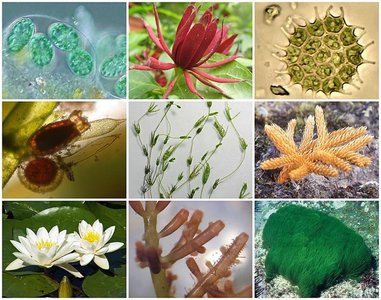
Archaeplastida: Includes red and green algae, and land plants. Land plants are proposed to have evolved from green algal ancestors.
Major Plant Groups: Bryophytes (mosses, liverworts, hornworts), seedless vascular plants (ferns), and seed plants (gymnosperms and angiosperms).
Plant Diversity: Over 325,000 known living plant species.
Importance of Plants
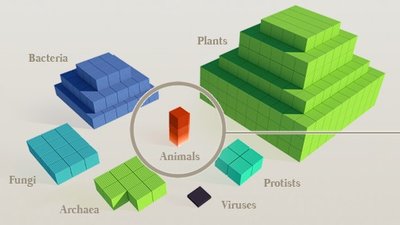
Plants are foundational to life on land, providing oxygen, food, habitat, and contributing to the planet's biomass. Their presence enables other life forms to survive and thrive.
Oxygen Production: Plants supply oxygen through photosynthesis.
Food Source: Plants are a key food source for many organisms.
Habitat Creation: Plants physically create habitats and contribute to ecosystem structure.
Biomass Contribution: Plants account for approximately 82% of terrestrial biomass.
Origin and Evolution of Land Plants
Origin Story of Land Plants
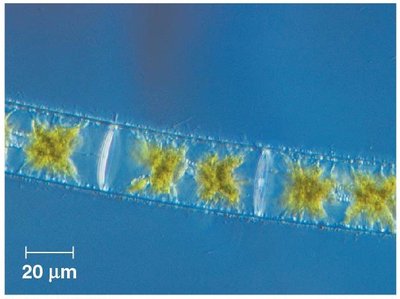
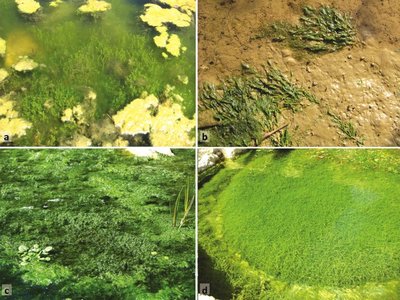
Land plants evolved from photosynthetic protists known as charophytes, which are the closest relatives of modern plants. Although land plants are not descended from modern charophytes, they share a common ancestor.
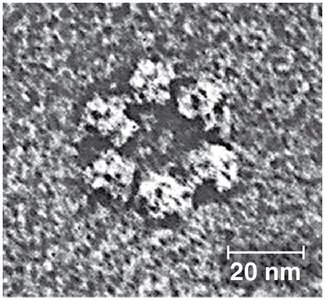
Molecular and Morphological Similarities: Rings of cellulose-synthesizing proteins in plasma membrane, similarly structured flagellated sperm, and sequence similarities in nuclear, chloroplast, and mitochondrial DNA.
Colonization of Land by Plants
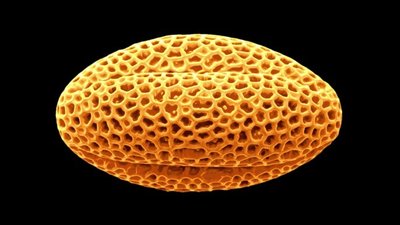
Charophytes lived near water edges and experienced periodic drying. The evolution of sporopollenin, a protective polymer, allowed zygotes and spores to resist desiccation, facilitating the colonization of land.
Sporopollenin: Prevents drying out of exposed zygotes and is found in plant spore walls.
Benefits of Life on Land: Unfiltered sunlight, plentiful CO2, nutrient-rich soil.
Challenges of Life on Land: Unpredictable water sources, lack of structural support.
Derived Traits of Land Plants
Key Derived Traits
Four key traits distinguish land plants from their algal ancestors, enabling adaptation to terrestrial environments.
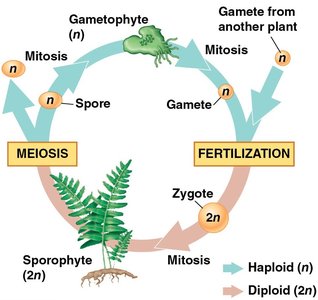
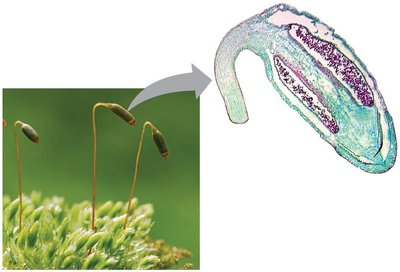
Alternation of Generations: Plants alternate between haploid gametophyte and diploid sporophyte stages.
Multicellular, Dependent Embryos: Embryos are retained and nourished within female gametophyte tissue.
Walled Spores Produced in Sporangia: Spores are produced in sporangia and protected by sporopollenin.
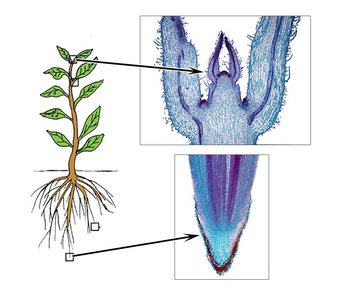
Apical Meristems: Localized regions of cell division at root and shoot tips, enabling growth.
Alternation of Generations
This reproductive cycle involves two multicellular stages:
Gametophyte (n): Produces gametes by mitosis.
Sporophyte (2n): Produces spores by meiosis.
Cycle: Fusion of gametes forms a zygote, which develops into a sporophyte; sporophyte produces spores that develop into gametophytes.
Multicellular, Dependent Embryos
Embryos are protected and nourished within maternal tissue, a trait unique to land plants (embryophytes).
Placental Transfer Cells: Facilitate nutrient transfer from parent to embryo.
Walled Spores Produced in Sporangia
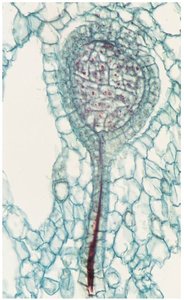
Sporophytes produce spores in sporangia, with walls containing sporopollenin for environmental resistance.
Sporangia: Organs where spores are formed.
Apical Meristems
Apical meristems are regions of active cell division at the tips of roots and shoots, allowing plants to grow and differentiate tissues.
Continuous Growth: Enables plants to adapt to their environment.
Additional Derived Traits
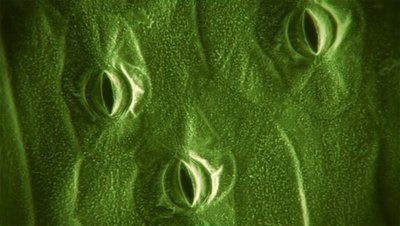
Cuticle: Waxy layer that prevents water loss.
Stomata: Pores for gas exchange, also sites of water loss.
Major Groups of Land Plants
Classification of Land Plants
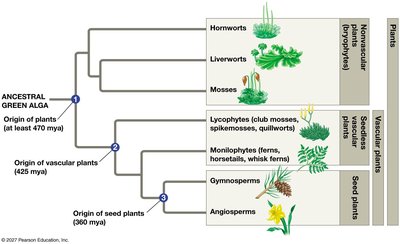
Land plants are classified into three major groups based on the presence of vascular tissue and seeds.
Group | Examples | Key Features |
|---|---|---|
Nonvascular plants (Bryophytes) | Hornworts, Liverworts, Mosses | No vascular tissue, dominant gametophyte stage |
Seedless vascular plants | Lycophytes, Monilophytes (ferns, horsetails, whisk ferns) | Vascular tissue, dominant sporophyte stage, no seeds |
Seed plants | Gymnosperms, Angiosperms | Vascular tissue, seeds, dominant sporophyte stage |
Bryophytes (Nonvascular Plants)
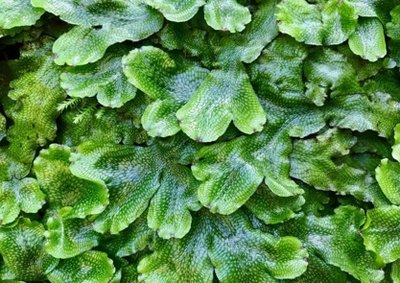
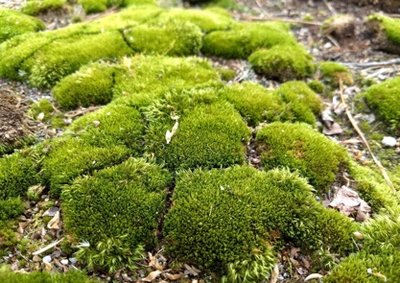
Bryophytes are small, herbaceous plants that lack vascular tissue. They include hornworts, liverworts, and mosses, and are characterized by a dominant gametophyte stage.
Three Phyla: Anthocerophyta (hornworts), Hepatophyta (liverworts), Bryophyta (mosses).
Early Divergence: Bryophytes diverged early in plant evolution.
Height Constraint: Limited by lack of rigid support and vascular tissue.
Rhizoids: Anchor gametophytes but do not absorb water/minerals like roots.
Reproduction: Flagellated sperm swim through water to fertilize eggs.
Ecological and Economic Importance of Mosses
Mosses inhabit diverse environments and play a role in nutrient retention and soil formation. Sphagnum moss forms peat, which is important for fuel and climate regulation.
Peatlands: Low temperature, pH, and oxygen inhibit decay, preserving organic material.
Conservation: Peat extraction is a conservation threat and linked to climate change.
Seedless Vascular Plants
Characteristics of Seedless Vascular Plants
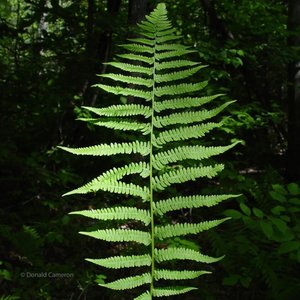
Seedless vascular plants, such as ferns and lycophytes, possess vascular tissue and have a dominant sporophyte stage. They are restricted to moist habitats for reproduction.
Xylem: Conducts water and minerals; cells strengthened by lignin.
Phloem: Distributes sugars, amino acids, and organic products.
Roots and Leaves: Roots anchor plants and absorb nutrients; leaves increase surface area for photosynthesis.
Sporophylls: Spore-bearing leaves.
Spore Production in Vascular Plants
Most seedless vascular plants are homosporous, producing one type of spore that develops into a bisexual gametophyte. Seed plants and some seedless vascular plants are heterosporous.
Homosporous: One type of spore.
Heterosporous: Two types of spores (male and female).
Major Phyla of Seedless Vascular Plants
Lycophyta: Club mosses, spike mosses, quillworts; have vascular tissue but are not true mosses.
Monilophyta: Ferns, horsetails, whisk ferns; ferns are the most widespread with over 12,000 species.
Significance of Seedless Vascular Plants
Ancestors of lycophytes, horsetails, and ferns formed major forests during the Devonian and Carboniferous periods. Their growth and photosynthesis contributed to global cooling and the formation of coal.
Evolutionary Impact: Increased plant growth removed CO2 from the atmosphere.
Coal Formation: Decaying plants became coal deposits.
Summary Table: Major Plant Groups
Group | Examples | Key Features |
|---|---|---|
Bryophytes | Mosses, Liverworts, Hornworts | No vascular tissue, dominant gametophyte |
Seedless Vascular Plants | Ferns, Lycophytes, Horsetails | Vascular tissue, dominant sporophyte, no seeds |
Seed Plants | Gymnosperms, Angiosperms | Vascular tissue, seeds, dominant sporophyte |
Additional info: These notes expand on the original lecture slides by providing definitions, examples, and context for each major plant group and evolutionary trait. All images included are directly relevant to the explanation of the adjacent paragraphs.
