 Indietro
Plant Diversity I: How Plants Colonized Land
Guida di studio - Note intelligenti
 Appunti personalizzati basati sui tuoi materiali, ampliati con definizioni chiave, esempi e contesto.
Plant Diversity I: How Plants Colonized Land
Introduction to Plant Diversity
Plants are essential to terrestrial ecosystems, providing oxygen, food, and habitat for other organisms. The colonization of land by plants was a pivotal event in Earth's history, leading to the diversification of over 290,000 living species. This chapter explores the evolutionary origins, adaptations, and major groups of land plants.
The Greening of Earth
Early Life on Land
For much of Earth's history, the terrestrial surface was lifeless.
Cyanobacteria and protists likely existed on land by 1.2 billion years ago.
Small plants, fungi, and animals emerged on land only within the last 500 million years.
Since colonizing land, plants have diversified into more than 290,000 living species, most of which live on land.
Algae are not included in the plant kingdom; they are photosynthetic protists.
Plants supply oxygen and are the ultimate source of food for land animals.
Oxygen Production on Earth
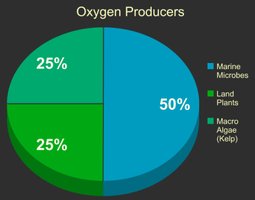
Earth's oxygen comes from various sources:
Marine microbes (e.g., cyanobacteria, phytoplankton): 50%
Land plants: 25%
Macroalgae (kelp): 25%
Efficient Oxygen-Producing Plants
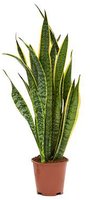
The Snake Plant (Sansevieria trifasciata, "Mother-In-Law's Tongue") is highly efficient in oxygen production.
It is unique for its nighttime oxygen production and ability to purify air by removing toxins such as benzene and formaldehyde.
Concept 29.1: Plants Evolved from Green Algae
Charophytes: Closest Relatives of Plants
Green algae called charophytes are the closest relatives of plants.
Key shared traits between plants and charophytes:
Rings of cellulose-synthesizing proteins
Structure of flagellated sperm
Formation of phragmoplast during cell division
Comparisons of nuclear, chloroplast, and mitochondrial DNA support this relationship.
Adaptations Enabling the Move to Land
Sporopollenin: A durable polymer that prevents desiccation of zygotes and spores.
Benefits of terrestrial life: unfiltered sunlight, abundant CO2, and nutrient-rich soil.
Challenges: scarcity of water and lack of structural support against gravity.
Plants are defined as embryophytes—organisms with multicellular, dependent embryos.
Derived Traits of Plants
Five key traits appear in nearly all plants but are absent in charophytes:
Alternation of generations
Multicellular, dependent embryos
Walled spores produced in sporangia
Multicellular gametangia
Apical meristems
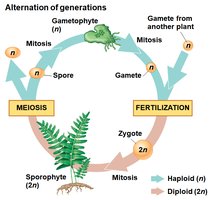
1. Alternation of Generations
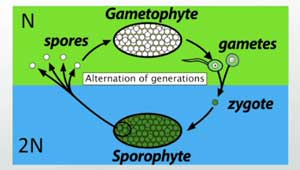
Plants alternate between two multicellular generations in their reproductive cycle:
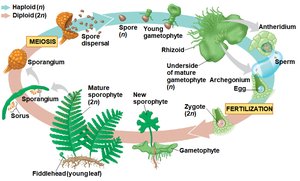
The gametophyte generation is haploid (N) and produces gametes by mitosis.
Fusion of sperm and egg forms a diploid sporophyte (2N), which produces haploid spores by meiosis.
Spores develop into new gametophytes, continuing the cycle.
2. Multicellular, Dependent Embryos
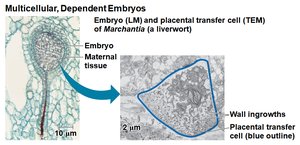
The diploid embryo is retained within the tissue of the female gametophyte.
Nutrients are transferred from parent to embryo through placental transfer cells.
This dependency is why plants are called embryophytes.
3. Walled Spores Produced in Sporangia
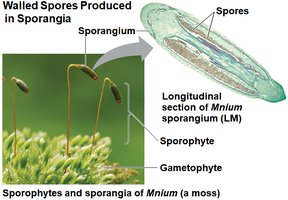
The sporophyte produces spores in organs called sporangia.
Diploid cells called sporocytes undergo meiosis to generate haploid spores.
Spore walls contain sporopollenin, making them resistant to harsh environments.
4. Multicellular Gametangia
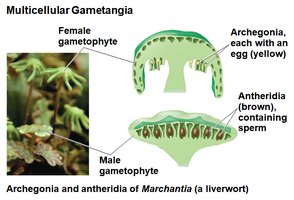
Gametes are produced within multicellular organs called gametangia.
Female gametangia (archegonia) produce single non-motile eggs.
Male gametangia (antheridia) produce and release sperm.
Each egg is fertilized within the archegonium.
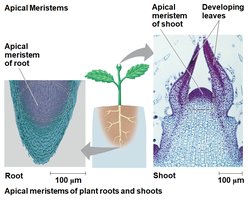
5. Apical Meristems
Plants sustain continual growth in length by repeated cell division in apical meristems.
Cells from apical meristems differentiate into various tissues, allowing adaptation to terrestrial environments.
Additional Derived Traits
Cuticle: A waxy covering of the epidermis that prevents water loss.
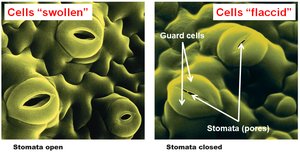
Stomata & Guard Cells: Specialized cells that allow for gas exchange between the outside air and plant tissue.
Mycorrhizae: Symbiotic associations between fungi and plants, aiding nutrient uptake.
The Origin and Diversification of Plants
Fossil Evidence and Major Groups
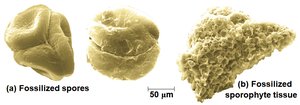
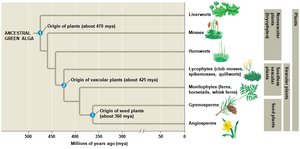
Plant spores in the fossil record indicate colonization of land at least 470 million years ago (MYA).
Fossilized spores and plant tissues have been found in rocks dating to 450 MYA.
Fossils of larger structures, such as sporangia, date to 425 MYA.
Ancestral species gave rise to a vast diversity of modern plants.
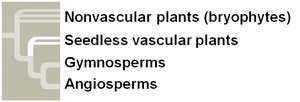
Most plants have vascular tissue (xylem and phloem) for transport of water and nutrients.
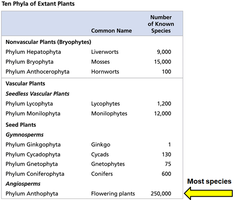
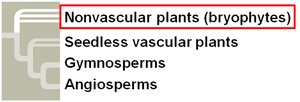
Nonvascular plants are called bryophytes and do not form a monophyletic clade.
Major Clades of Plants
Seedless vascular plants are divided into two clades:
Lycophytes: club mosses and their relatives
Monilophytes: ferns and their relatives
Seed plants form a clade and are divided into:
Gymnosperms: "naked seeds" not enclosed in chambers
Angiosperms: "enclosed seeds" develop inside flowers
Concept 29.2: Mosses and Nonvascular Plants
Bryophyte Diversity and Life Cycles
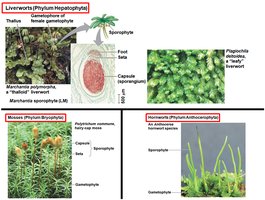
Bryophytes are represented by three phyla of small, herbaceous (non-woody) plants:
Liverworts (Phylum Hepatophyta)
Mosses (Phylum Bryophyta)
Hornworts (Phylum Anthocerophyta)
These groups represent the earliest lineages to diverge from the common ancestor of land plants.
Bryophyte Gametophytes
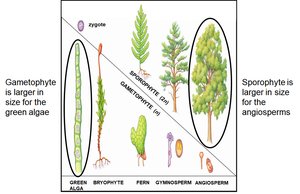
In all three bryophyte phyla, the gametophyte is the dominant, larger, and longer-living generation.
Sporophytes are typically present only part of the time and are dependent on the gametophyte.
Gametophyte height is constrained by the lack of vascular tissues.
Rhizoids anchor gametophytes to the substrate.
Mature gametophytes produce flagellated sperm in antheridia and eggs in archegonia; sperm swim through water to fertilize eggs.
Some mosses reproduce asexually via brood bodies, which detach and grow into clones.
Bryophyte Sporophytes
Bryophyte sporophytes never live independently of the gametophyte.
They are the smallest and simplest sporophytes among all extant plant groups.
A sporophyte consists of a foot, a seta (stalk), and a sporangium (capsule) that discharges spores through a peristome.
Hornwort and moss sporophytes have stomata; liverworts do not.
Ecological and Economic Importance of Mosses
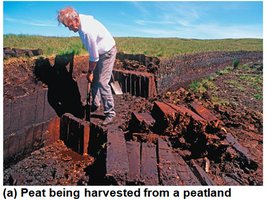
Sphagnum (peat moss) forms extensive deposits of partially decayed organic material known as peat.
Peat is used as a fuel source and for flavoring (e.g., in Scotch whisky).
Peatlands cover 3% of Earth's land surface and contain about 30% of the world's soil carbon.
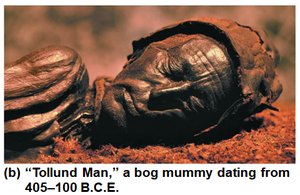
Low temperature, pH, and oxygen levels in peatlands inhibit decay, preserving organic material and even ancient human remains.
Overharvesting Sphagnum could release stored CO2 into the atmosphere.
Concept 29.3: Ferns and Other Seedless Vascular Plants
Evolution of Vascular Plants
Bryophytes were the dominant vegetation for the first 100 million years of plant evolution.
The earliest fossils of vascular plants date to 425 million years ago; ancient forests formed coal deposits.
Vascular tissue allowed plants to grow tall and colonize new environments.
Like bryophytes, seedless vascular plants have flagellated sperm and usually live in moist areas.
Key Traits of Vascular Plants
Life cycles with dominant sporophytes
Vascular tissue: xylem and phloem
Well-developed roots and leaves
Spore-bearing leaves called sporophylls
1. Life Cycles with Dominant Sporophytes
In seedless vascular plants, the sporophyte is the larger, more complex generation.
Example: In ferns, the leafy plant is the sporophyte; the gametophyte is a small, independent plant.
2. Transport in Xylem and Phloem
Xylem conducts water and minerals, containing tube-shaped cells called tracheids strengthened by lignin.
Phloem distributes sugars, amino acids, and other organic products.
Vascular tissue enabled increased height and structural support.
3. Evolution of Roots
Roots anchor vascular plants and absorb water and nutrients from the soil.
Roots may have evolved from subterranean stems.
4. Evolution of Leaves
Leaves increase surface area for photosynthesis.
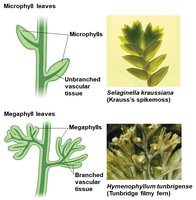
Two types of leaves:
Microphylls: small leaves with a single vein
Megaphylls: larger leaves with a highly branched vascular system
Sporophylls and Spore Variations
Sporophylls are modified leaves with sporangia.
Sori are clusters of sporangia on the undersides of sporophylls.
Strobili are cone-like structures formed from groups of sporophylls.
Most seedless vascular plants are homosporous, producing one type of spore that develops into a bisexual gametophyte.
Some are heterosporous, producing megaspores (female gametophytes) and microspores (male gametophytes).
Classification of Seedless Vascular Plants
Two main clades:
Phylum Lycophyta: club mosses, spike mosses, and quillworts (small herbaceous plants)
Phylum Monilophyta: ferns, horsetails, and whisk ferns (ferns are the most widespread, with over 12,000 species)
Summary Table: Major Groups of Land Plants
Group | Examples | Key Features |
|---|---|---|
Bryophytes (Nonvascular) | Liverworts, Mosses, Hornworts | Dominant gametophyte, no vascular tissue |
Seedless Vascular Plants | Club mosses, Ferns, Horsetails | Dominant sporophyte, vascular tissue, no seeds |
Gymnosperms | Conifers, Cycads, Ginkgo | Seeds not enclosed in fruit |
Angiosperms | Flowering plants | Seeds enclosed in fruit, flowers |
Additional info: This summary integrates foundational concepts from Chapter 29 of a General Biology II course, focusing on the evolutionary history, adaptations, and classification of land plants. It is suitable for exam preparation and review of key terminology and processes.
