 Indietro
Plant Diversity I: How Plants Colonized Land
Guida di studio - Note intelligenti
 Appunti personalizzati basati sui tuoi materiali, ampliati con definizioni chiave, esempi e contesto.
Plant Diversity I: How Plants Colonized Land
Introduction to Plant Colonization of Land
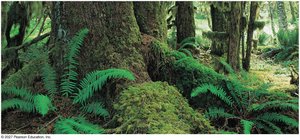
Plants, fungi, and animals began colonizing terrestrial environments within the last 500 million years, transforming Earth's landscape and ecosystems. The first forests appeared about 385 million years ago, marking a significant milestone in plant evolution.
Major Developments in Plant Evolution
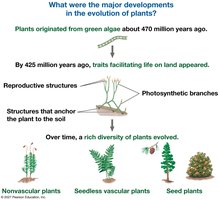
Plant evolution involved several key developments that enabled survival and diversification on land. These include adaptations for reproduction, structural support, and photosynthesis.
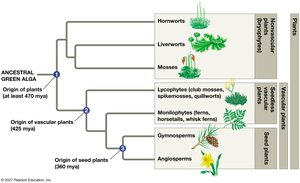
Origin from Green Algae: Plants originated from green algae about 470 million years ago.
Adaptations for Land: By 425 million years ago, traits facilitating terrestrial life appeared, such as reproductive structures and photosynthetic branches.
Diversity: Over time, plants diversified into nonvascular plants, seedless vascular plants, and seed plants.
Algal Ancestry and Evidence
Plants share several traits with green algae, especially charophytes, their closest living relatives. Genetic evidence identifies Zygnematophyceae as the closest relatives, but land plants and modern charophytes share a common ancestor rather than a direct lineage.
Shared Traits: Multicellularity, photosynthetic autotrophy, cellulose-rich cell walls, chloroplasts with chlorophyll a and b, similar cellulose-synthesizing proteins, and flagellated sperm.
Genetic Similarity: Strong similarities in nuclear, chloroplast, and mitochondrial DNA.
Adaptations Enabling the Move to Land
Transitioning from aquatic to terrestrial environments required adaptations to prevent desiccation and utilize new resources.
Sporopollenin: A durable polymer coating reproductive cells, preventing drying out.
Benefits: Increased sunlight, abundant CO2, nutrient-rich soil.
Challenges: Limited water, risk of desiccation, need for structural support.
Derived Traits of Land Plants
Four key traits distinguish land plants from their algal ancestors:
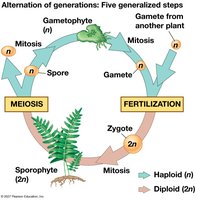
Alternation of Generations: Life cycles alternate between multicellular haploid (gametophyte) and diploid (sporophyte) stages.
Multicellular, Dependent Embryos: Embryos are retained and nourished within the female gametophyte.
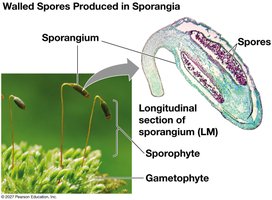
Walled Spores Produced in Sporangia: Spores are produced in multicellular organs and protected by sporopollenin.
Apical Meristems: Regions of cell division at root and shoot tips, enabling growth toward resources.
Alternation of Generations
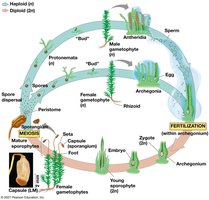
Plant life cycles alternate between gametophyte (n) and sporophyte (2n) stages. Gametophytes produce gametes by mitosis; sporophytes produce spores by meiosis. Spores develop into gametophytes without fertilization.
Equation:
Multicellular, Dependent Embryos
After fertilization, the diploid embryo is retained within the female gametophyte, which protects and nourishes it. This trait is why land plants are also called embryophytes.
Walled Spores Produced in Sporangia
Sporophytes produce haploid spores in sporangia. Spore walls contain sporopollenin, protecting them from environmental stress.
Apical Meristems
Apical meristems are regions of active cell division at the tips of roots and shoots, allowing plants to grow toward water, minerals, and light.
Additional Derived Traits
Cuticle: A waxy covering that reduces water loss.
Stomata: Pores for gas exchange.
Mycorrhizal Associations: Early plants formed symbiotic relationships with fungi to obtain water and nutrients.
Origin and Diversification of Plants
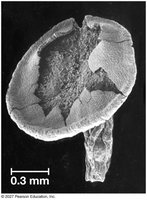
Fossil evidence shows the earliest plant spores appeared about 470 million years ago. Early land plants such as Cooksonia had sporangia and date to about 425 million years ago.
Major Groups of Living Plants
Plant evolution led to four major groups:
Nonvascular Plants (Bryophytes): Liverworts, mosses, hornworts; lack vascular tissue.
Seedless Vascular Plants: Lycophytes and ferns; have vascular tissue but no seeds.
Gymnosperms: Vascular plants with "naked" seeds (e.g., conifers).
Angiosperms: Flowering plants with seeds enclosed in fruits.
The Evolution of Vascular Tissue
Vascular tissue consists of specialized cells for transporting water and nutrients. Vascular plants can grow taller and access more resources.
Xylem: Transports water and minerals; cells are dead at maturity and strengthened by lignin.
Phloem: Transports sugars and organic compounds; cells are living at maturity.
Nonvascular Plants: Bryophytes
Bryophytes (liverworts, mosses, hornworts) lack an extensive vascular system and are not a monophyletic group. Their life cycles are dominated by the gametophyte generation.
Seedless Vascular Plants
Seedless vascular plants include lycophytes and monilophytes (ferns and relatives). They have vascular tissue but reproduce with spores and require water for fertilization.
Seed Plants
Seed plants are vascular plants that produce seeds, which contain a diploid embryo, nutrient supply, and protective coat. Gymnosperms produce "naked" seeds, while angiosperms produce seeds within fruits.
Bryophyte Life Cycles
Bryophyte life cycles are gametophyte-dominated. The sporophyte is dependent on the gametophyte and present only part of the life cycle.
Ecological Importance of Mosses
Mosses are found in diverse habitats and can tolerate desiccation. Sphagnum (peat moss) forms peat, which stores significant amounts of global soil carbon. Peatlands slow decomposition and help regulate atmospheric CO2.
Seedless Vascular Plants: Growing Tall
Vascular tissue allowed plants to grow taller and transport water efficiently. Seedless vascular plants still depend on water for fertilization due to flagellated sperm.
Origins and Traits of Vascular Plants
In vascular plants, the sporophyte became the dominant generation and can live independently. Increased height provides greater access to sunlight.
Bryophytes: Gametophyte dominant (n), sporophyte dependent.
Vascular Plants: Sporophyte dominant (2n), sporophyte independent.
Key Traits of Vascular Plants
Dominant Sporophyte Generation: The sporophyte is the main plant body.
Xylem and Phloem: Specialized tissues for transport.
Roots and Leaves: Well-developed structures for anchorage, absorption, and photosynthesis.
Life Cycle of a Fern
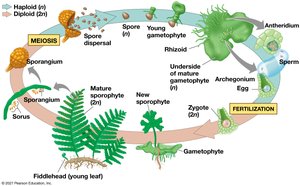
Ferns exhibit a sporophyte-dominated life cycle, with independent gametophytes and sporophytes. Spores are produced in sporangia and develop into gametophytes.
Transport in Xylem and Phloem
Xylem: Dead cells at maturity, strengthened by lignin, transport water and minerals.
Phloem: Living cells, transport sugars and organic compounds.
Evolution of Roots and Leaves
Roots: Anchor plants and absorb water and minerals.
Leaves: Increase surface area for light capture and photosynthesis.
Vascular tissue connects roots and leaves, enabling efficient transport and growth.
Homospory vs. Heterospory
Homospory: One type of spore, usually forming bisexual gametophytes.
Heterospory: Two types of spores, forming separate male and female gametophytes. All seed plants are heterosporous.
Heterospory was a key step toward the evolution of seeds.
Classification of Seedless Vascular Plants
Lycophytes: Club mosses and relatives.
Monilophytes: Ferns, horsetails, whisk ferns, and relatives.
Both groups have vascular tissue and reproduce with spores, requiring water for fertilization.
Seedless Vascular Plants Changed Earth
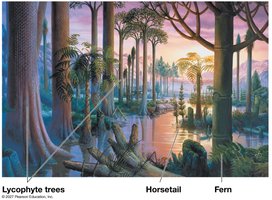
During the Devonian and Carboniferous periods, vast forests of seedless vascular plants contributed to a decline in atmospheric CO2, leading to global cooling and glaciation.
Significance of Seedless Vascular Plants
Carboniferous forests accumulated peat, which over millions of years became coal. As climates became drier, seed plants became more important. Burning coal today releases ancient carbon back into the atmosphere as CO2.
Photosynthesis: Captured carbon in ancient forests.
Peat Formation: Slow decomposition in swamps.
Coal Formation: Burial, heat, and pressure transformed peat into coal.
Fossil-Fuel Combustion: Returns stored carbon to the atmosphere.
