 Indietro
Plant Diversity, Structure, Nutrition, and Reproduction: Study Guide for General Biology
Guida di studio - Note intelligenti
 Appunti personalizzati basati sui tuoi materiali, ampliati con definizioni chiave, esempi e contesto.
Plant Evolution and Diversity
Evidence for Plant Descent from Green Algae
Plants are believed to have evolved from green algae, specifically charophytes, based on similarities in cell wall composition, chloroplast structure, and reproductive mechanisms. - Key Evidence: Similarities in cellulose-synthesizing complexes, peroxisome enzymes, and structure of flagellated sperm. - Derived Characters of Plants: Multicellular, dependent embryos; alternation of generations; walled spores produced in sporangia; apical meristems.
Major Groups of Plants
Plants are classified based on the presence or absence of vascular tissue and seeds. - Nonvascular plants (Bryophytes): Mosses, liverworts, hornworts; lack vascular tissue. - Seedless vascular plants: Ferns, club mosses; have vascular tissue but no seeds. - Gymnosperms: Vascular plants with naked seeds (e.g., conifers). - Angiosperms: Flowering plants with seeds enclosed in an ovary.
Alternation of Generations
The plant life cycle alternates between multicellular haploid (gametophyte) and diploid (sporophyte) stages. - Gametophyte: Produces gametes by mitosis. - Sporophyte: Produces spores by meiosis. - Fertilization: Fusion of gametes forms a diploid zygote, which develops into a sporophyte. Example: Ferns exhibit alternation of generations, with visible sporophyte and microscopic gametophyte stages. 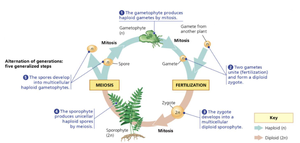
Fungi: Structure, Nutrition, and Role in Colonization of Land
Structure and Nutrition of Fungi
Fungi are heterotrophic organisms that absorb nutrients from their environment. - Hyphae: Filamentous structures forming the mycelium. - Mycelium: Network of hyphae that increases surface area for absorption. - Nutrition: Fungi secrete enzymes to break down organic matter and absorb nutrients.
Role of Fungi in Colonization of Land
Fungi form mutualistic associations with plants (mycorrhizae), aiding in nutrient uptake and enabling plants to colonize terrestrial environments. - Mycorrhizae: Symbiotic relationship between fungal hyphae and plant roots. Example: Mycorrhizal fungi help plants absorb phosphorus and other minerals from soil.
Plant Structure and Organization
Root System and Shoot System
The plant body is organized into root and shoot systems, each with specialized organs. - Root System: Anchors plant, absorbs water and minerals, stores food. - Shoot System: Includes stems, leaves, and flowers; responsible for photosynthesis and reproduction. 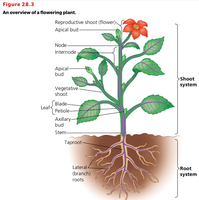
Major Plant Organs and Their Functions
- Roots: Absorption and anchorage. - Stems: Support and transport. - Leaves: Main site of photosynthesis. - Flowers: Reproductive structures in angiosperms.
Plant Tissue Types
Plants have three main tissue types, each with distinct functions.
Vascular tissue: Xylem (water/mineral transport), Phloem (sugar/organic nutrient transport)
Dermal tissue: Protective outer covering
Ground tissue: Storage, photosynthesis, support
Plant Cell Types
- Parenchyma: Metabolism, storage, photosynthesis. - Collenchyma: Flexible support for growing regions. - Sclerenchyma: Rigid support, thickened by lignin. - Tracheids and Vessel Elements: Water-conducting cells in xylem. - Sieve-tube Elements: Sugar-conducting cells in phloem.
Meristems and Plant Growth
Meristems are regions of undifferentiated cells that enable plant growth. - Apical meristems: Responsible for primary growth (lengthening). - Lateral meristems: Responsible for secondary growth (thickening).
Zones of Primary Growth in Roots
- Zone of cell division: Meristematic activity. - Zone of elongation: Cells increase in length. - Zone of differentiation: Cells mature into specialized types.
Plant Nutrition and Resource Acquisition
Essential Elements and Nutrients
Plants require both macronutrients and micronutrients for growth and development.
Macronutrients: Nitrogen, phosphorus, potassium, calcium, magnesium, sulfur
Micronutrients: Iron, manganese, zinc, copper, molybdenum, boron, chlorine
Resource Acquisition Adaptations
- Root hairs: Increase surface area for absorption. - Mycorrhizae: Enhance nutrient uptake. - Cation exchange: Roots release H+ ions to displace mineral cations from soil particles. Equation:
Role of Bacteria and Fungi in Plant Nutrition
- Nitrogen-fixing bacteria: Convert atmospheric nitrogen to forms usable by plants. - Rhizobium: Forms nodules on legume roots for nitrogen fixation. - Mycorrhizal fungi: Aid in mineral absorption.
Transpiration
Transpiration is the loss of water vapor from plant leaves, driving water and nutrient movement from roots to shoots.
Plant Reproduction and Flower Structure
Angiosperm Reproduction
Angiosperms reproduce through a complex process involving flowers, pollination, fertilization, and seed formation. - Five Major Steps: 1. Flower formation 2. Pollination 3. Fertilization (double fertilization) 4. Seed development 5. Fruit formation
Angiosperm Life Cycle Stages
1. Gametophyte formation 2. Pollination 3. Fertilization 4. Seed and fruit development
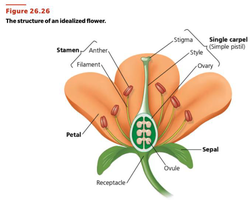
Flower Structure
Flowers contain specialized organs for reproduction.
Sepals: Protect flower bud
Petals: Attract pollinators
Stamens: Male organs (anther, filament)
Carpels: Female organs (stigma, style, ovary)
Pollination and Seed Adaptations
- Abiotic pollination: Wind, water - Biotic pollination: Animals (insects, birds) - Seed coat: Protects embryo - Dormancy: Allows seeds to survive unfavorable conditions
Sexual vs. Asexual Reproduction
Sexual Reproduction | Asexual Reproduction |
|---|---|
Genetic diversity | Genetically identical offspring |
Requires pollination/fertilization | No fusion of gametes |
Adaptation to changing environments | Rapid colonization |
Plant Responses and Hormones
Plant Sensing and Response
Plants respond to environmental stimuli through growth and physiological changes. - Factors sensed: Light, gravity, touch, chemicals, temperature
Plant Hormones and Their Functions
Auxin: Cell elongation, root formation, fruit growth
Cytokinins: Cell division, delay aging, control apical dominance
Gibberellins: Stem growth, seed germination, fruit development
Abscisic acid (ABA): Inhibits growth, promotes dormancy
Ethylene: Response to stress, fruit ripening, leaf abscission
Triple Response to Mechanical Stress
The triple response allows plants to adapt to mechanical stress by altering growth patterns. - Components: Slowing of stem elongation, thickening of stem, horizontal growth
Senescence, Leaf Abscission, and Fruit Ripening
- Senescence: Programmed cell or organ death - Leaf abscission: Shedding of leaves - Fruit ripening: Ethylene-mediated process for seed dispersal
Key Terms and Definitions
Alternation of generations: Life cycle with multicellular diploid and haploid stages
Angiosperm: Flowering plant with seeds in an ovary
Apical meristem: Region of cell division at plant tips
Carpel: Female reproductive organ of a flower
Conifer: Cone-bearing gymnosperm
Cuticle: Waxy covering preventing water loss
Embryophyte: Land plant with multicellular, dependent embryos
Flower: Specialized reproductive structure in angiosperms
Fruit: Mature ovary protecting seeds
Gametophyte: Haploid stage producing gametes
Gymnosperm: Seed plant with naked seeds
Hypha: Fungal filament
Lignin: Structural polymer in plant cell walls
Mycelium: Network of fungal hyphae
Mycorrhiza: Mutualistic association of plant roots and fungi
Phloem: Tissue transporting sugars
Pollen grain: Male gametophyte in seed plants
Root: Plant organ for anchorage and absorption
Seed: Embryo with food supply and protective coat
Sepal: Protective leaf for flower bud
Sporophyte: Diploid stage producing spores
Stamen: Male reproductive organ of a flower
Stoma: Pore for gas exchange
Vascular tissue: Transport system in plants
Xylem: Tissue transporting water and minerals
Summary Table: Major Plant Groups
Group | Vascular Tissue | Seeds | Example |
|---|---|---|---|
Nonvascular plants | No | No | Mosses |
Seedless vascular plants | Yes | No | Ferns |
Gymnosperms | Yes | Yes (naked) | Pines |
Angiosperms | Yes | Yes (enclosed) | Flowering plants |
