 Indietro
Plant Evolution, Structure, Nutrition, and Reproduction: Study Guide for General Biology
Guida di studio - Note intelligenti
 Appunti personalizzati basati sui tuoi materiali, ampliati con definizioni chiave, esempi e contesto.
Plant Evolution and the Colonization of Land
Evidence for Plant Descent from Green Algae
Plants are believed to have evolved from green algae, specifically charophytes, based on similarities in cell wall composition, chloroplast structure, and reproductive mechanisms. - Key Evidence: Presence of sporopollenin in both charophytes and land plants, which prevents desiccation. - Derived Characters of Plants: Multicellular, dependent embryos (embryophytes), alternation of generations, apical meristems, and cuticle.
Alternation of Generations
Alternation of generations is a fundamental life cycle in plants, involving both multicellular diploid (sporophyte) and haploid (gametophyte) stages. - Sporophyte: Multicellular diploid form; produces haploid spores by meiosis. - Gametophyte: Multicellular haploid form; produces gametes by mitosis. - Fertilization: Fusion of gametes forms a diploid zygote, which develops into a sporophyte. Example: Ferns exhibit clear alternation of generations, with visible sporophyte and gametophyte stages. 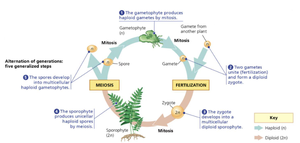
Fungi and Their Role in Plant Colonization
Structure and Nutrition of Fungi
Fungi are heterotrophic organisms that absorb nutrients from their environment. Their bodies are composed of hyphae, which form a network called mycelium. - Hyphae: Filamentous structures that increase surface area for absorption. - Mycelium: Densely branched network of hyphae. - Nutrition: Fungi decompose organic matter and form mutualistic relationships (e.g., mycorrhizae) with plants. Role in Colonization: Mycorrhizal fungi enhance water and mineral uptake for plants, facilitating their adaptation to land.
Major Groups of Plants
Nonvascular Plants (Bryophytes)
Nonvascular plants lack specialized vascular tissues and include mosses, liverworts, and hornworts. - Characteristics: Small size, require moist environments, dominant gametophyte stage.
Seedless Vascular Plants
These plants possess vascular tissues (xylem and phloem) but do not produce seeds. - Examples: Ferns, horsetails, club mosses. - Characteristics: Dominant sporophyte stage, true roots, leaves, and stems.
Gymnosperms
Gymnosperms are seed-producing plants with "naked" seeds not enclosed in an ovary. - Examples: Conifers (pines, firs), cycads, ginkgo. - Adaptations: Seeds, pollen grains, reduced gametophyte.
Angiosperms
Angiosperms are flowering plants that produce seeds within a protective ovary. - Characteristics: Flowers, fruits, double fertilization. - Adaptations: Flowers attract pollinators; fruits aid in seed dispersal.
Plant Structure and Organization
Root and Shoot Systems
The plant body is organized into root and shoot systems, each with specialized organs. - Root System: Anchors plant, absorbs water and minerals, stores food. - Shoot System: Includes stems, leaves, and flowers; responsible for photosynthesis and reproduction. 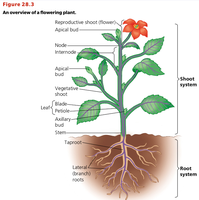
Major Plant Organs and Their Functions
- Roots: Absorption, anchorage, storage. - Stems: Support, transport, growth. - Leaves: Main site of photosynthesis. - Flowers: Reproductive structures in angiosperms.
Plant Tissue Types
Plants have three main tissue types: - Vascular Tissue: Xylem (water/mineral transport), Phloem (sugar/organic nutrient transport). - Dermal Tissue: Protective outer covering. - Ground Tissue: Storage, photosynthesis, support.
Plant Cell Types
- Parenchyma: Metabolism, storage, photosynthesis. - Collenchyma: Flexible support for growing regions. - Sclerenchyma: Rigid support, thickened by lignin.
Meristems and Plant Growth
Meristems are regions of undifferentiated cells that enable plant growth. - Apical Meristems: Responsible for primary growth (lengthening). - Lateral Meristems: Responsible for secondary growth (thickening).
Zones of Primary Growth in Roots
- Zone of Cell Division: Meristematic activity. - Zone of Elongation: Cells increase in length. - Zone of Differentiation: Cells mature into specialized types.
Resource Acquisition, Nutrition, and Transport in Plants
Essential Minerals and Resources
Plants require essential elements for growth, classified as macronutrients (needed in large amounts) and micronutrients (needed in small amounts). - Macronutrients: Nitrogen, phosphorus, potassium, calcium, magnesium, sulfur. - Micronutrients: Iron, manganese, zinc, copper, boron, molybdenum, chlorine.
Adaptations for Resource Acquisition
- Root Hairs: Increase surface area for absorption. - Mycorrhizae: Symbiotic fungi enhance nutrient uptake.
Cation Exchange in Roots
Cation exchange is the process by which plants obtain mineral ions from soil particles. - Process: Hydrogen ions released by roots displace mineral cations from soil, making them available for absorption.
Role of Bacteria and Fungi
- Nitrogen-Fixing Bacteria: Convert atmospheric nitrogen to forms usable by plants (e.g., Rhizobium in legume nodules). - Mycorrhizal Fungi: Aid in water and mineral uptake.
Transpiration
Transpiration is the loss of water vapor from plant surfaces, primarily through stomata. - Importance: Drives water and nutrient transport, cools plant, maintains turgor pressure.
Angiosperm Reproduction and Flower Structure
Major Steps of Angiosperm Reproduction
Angiosperm reproduction involves pollination, fertilization, seed formation, and dispersal. - Pollination: Transfer of pollen to stigma. - Fertilization: Double fertilization produces zygote and endosperm. - Seed Formation: Embryo develops within seed coat. - Dispersal: Fruits aid in seed dispersal.
Flower Structure
Flowers are composed of four main organs: sepals, petals, stamens, and carpels. - Sepals: Protect flower bud. - Petals: Attract pollinators. - Stamens: Male reproductive organs (anther, filament). - Carpels: Female reproductive organs (stigma, style, ovary). 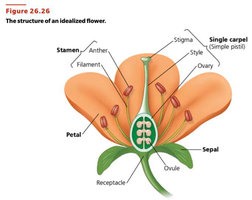
Abiotic vs. Biotic Pollination
- Abiotic: Pollination by wind or water. - Biotic: Pollination by animals (insects, birds, bats).
Seed Adaptations
- Seed Coat: Protects embryo. - Dormancy: Allows seeds to survive unfavorable conditions.
Sexual vs. Asexual Reproduction
- Sexual: Genetic diversity, adaptation to changing environments. - Asexual: Rapid colonization, offspring genetically identical to parent.
Plant Responses to Internal b d External Signals
Plant Hormones and Their Functions
Plant hormones regulate growth, development, and responses to stimuli.
Hormone | Site of Production | Major Function |
|---|---|---|
Auxin | Apical meristems | Cell elongation, root formation, fruit growth |
Cytokinins | Roots | Cell division, delay aging, apical dominance |
Gibberellins | Seeds, young leaves | Stem growth, seed germination, fruit development |
Abscisic Acid (ABA) | Leaves, stems, roots | Inhibits growth, promotes dormancy, closes stomata |
Ethylene | All parts (as gas) | Fruit ripening, leaf abscission, response to stress |
Triple Response to Mechanical Stress
The triple response enables seedlings to overcome obstacles by slowing stem elongation, thickening the stem, and causing horizontal growth.
Senescence, Leaf Abscission, and Fruit Ripening
- Senescence: Programmed cell death of organs or entire plant. - Leaf Abscission: Shedding of leaves, regulated by hormones. - Fruit Ripening: Ethylene triggers ripening, making fruit attractive for dispersal.
Classification: Monocots vs. Eudicots
Differences Between Monocots and Eudicots
Feature | Monocots | Eudicots |
|---|---|---|
Seed Leaves (Cotyledons) | One | Two |
Leaf Venation | Parallel | Net-like |
Flower Parts | Multiples of 3 | Multiples of 4 or 5 |
Vascular Bundles | Scattered | Arranged in ring |
Root System | Fibrous | Taproot |
Example: Grasses are monocots; roses are eudicots.
Summary Table: Major Plant Groups
Group | Vascular Tissue | Seeds | Flowers |
|---|---|---|---|
Nonvascular Plants | No | No | No |
Seedless Vascular Plants | Yes | No | No |
Gymnosperms | Yes | Yes | No |
Angiosperms | Yes | Yes | Yes |
Additional info: These notes expand on brief study guide points to provide a comprehensive overview of plant evolution, structure, nutrition, reproduction, and responses, suitable for exam preparation in General Biology.
