 Indietro
Ch.34/35 Plant Form, Function, and Water Transport: Structure and Physiology of Land Plants
Guida di studio - Note intelligenti
 Appunti personalizzati basati sui tuoi materiali, ampliati con definizioni chiave, esempi e contesto.
Plant Form and Function
Introduction to Plant Form and Function
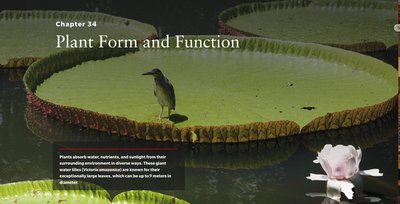
Plants absorb water, nutrients, and sunlight from their environment to drive growth and sustain life. Their structural adaptations allow them to thrive in diverse habitats, from aquatic environments to dry land. The study of plant form and function reveals how these adaptations support survival, growth, and reproduction.
Key Features of Land Plants
Land plants evolved several features to facilitate life outside water, including specialized tissues for water retention, structural support, and efficient nutrient transport.
Cuticle: A waxy layer that prevents water loss.
Stomata: Pores for gas exchange, regulated by guard cells.
Vascular tissue: Specialized for transport of water, minerals, and sugars.
Roots: Anchor plants and absorb water and nutrients.

Plant Tissue Systems
Main Plant Tissue Systems
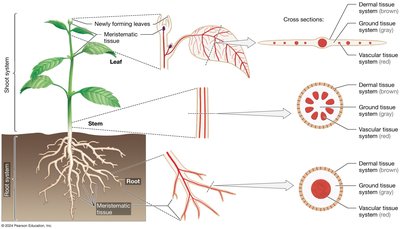
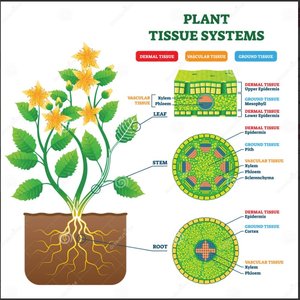
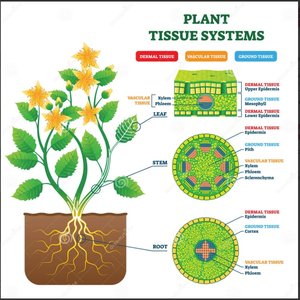
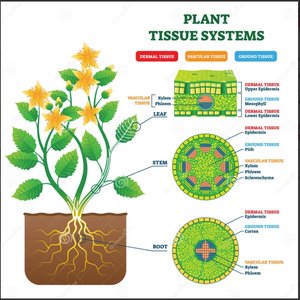
Plant organs are composed of three main tissue systems: dermal, vascular, and ground tissue. Each system has distinct functions and cell types.
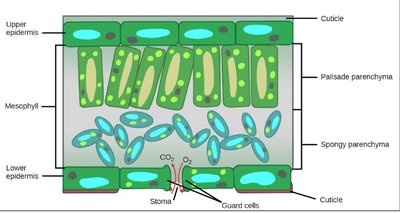
Dermal Tissue: Forms the outer protective covering (epidermis, cuticle, root hairs, trichomes, stomata).
Vascular Tissue: Conducts water, minerals, and sugars (xylem and phloem).
Ground Tissue: Functions in photosynthesis, storage, and support (parenchyma, collenchyma, sclerenchyma).
Dermal Tissue System
The dermal tissue system protects the plant and regulates interactions with the environment. It includes the epidermis, cuticle, stomata, trichomes, and root hairs.
Epidermis: Outermost cell layer.
Cuticle: Waxy layer preventing water loss.
Stomata: Openings for gas exchange.
Trichomes: Hair-like structures for protection and water regulation.
Root hairs: Increase surface area for water and nutrient absorption.
Vascular Tissue System
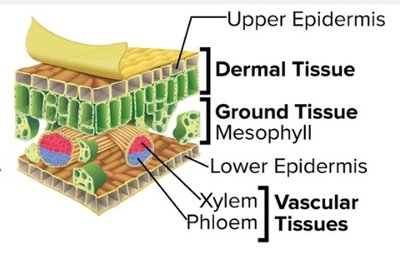
The vascular tissue system is responsible for the transport of water, minerals, and organic nutrients throughout the plant. It consists of xylem and phloem.
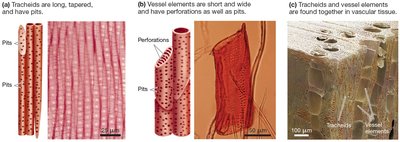
Xylem: Conducts water and minerals from roots to leaves. Composed of tracheids and vessel elements, which are dead at maturity.
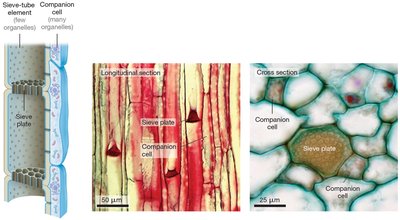
Phloem: Transports sugars and organic nutrients from leaves to other parts. Composed of sieve tube elements and companion cells, which are living at maturity.
Ground Tissue System
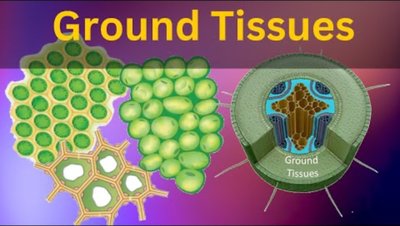
Ground tissue fills the interior of the plant and is involved in photosynthesis, storage, and structural support. It includes parenchyma, collenchyma, and sclerenchyma cells.
Parenchyma: Thin-walled cells for photosynthesis and storage.
Collenchyma: Provides flexible support.
Sclerenchyma: Provides rigid support with thick cell walls.
Plant Growth: Meristems and Primary/Secondary Growth
Primary Meristems and Growth
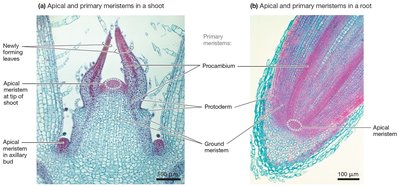
Meristems are regions of undifferentiated cells that enable plant growth. Apical meristems (SAM and RAM) give rise to primary meristems, which differentiate into the three main tissue systems.
Protoderm: Forms dermal tissue.
Ground meristem: Forms ground tissue.
Procambium: Forms vascular tissue.
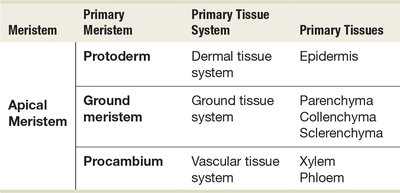
Meristem | Primary Meristem | Primary Tissue System | Primary Tissues |
|---|---|---|---|
Apical Meristem | Protoderm | Dermal tissue system | Epidermis |
Apical Meristem | Ground meristem | Ground tissue system | Parenchyma, Collenchyma, Sclerenchyma |
Apical Meristem | Procambium | Vascular tissue system | Xylem, Phloem |
Secondary Growth
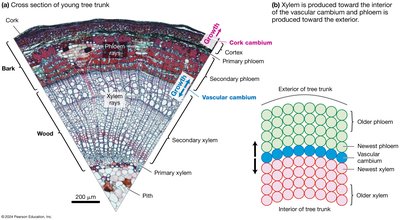
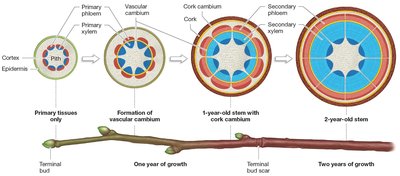
Secondary growth increases the thickness of stems and roots, mainly in woody plants. It is driven by lateral meristems: vascular cambium and cork cambium.
Vascular cambium: Produces secondary xylem (wood) and secondary phloem.
Cork cambium: Produces protective outer tissues (cork, bark).
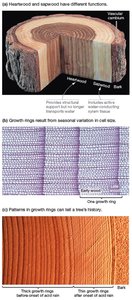
Annual rings: Formed by seasonal variation in growth, used in dendroecology to study tree history.
Properties and Movement of Water in Plants
Structure and Properties of Water
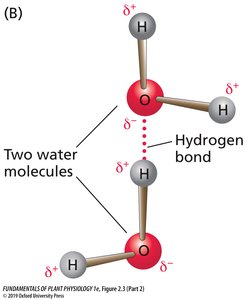
Water is a polar molecule, with oxygen having a partial negative charge and hydrogen atoms having partial positive charges. Hydrogen bonds form between water molecules, giving water unique properties essential for plant life.
Polarity: Enables water to be an excellent solvent.
Hydrogen bonding: Buffers temperature fluctuations and supports cohesion and adhesion.
Cohesion, Adhesion, and Surface Tension
Cohesion refers to the mutual attraction between water molecules, while adhesion is the attraction of water to solid surfaces such as cell walls. Surface tension and capillary action enable water to move upward in plants.
Cohesion: Maintains continuous water columns in xylem.
Adhesion: Helps water adhere to cell walls and move against gravity.
Surface tension: Causes capillarity, aiding water movement in small tubes.
Diffusion and Osmosis
Water moves across plant membranes by diffusion and osmosis. Diffusion is the movement from high to low concentration, while osmosis is the movement of water across a selectively permeable membrane.
Fick's first law: Flux is proportional to the concentration gradient.
Aquaporins: Water-selective pores facilitating water movement.
Water Potential
Water potential () is the potential energy of water per unit volume, predicting the direction of water movement. It is influenced by solute concentration (), pressure (), and gravity.
Formula:
Water flows: From regions of higher to lower water potential.
Reference state: Pure water at ambient temperature and standard atmospheric pressure ( MPa).
Water Transport in Plants: Cohesion-Tension Theory
Mechanism of Water Transport
The cohesion-tension theory explains how water moves from roots to leaves. Transpiration creates tension at leaf surfaces, pulling water upward through the xylem. The energy for this process comes from the sun.
Transpiration: Evaporation of water from leaf surfaces, cooling the plant.
Tension: Negative pressure draws water from roots to leaves.
Cohesion and adhesion: Maintain continuous water columns and facilitate upward movement.
Transpiration and Water Loss
Transpiration is the passive process of water uptake by roots and its loss by evaporation from leaves and stems. It is essential for nutrient transport and temperature regulation but results in significant water loss.
Water loss: Up to 97% of water taken up by plants is lost to the atmosphere.
CO2 uptake: Coupled to water loss; plants lose many water molecules for each CO2 molecule gained.
Summary Table: Components of Primary Growth
Meristem | Primary Meristem | Primary Tissue System | Primary Tissues |
|---|---|---|---|
Apical Meristem | Protoderm | Dermal tissue system | Epidermis |
Apical Meristem | Ground meristem | Ground tissue system | Parenchyma, Collenchyma, Sclerenchyma |
Apical Meristem | Procambium | Vascular tissue system | Xylem, Phloem |
Additional info: These notes expand on brief lecture points to provide a comprehensive overview of plant structure, tissue systems, growth, and water transport, suitable for General Biology students.
