 Indietro
Plant Structure and Function: Study Guide for General Biology
Guida di studio - Note intelligenti
 Appunti personalizzati basati sui tuoi materiali, ampliati con definizioni chiave, esempi e contesto.
Seed Structure
Parts of a Seed and Their Functions
Seeds are fundamental units of plant reproduction, containing all the necessary components for the development of a new plant. - Seed coat: The protective outer layer that shields the internal parts of the seed and maintains seed dormancy. - Endosperm: Serves as a nutrient reservoir, storing proteins and other nutrients for the developing embryo. - Embryo: The young plant itself, which will differentiate into all tissues of the mature plant.
Germination Process
Germination is the process by which a seed begins to grow and develop into a plant. - The seed absorbs water, activating metabolic processes. - The seed swells, and metabolism becomes active. - The radicle (first root) emerges before any other part. - The shoot grows upward, followed by leaf development and photosynthesis. - Key Point: The root (radicle) emerges first during germination, not the stem or leaves.
Monocotyledons vs. Dicotyledons
Anatomical Differences
Monocots and dicots are two major groups of flowering plants, distinguished by several anatomical features.
Feature | Monocot | Dicot |
|---|---|---|
Seed | One cotyledon | Two cotyledon |
Root | Fibrous roots | Tap roots |
Vascular | Scattered | Ringed |
Leaf | Parallel veins | Net-like veins |
Flower | Multiples of 3 | Multiples of 4 or 5 |
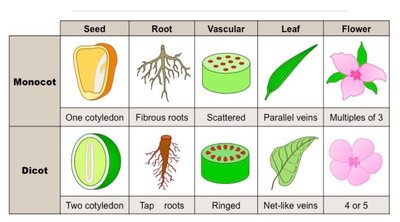 - Monocots: Have one seed leaf (cotyledon), fibrous roots, scattered vascular bundles, parallel leaf veins, and flower parts in multiples of three. - Dicots: Have two seed leaves, taproots, ringed vascular bundles, net-like leaf veins, and flower parts in multiples of four or five.
Plant Leaves
Megaphylls
Megaphylls are leaves with a complex network of veins. - Definition: Megaphylls are formed through the evolutionary process of webbing, where spaces between close vascular tissues become filled with chlorophyll-containing cells. - Example: Most modern plant leaves are megaphylls, allowing efficient photosynthesis.
Root Zone
Functions and Feeder Roots
The root zone is essential for plant health and growth. - Storage: Roots store energy resources for the plant. - Absorption: Roots absorb water and minerals from the soil. - Oxygen absorption: Roots also take in oxygen necessary for cellular respiration. - Feeder roots: Small, fine roots responsible for absorbing most water and nutrients. - Damage to feeder roots: Leads to wilting, nutrient deficiencies, slower growth, and potentially plant death.
Seed Dormancy
Definition and Purpose
Seed dormancy is a survival mechanism in plants. - Definition: Seed dormancy is a state where seeds maintain a reduced metabolic rate, staying alive but not growing until conditions are optimal. - Purpose: Prevents seeds from germinating when environmental conditions are unfavorable for survival. 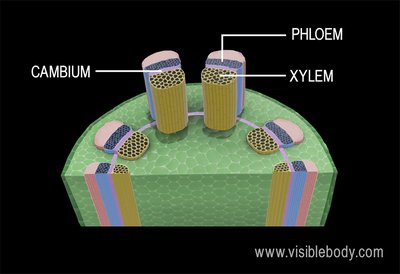
Plant Vascular Tissue
Xylem and Phloem
Plants have specialized tissues for transporting water, nutrients, and food. - Xylem: Transports water and dissolved minerals mainly upward from roots to stems and leaves. - Phloem: Transports sugars (food) from sites of production (like leaves) to other parts of the plant. - Cambium: In dicots, the cambium is a layer that produces new xylem and phloem, contributing to the thickness/girth of roots and stems (creating bark).
Plant Gas Exchange
Stomata and Their Function
Stomata are essential for gas exchange and water regulation in plants. - Stomata: Tiny pores in the plant epidermis, usually found on leaves. - Functions: Allow carbon dioxide (CO2) to enter for photosynthesis, oxygen (O2) to exit, and water vapor to escape through transpiration. - Guard cells: Specialized cells that control the opening and closing of stomata, regulating gas exchange and water loss.
Additional info:
- Cambium is present in dicots but not in monocots, which affects the ability of the plant to increase in girth. - Practice comparing monocots and dicots, and review plant structures and their functions for exam preparation.
