 Indietro
Plant Structure, Growth, Reproduction, and Adaptations: Study Guide for General Biology
Guida di studio - Note intelligenti
 Appunti personalizzati basati sui tuoi materiali, ampliati con definizioni chiave, esempi e contesto.
Plant Evolution and Adaptations
Evidence for Plant Descent from Green Algae
Plants are believed to have evolved from green algae, specifically charophytes, based on similarities in cell wall composition, chloroplast structure, and reproductive mechanisms. Key derived characters of plants include multicellular, dependent embryos, alternation of generations, and the presence of apical meristems.
Multicellular, dependent embryos: Embryophytes retain embryos within parental tissues for protection and nourishment.
Alternation of generations: Plants alternate between multicellular haploid (gametophyte) and diploid (sporophyte) stages.
Apical meristems: Regions of cell division at the tips of roots and shoots enable growth and adaptation to terrestrial environments.
Cuticle and stomata: Adaptations to prevent water loss and facilitate gas exchange.
Alternation of Generations
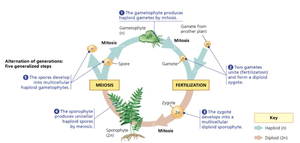
Alternation of generations is a fundamental life cycle in plants, involving both haploid and diploid multicellular stages. The sporophyte (diploid) produces haploid spores by meiosis, which develop into gametophytes (haploid). Gametophytes produce gametes by mitosis, and fertilization restores the diploid state.
Sporophyte: Multicellular diploid form; produces spores via meiosis.
Gametophyte: Multicellular haploid form; produces gametes via mitosis.
Fertilization: Fusion of gametes forms a diploid zygote.
Fungi and Plant Colonization of Land
Structure and Nutrition of Fungi
Fungi are heterotrophic organisms with a body composed of hyphae, forming a mycelium. They absorb nutrients from their environment and play a crucial role in the colonization of land through mutualistic associations with plants (mycorrhizae).
Hyphae: Filamentous structures that increase surface area for absorption.
Mycelium: Network of hyphae; main body of the fungus.
Mycorrhizae: Symbiotic relationship between fungi and plant roots, enhancing nutrient uptake.
Major Groups of Plants
Nonvascular Plants (Bryophytes)
Nonvascular plants, such as mosses, liverworts, and hornworts, lack specialized vascular tissues and are typically found in moist environments. They rely on diffusion for water and nutrient transport.
Gametophyte-dominant: The haploid stage is the main life form.
Reproduction: Requires water for sperm motility.
Seedless Vascular Plants
Seedless vascular plants, including ferns and club mosses, possess vascular tissues (xylem and phloem) but reproduce via spores rather than seeds.
Sporophyte-dominant: The diploid stage is the main life form.
Vascular tissues: Allow for greater size and complexity.
Gymnosperms
Gymnosperms are seed plants that produce "naked" seeds not enclosed in an ovary. Examples include conifers such as pines and firs.
Adaptations: Seeds, pollen grains, and reduced gametophytes.
Angiosperms
Angiosperms are flowering plants that produce seeds within a protective ovary. They are the most diverse group of plants.
Flowers: Specialized structures for sexual reproduction.
Fruits: Mature ovaries that protect seeds and aid in dispersal.
Plant Structure and Organization
Root and Shoot Systems
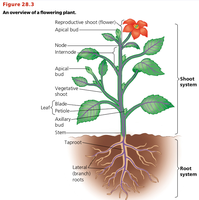
The plant body is organized into root and shoot systems. Roots anchor the plant and absorb water and minerals, while shoots consist of stems, leaves, and flowers.
Root system: Includes taproot and lateral roots.
Shoot system: Includes stems, leaves, and reproductive structures.
Major Plant Organs and Tissue Types
Plants have three main tissue types: dermal, vascular, and ground tissue. Each organ (root, stem, leaf) contains these tissues in varying proportions.
Dermal tissue: Protective outer layer (epidermis, cuticle).
Vascular tissue: Xylem (water/mineral transport) and phloem (sugar transport).
Ground tissue: Functions in storage, photosynthesis, and support.
Plant Cell Types
Parenchyma: Metabolic functions, storage, and photosynthesis.
Collenchyma: Flexible support for growing regions.
Sclerenchyma: Rigid support, thickened by lignin.
Tracheids and vessel elements: Water-conducting cells in xylem.
Sieve-tube elements: Sugar-conducting cells in phloem.
Plant Growth and Meristems
Role of Meristems
Meristems are regions of undifferentiated cells that enable continuous growth. Apical meristems drive primary growth (lengthening), while lateral meristems drive secondary growth (thickening).
Primary growth: Occurs at apical meristems; produces new roots and shoots.
Secondary growth: Occurs at lateral meristems (vascular cambium, cork cambium); increases girth.
Zones of Primary Growth in Roots
Zone of cell division: Meristematic activity.
Zone of elongation: Cells increase in length.
Zone of differentiation: Cells mature into specialized types.
Leaf Structure and Function
Leaf Organization
Leaves are the main photosynthetic organs, containing specialized cells and structures for gas exchange and light absorption.
Stomata: Pores for gas exchange, regulated by guard cells.
Mesophyll: Photosynthetic tissue inside the leaf.
Plant Reproduction and Flower Structure
Angiosperm Reproduction
Angiosperm reproduction involves five major steps: formation of gametes, pollination, fertilization, seed development, and fruit formation. The life cycle includes four stages: gametophyte, fertilization, sporophyte, and seed dispersal.
Abiotic pollination: Pollination by wind or water.
Biotic pollination: Pollination by animals (insects, birds).
Seed adaptations: Seed coat for protection, dormancy for survival.
Structure of a Flower
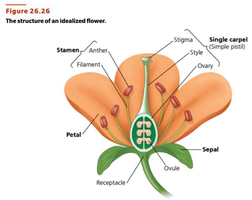
Flowers contain four main organs: sepals, petals, stamens, and carpels. Each organ has a specific role in reproduction.
Sepals: Protect the flower bud.
Petals: Attract pollinators.
Stamens: Male reproductive organs (anther, filament).
Carpels: Female reproductive organs (stigma, style, ovary).
Resource Acquisition and Nutrition
Minerals and Resources Needed by Plants
Plants require essential elements for growth, including macronutrients (N, P, K, Ca, Mg, S) and micronutrients (Fe, Mn, Zn, Cu, Mo, B, Cl, Ni).
Adaptations for Resource Acquisition
Root hairs: Increase surface area for absorption.
Mycorrhizae: Enhance nutrient uptake via symbiosis with fungi.
Cation exchange: Roots release H+ ions to displace mineral cations from soil particles.
Transpiration
Transpiration is the loss of water vapor from leaves, driving the uptake of water and minerals from roots and facilitating cooling.
Plant Hormones and Responses
Plant Hormones
Plants use hormones to regulate growth, development, and responses to environmental stimuli.
Auxin: Cell elongation, root formation.
Cytokinins: Cell division, delay of aging.
Gibberellins: Stem growth, seed germination.
Abscisic acid (ABA): Stress response, seed dormancy.
Ethylene: Fruit ripening, response to mechanical stress.
Triple Response to Mechanical Stress
Slowing of stem elongation
Thickening of the stem
Curvature causing horizontal growth
Senescence, Leaf Abscission, and Fruit Ripening
Senescence: Programmed cell death.
Leaf abscission: Shedding of leaves.
Fruit ripening: Ethylene-mediated process.
Comparison of Monocots and Eudicots
Feature | Monocots | Eudicots |
|---|---|---|
Seed leaves (cotyledons) | One | Two |
Leaf venation | Parallel | Net-like |
Flower parts | Multiples of three | Multiples of four or five |
Vascular bundles | Scattered | Arranged in a ring |
Summary Table: Major Plant Groups
Group | Vascular Tissue | Seeds | Flowers |
|---|---|---|---|
Nonvascular plants | No | No | No |
Seedless vascular plants | Yes | No | No |
Gymnosperms | Yes | Yes | No |
Angiosperms | Yes | Yes | Yes |
Additional info: Academic context was added to expand brief points and clarify key concepts for exam preparation.
