 Indietro
Plant Structure, Growth, Reproduction, and Adaptations: Study Guide for General Biology
Guida di studio - Note intelligenti
 Appunti personalizzati basati sui tuoi materiali, ampliati con definizioni chiave, esempi e contesto.
Plant Evolution and Adaptations
Evidence for Plant Descent from Green Algae
Plants are believed to have evolved from green algae, specifically charophytes, based on similarities in cell wall composition, chloroplast structure, and reproductive mechanisms.
Key Derived Characters of Plants: Multicellular, dependent embryos; alternation of generations; walled spores produced in sporangia; apical meristems; cuticle and stomata for water regulation.
Example: The presence of sporopollenin in both charophytes and land plants prevents desiccation.
Alternation of Generations
Alternation of generations is a fundamental life cycle in plants, involving both multicellular diploid (sporophyte) and haploid (gametophyte) stages.
Sporophyte: Multicellular diploid form; produces haploid spores by meiosis.
Gametophyte: Multicellular haploid form; produces gametes by mitosis.
Fertilization: Fusion of gametes forms a diploid zygote, which develops into a sporophyte.
Diagram: Alternation of generations cycle. 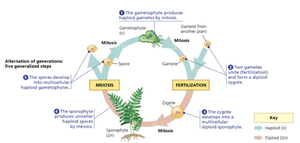
Key Adaptations for Life on Land
Seeds: Protect and nourish the embryo, allowing plants to colonize dry environments.
Pollen grains: Enable fertilization without water.
Flowers and fruits: Facilitate pollination and seed dispersal.
Cuticle: Waxy covering prevents water loss.
Stomata: Allow gas exchange while minimizing water loss.
Major Groups of Plants
Nonvascular Plants (Bryophytes)
Characteristics: Lack vascular tissue; small size; require moist environments.
Examples: Mosses, liverworts, hornworts.
Reproduction: Dominant gametophyte stage; sporophyte dependent on gametophyte.
Seedless Vascular Plants
Characteristics: Have vascular tissue (xylem and phloem); do not produce seeds.
Examples: Ferns, horsetails, club mosses.
Reproduction: Dominant sporophyte stage; produce spores.
Gymnosperms
Characteristics: Vascular plants with "naked" seeds (not enclosed in an ovary).
Examples: Conifers (pines, firs), cycads, ginkgo.
Reproduction: Seeds develop on cones; wind pollination.
Angiosperms
Characteristics: Flowering plants; seeds enclosed in an ovary (fruit).
Examples: Grasses, roses, oaks.
Reproduction: Flowers facilitate pollination; fruits aid seed dispersal.
Monocots vs. Eudicots
Monocots: One cotyledon, parallel leaf veins, scattered vascular bundles, fibrous roots, floral parts in multiples of three.
Eudicots: Two cotyledons, net-like leaf veins, ringed vascular bundles, taproot system, floral parts in multiples of four or five.
Plant Structure and Organization
Overview of the Plant Body
The plant body is organized into two main systems: the root system and the shoot system.
Root System: Anchors plant, absorbs water and minerals, stores food.
Shoot System: Includes stems, leaves, and flowers; responsible for photosynthesis, reproduction, and support.
Diagram: Flowering plant structure. 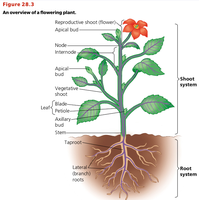
Major Plant Organs and Their Functions
Roots: Absorption, anchorage, storage.
Stems: Support, transport, growth.
Leaves: Photosynthesis, gas exchange.
Flowers: Reproduction.
Plant Tissue Types
Vascular Tissue: Xylem (water/mineral transport), phloem (sugar/organic nutrient transport).
Dermal Tissue: Protective outer covering (epidermis, cuticle).
Ground Tissue: Storage, photosynthesis, support (parenchyma, collenchyma, sclerenchyma).
Plant Cell Types
Parenchyma: Metabolism, storage, photosynthesis.
Collenchyma: Flexible support for young tissues.
Sclerenchyma: Rigid support, thickened by lignin.
Tracheids and Vessel Elements: Water-conducting cells in xylem.
Sieve-tube Elements: Sugar-conducting cells in phloem.
Meristems and Plant Growth
Apical Meristems: Located at tips of roots and shoots; responsible for primary growth (lengthening).
Lateral Meristems: Vascular cambium and cork cambium; responsible for secondary growth (thickening).
Zones of Primary Growth in Roots
Zone of Cell Division: Includes root apical meristem.
Zone of Elongation: Cells elongate, pushing root tip forward.
Zone of Differentiation: Cells mature into specialized types.
Plant Nutrition and Resource Acquisition
Essential Elements and Nutrients
Plants require both macronutrients (e.g., nitrogen, phosphorus, potassium) and micronutrients (e.g., iron, zinc) for growth and development.
Macronutrients: Needed in large amounts (N, P, K, Ca, Mg, S).
Micronutrients: Needed in small amounts (Fe, Zn, Mn, Cu, B, Mo, Cl, Ni).
Resource Acquisition Adaptations
Root Hairs: Increase surface area for absorption.
Mycorrhizae: Mutualistic association with fungi enhances nutrient uptake.
Cation Exchange: Roots release H+ ions to displace mineral cations from soil particles, making them available for absorption.
Transpiration
Transpiration is the evaporative loss of water from plant surfaces, primarily through stomata. It drives the upward movement of water and minerals from roots to leaves.
Importance: Maintains nutrient flow, cools plant, supports photosynthesis.
Plant Reproduction
Angiosperm Reproduction: Major Steps
Angiosperm reproduction involves five major steps:
Formation of gametes (male and female).
Pollination (transfer of pollen to stigma).
Fertilization (fusion of gametes).
Seed development and dormancy.
Seed dispersal and germination.
Angiosperm Life Cycle: Four Stages
Flower formation and gametophyte development.
Pollination and fertilization (double fertilization).
Seed and fruit development.
Seed germination and growth into mature plant.
Flower Structure and Function
Flowers are specialized reproductive organs in angiosperms, consisting of sepals, petals, stamens, and carpels.
Stamens: Male reproductive organs (anther and filament).
Carpels: Female reproductive organs (stigma, style, ovary).
Petals: Attract pollinators.
Sepals: Protect flower bud.
Diagram: Structure of an idealized flower. 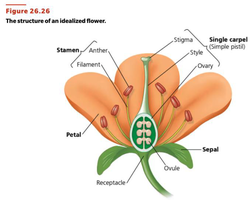
Pollination Mechanisms
Abiotic Pollination: Wind or water.
Biotic Pollination: Animals (insects, birds, bats).
Floral Adaptations: Color, scent, nectar, shape.
Seed Adaptations
Seed Coat: Protects embryo.
Dormancy: Allows seeds to survive unfavorable conditions.
Sexual vs. Asexual Reproduction
Sexual: Genetic diversity, adaptation to changing environments.
Asexual: Rapid colonization, offspring genetically identical to parent.
Plant Responses and Hormones
Plant Sensing and Response
Plants sense and respond to environmental factors such as light, gravity, touch, and chemicals.
Phototropism: Growth toward light.
Gravitropism: Growth in response to gravity.
Tropism: General term for directional growth responses.
Plant Hormones and Their Functions
Auxin: Cell elongation, root formation, fruit growth.
Cytokinins: Cell division, delay aging, control apical dominance.
Gibberellins: Stem and leaf growth, seed germination, fruit development.
Abscisic Acid (ABA): Inhibits growth, promotes dormancy, closes stomata.
Ethylene: Response to stress, fruit ripening, leaf abscission.
Triple Response to Mechanical Stress
Slowing of stem elongation.
Thickening of the stem.
Curvature causing horizontal growth.
Senescence, Leaf Abscission, and Fruit Ripening
Senescence: Programmed cell or organ death.
Leaf Abscission: Shedding of leaves, regulated by hormones.
Fruit Ripening: Controlled by ethylene, involves changes in color, texture, and sweetness.
Key Terms and Definitions
Alternation of generations: Life cycle with both multicellular diploid and haploid forms.
Angiosperm: Flowering plant with seeds enclosed in an ovary.
Apical meristems: Regions of cell division at plant tips.
Carpel: Ovule-producing organ of a flower.
Conifer: Cone-bearing gymnosperm.
Cuticle: Waxy covering preventing water loss.
Embryophyte: Land plant with multicellular, dependent embryos.
Flower: Specialized reproductive shoot in angiosperms.
Fruit: Mature ovary protecting seeds.
Gametophyte: Haploid form producing gametes.
Gymnosperm: Vascular plant with naked seeds.
Hypha: Filament in fungi.
Lignin: Structural polymer in plant cell walls.
Mycelium: Network of fungal hyphae.
Mycorrhiza: Mutualistic association of plant roots and fungi.
Nonvascular plant: Bryophyte lacking vascular tissue.
Ovary: Structure containing ovules.
Petal: Modified leaf attracting pollinators.
Phloem: Tissue transporting sugars.
Pollen grain: Male gametophyte in seed plants.
Pollination: Transfer of pollen to ovules.
Root: Organ for anchorage and absorption.
Seed: Embryo with food and protective coat.
Seedless vascular plant: Vascular plant lacking seeds.
Sepal: Modified leaf protecting flower bud.
Spore: Haploid cell for reproduction.
Sporophyte: Diploid form producing spores.
Sporopollenin: Durable polymer in spores.
Stamen: Pollen-producing organ.
Stoma: Pore for gas exchange.
Vascular plant: Plant with vascular tissue.
Vascular tissue: Transport system in plants.
Xylem: Tissue transporting water and minerals.
Tables
Comparison of Plant Groups
Group | Vascular Tissue | Seeds | Dominant Generation | Example |
|---|---|---|---|---|
Nonvascular (Bryophytes) | No | No | Gametophyte | Moss |
Seedless Vascular | Yes | No | Sporophyte | Fern |
Gymnosperms | Yes | Yes (naked) | Sporophyte | Pine |
Angiosperms | Yes | Yes (enclosed) | Sporophyte | Rose |
Major Plant Hormones and Functions
Hormone | Site of Production | Major Function |
|---|---|---|
Auxin | Apical meristems | Cell elongation, root formation |
Cytokinins | Roots | Cell division, delay aging |
Gibberellins | Seeds, young leaves | Stem growth, seed germination |
Abscisic Acid (ABA) | Leaves, stems | Inhibits growth, promotes dormancy |
Ethylene | All parts | Fruit ripening, leaf abscission |
Equations
Cation Exchange in Soil
Roots release hydrogen ions () to displace mineral cations from soil particles:
Transpiration Pull
Water movement through xylem is driven by negative pressure from transpiration:
Alternation of Generations
Meiosis and fertilization alternate in the plant life cycle:
Photosynthesis (for context)
Additional info:
Some explanations and tables were expanded for clarity and completeness based on standard General Biology content.
