 Indietro
Plant Transport Systems: Xylem, Phloem, and Photosynthesis
Guida di studio - Note intelligenti
 Appunti personalizzati basati sui tuoi materiali, ampliati con definizioni chiave, esempi e contesto.
Plant Transport Systems
Xylem and Water Transport
Plants have specialized tissues for transporting water, minerals, and nutrients. Xylem is responsible for moving water and dissolved minerals from the roots to the rest of the plant. This process is essential for plant structure, nutrient distribution, and photosynthesis.
Xylem Structure: Composed of dead cells that form tubes, allowing water to move upward through capillary action and transpiration pull.
Water Uptake: Roots absorb water from the soil, which then travels through the root cortex and enters the xylem.
Casparian Strip: A barrier in the root endodermis that forces water and solutes to pass through cell membranes, acting as a filter.
Transpiration: The evaporation of water from leaves creates tension that pulls water upward through the xylem.
Osmosis: Water moves into root cells by osmosis, driven by solute concentration differences.
Example: Large trees can transport hundreds of gallons of water daily from roots to leaves, driven by transpiration and cohesion of water molecules.
Phloem and Sugar Transport
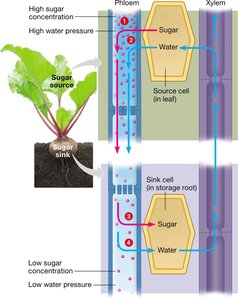
Phloem transports sugars and other organic molecules produced during photosynthesis from 'source' tissues (like leaves) to 'sink' tissues (such as roots, fruits, or growing shoots). This process is called translocation.
Phloem Structure: Made of living cells called sieve tube elements, connected by sieve plates that allow cytoplasmic flow.
Source to Sink: Sugars move from areas of high concentration (source) to areas of low concentration (sink).
Pressure-Flow Mechanism: High sugar concentration at the source draws water into the phloem by osmosis, creating high pressure. This pressure pushes the sugar solution toward the sink, where sugar is removed and water exits, lowering pressure.
Bidirectional Transport: Phloem can transport sugars in multiple directions, depending on the plant's needs.
Example: During the day, leaves act as sources, sending sugars to roots or fruits (sinks). At night, stored sugars may move from roots to growing shoots.
Stomata and Guard Cells
Stomata are small openings on the leaf surface that regulate gas exchange and water loss. Guard cells control the opening and closing of stomata by changing shape in response to water pressure.
Opening: When guard cells take up water, they swell and open the stomatal pore, allowing gas exchange.
Closing: When water is lost, guard cells shrink, closing the pore to conserve water.
Regulation: Stomata typically open during the day for photosynthesis and close at night to reduce water loss.
Photosynthesis and Photosystems
Photosystems and Light Harvesting
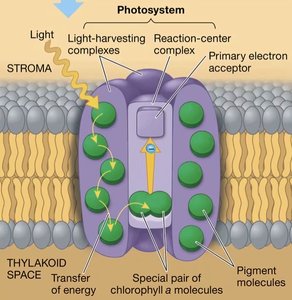
Photosynthesis occurs in the chloroplasts of plant cells, where light energy is converted into chemical energy. Photosystems are complexes of proteins and pigments that capture light energy and initiate the process of electron transport.
Photosystem Structure: Consists of light-harvesting complexes, a reaction-center complex, and a primary electron acceptor.
Light Absorption: Pigment molecules absorb light and transfer energy to a special pair of chlorophyll a molecules in the reaction center.
Electron Transfer: Excited electrons are transferred to the primary electron acceptor, beginning the electron transport chain.
Location: Photosystems are embedded in the thylakoid membrane within the chloroplast.
Example: Photosystem II and Photosystem I work together to produce ATP and NADPH, which are used in the Calvin cycle to synthesize sugars.
Routes of Water and Solute Movement in Roots
Water and solutes can move through plant roots via several routes before entering the xylem:
Apoplastic Route: Movement through cell walls and spaces between cells, without crossing membranes.
Symplastic Route: Movement from cell to cell through plasmodesmata (cytoplasmic connections).
Transmembrane Route: Movement across cell membranes and cytoplasm, involving repeated crossing of plasma membranes.
Casparian Strip: Forces water and solutes to cross a cell membrane at least once, ensuring selective uptake into the xylem.
Nitrogen Movement in Plants
Nitrogen is an essential nutrient for plants, required for the synthesis of amino acids, nucleic acids, and chlorophyll.
Uptake: Plants absorb nitrogen from the soil, primarily as nitrate (NO3-) or ammonium (NH4+).
Transport: Nitrogen moves through the plant via xylem and phloem to sites of growth and storage.
Loss: Nitrogen can leave the plant through root death or when the plant is eaten by herbivores.
Summary Table: Xylem vs. Phloem
Feature | Xylem | Phloem |
|---|---|---|
Main Function | Transports water and minerals | Transports sugars and organic molecules |
Direction of Flow | Upward (roots to leaves) | Source to sink (varies) |
Cell Type | Dead (tracheids, vessel elements) | Living (sieve tube elements, companion cells) |
Driving Force | Transpiration pull, cohesion, adhesion | Pressure-flow mechanism (osmotic pressure) |
