 Indietro
Population Ecology and Island Biogeography: Key Concepts and Applications
Guida di studio - Note intelligenti
 Appunti personalizzati basati sui tuoi materiali, ampliati con definizioni chiave, esempi e contesto.
Population Ecology
Definition and Scope
Population ecology is the study of how and why the number of individuals in a population changes over time. It focuses on groups of individuals of the same species living in the same area at the same time. Analytical tools in population ecology help biologists understand population size changes, age-class distributions, and inform management strategies for conservation and control of invasive species.
Population: A group of individuals of the same species in a specific area and time.
Demography: The study of population size and structure through time.
Key parameters: Birth rates, death rates, immigration rates, emigration rates.
Fitness trade-offs: Allocation of limited resources among growth, reproduction, and survival.
Population Growth Rates
Population growth is determined by the balance of births, deaths, immigration, and emigration. For theoretical models, immigration and emigration are often assumed to be zero, focusing on birth and death rates.
Growth rate: Change in the number of individuals (N) per unit time (t).
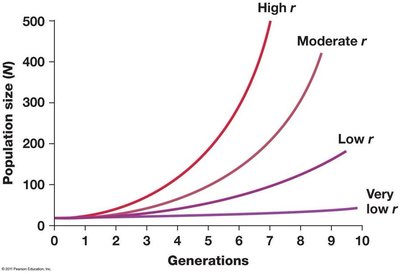
Per-capita rate of increase (r): Difference between birthrate and death rate per individual.
Intrinsic rate of increase (rmax): Maximum value of r under ideal conditions (unlimited resources, minimal threats).
Equation:
Interpretation: Positive r means population is growing; negative r means population is shrinking.
Resource Allocation and Life History
Species differ in their patterns of resource allocation due to limited resources. These differences affect their growth rates and population dynamics.
High fecundity species: Many offspring, early maturity, short lifespan.
High survivorship species: Few offspring, late maturity, long lifespan.
Population Growth Curves
Population growth can be modeled as exponential or logistic, depending on environmental conditions.
Exponential growth: Occurs under ideal conditions with unlimited resources.
Logistic growth: Occurs when resources are limited, leading to a carrying capacity (K).
Carrying capacity (K): The maximum population size an environment can sustain, which may vary in time and space.
Equation for exponential growth:
Equation for logistic growth:
Theory of Island Biogeography
MacArthur and Wilson's Model
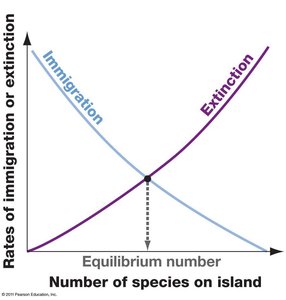
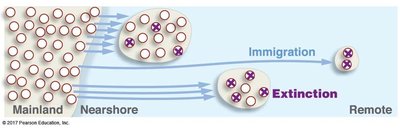
The Theory of Island Biogeography predicts the species richness (number of species) on islands based on immigration and extinction rates. The equilibrium number of species is where these rates intersect.
Immigration: Arrival of new species; decreases as the number of species increases.
Extinction: Loss of species; increases as the number of species increases.
Equilibrium: The predicted number of species where immigration and extinction rates are equal.
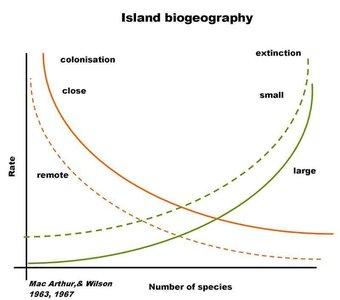
Island size and distance: Larger and closer islands have higher immigration and lower extinction rates, supporting more species.
Factors Affecting Species Richness
Species richness on islands is influenced by:
Distance to mainland: Closer islands have higher immigration rates.
Island size: Larger islands have lower extinction rates.
Habitat diversity: More habitat and resources support more species.
Gene flow: More likely on close islands, increasing immigration.
Island-Like Habitats
Other habitats, such as mountaintops, lakes, and forest fragments, can behave like islands biogeographically, exhibiting similar patterns of species richness and isolation effects.
Latitudinal Gradient in Biodiversity
Patterns and Hypotheses
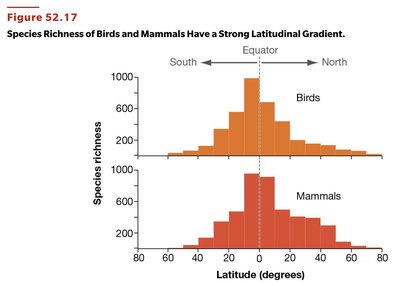
There is a strong latitudinal gradient in biodiversity, with greater species diversity at the equator than at the poles. Several hypotheses explain this pattern:
Spatial hypothesis: More surface area and environmental stability near the equator.
Energy hypothesis: Greater solar energy and precipitation at the equator, leading to higher net primary productivity.
Ecological interactions hypothesis: Higher complexity of species interactions and niche availability.
Evolutionary history hypothesis: Higher speciation rates, lower extinction rates, and greater immigration into equatorial regions.
Demographic Processes in Population Growth
Processes That Make Populations Grow or Shrink
Population size changes are driven by four main processes:
Births: Increase population size.
Deaths: Decrease population size.
Immigration: Individuals entering the population.
Emigration: Individuals leaving the population.
Quantifying Growth Rate
The overall growth rate of a population is a function of birth, death, immigration, and emigration rates. For modeling purposes, immigration and emigration are often set to zero.
Positive r: Population is growing.
Negative r: Population is shrinking.
Equation:
Summary Table: Factors Affecting Population Growth
Factor | Effect on Population |
|---|---|
Births | Increase |
Deaths | Decrease |
Immigration | Increase |
Emigration | Decrease |
Conclusion
Population ecology and island biogeography provide foundational concepts for understanding how populations and communities are structured and maintained. These principles are essential for conservation biology, management of natural resources, and predicting the effects of environmental change.
