 Indietro
Population Ecology & the Distribution of Organisms: Study Guide
Guida di studio - Note intelligenti
 Appunti personalizzati basati sui tuoi materiali, ampliati con definizioni chiave, esempi e contesto.
Population Ecology & the Distribution of Organisms
Introduction to Ecology
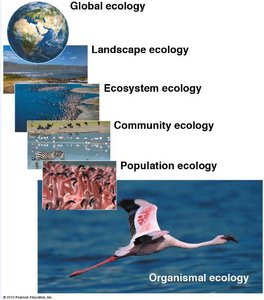
Ecology is the scientific study of the interactions between organisms and their environment. Ecologists investigate these interactions at multiple levels of biological organization, from individual organisms to the biosphere.
Organismal Ecology: Focuses on how an organism’s structure, physiology, and behavior meet environmental challenges.
Population Ecology: Studies groups of individuals of the same species living in a specific area.
Community Ecology: Examines interactions between populations of different species.
Ecosystem Ecology: Investigates energy flow and chemical cycling among organisms and their environment.
Landscape Ecology: Explores mosaics of connected ecosystems.
Global Ecology: Considers the biosphere, the sum of all ecosystems on Earth.
Earth’s Climate and Terrestrial Biomes
Climate is the most significant influence on the distribution of organisms on land. It is defined as the long-term, prevailing weather conditions in a given area.
Major Components of Climate: Temperature, precipitation, sunlight, and wind.
Global Climate Patterns: Determined by solar energy input and Earth’s movement.
Local Effects: Sun angle, bodies of water, and mountains create regional and seasonal climate variations.
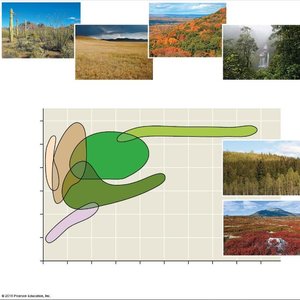
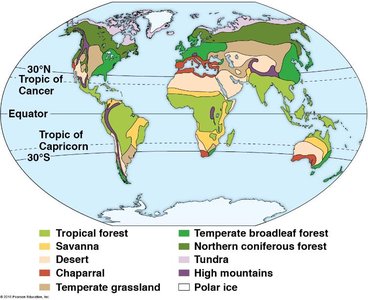
Biomes: Major life zones characterized by vegetation type (terrestrial) or physical environment (aquatic).
Climograph: A plot of annual mean temperature and precipitation for a region, showing biome distribution.
Disturbance and Biome Distribution
Disturbances such as storms, fires, or human activity can modify the distribution of biomes. Most terrestrial biomes are named for their predominant vegetation and are characterized by microorganisms, fungi, and animals adapted to their environment.
Example: Ocean currents influence coastal climates by heating or cooling air masses.
Species Abundance: Related to primary productivity, which is higher in ecosystems with abundant light and warmer temperatures.
Aquatic Biomes
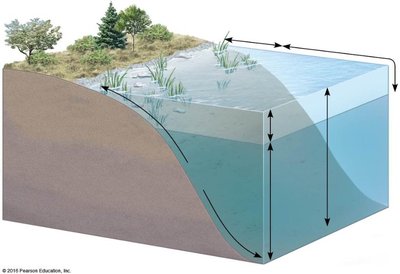
Aquatic biomes are classified by their physical and chemical environment, including salt concentration (marine vs. freshwater) and are divided into vertical and horizontal zones.
Photic Zone: Area with sufficient light for photosynthesis.
Aphotic Zone: Area where little light penetrates.
Benthic Zone: The bottom of all aquatic biomes.
Benthos: Community of organisms living in the benthic zone.
Littoral Zone: Shallow waters near shore suitable for rooted plants.
Thermocline: Abrupt temperature change separating warm upper layers from cold deeper water.
Oligotrophic Lake: Nutrient-poor, oxygen-rich lake.
Eutrophic Lake: Nutrient-rich, often oxygen-depleted lake due to heterotrophic activity.
Wetland: Habitat periodically inundated by water, supporting water-adapted plants.
Estuary: Transitional area between river and sea, with brackish water.
Intertidal Zone: Area periodically submerged and exposed by tides.
Interactions Between Organisms and the Environment
Factors Limiting Species Distribution
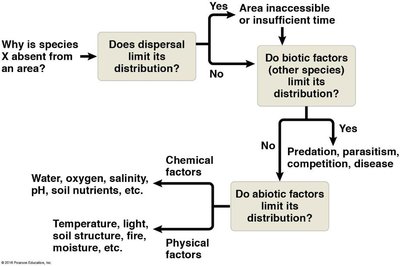
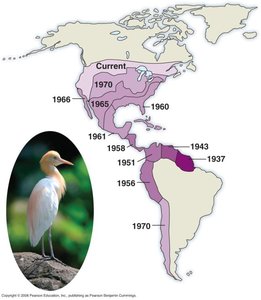
Species distributions are shaped by both ecological factors and evolutionary history. The movement of individuals away from their area of origin is called dispersal.
Biotic Factors: Living factors such as predation, herbivory, competition, parasites, and pollinators.
Abiotic Factors: Non-living factors including temperature, water, oxygen, salinity, sunlight, rocks, and soil.
Population Density, Dispersion, and Demographics
Population Density and Dispersion
Population ecology examines how biotic and abiotic factors influence the density, distribution, and size of populations.
Population Density: Number of individuals per unit area or volume.
Factors Increasing Density: Births and immigration.
Factors Decreasing Density: Deaths and emigration.
Zero Population Growth (ZPG): Births equal deaths.
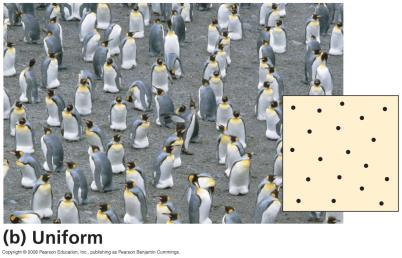
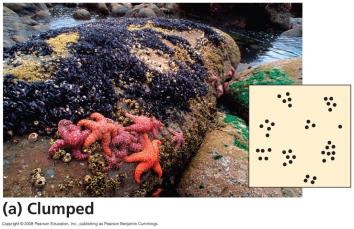
Patterns of Dispersion: Clumped, uniform, and random spacing among individuals.
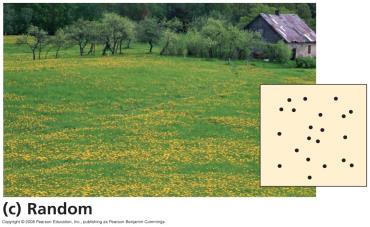
Demography and Survivorship Curves
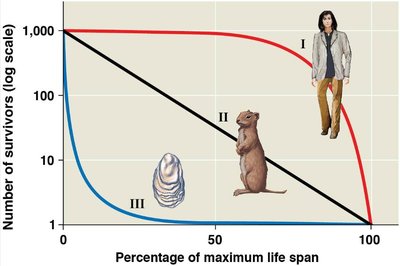
Demography is the study of vital statistics of populations and how they change over time. Life tables track age-specific survival and reproductive rates.
Type I Survivorship Curve: Low death rate early and mid-life, high in older age (e.g., humans).
Type II Survivorship Curve: Constant death rate across all ages.
Type III Survivorship Curve: High death rate early, lower in older age (e.g., oysters, fish, insects).
Population Growth Models
Exponential and Logistic Growth
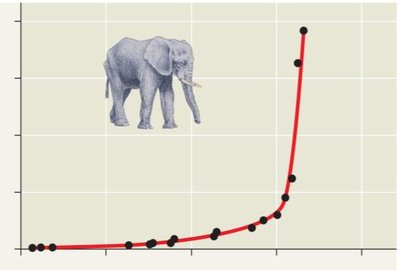
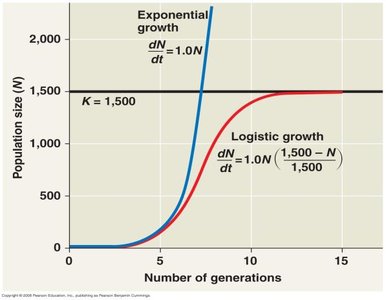
Population growth rate () is the change in the number of individuals in a given area over time. Exponential growth occurs in ideal conditions with unlimited resources, resulting in a J-shaped curve.
Exponential Growth Equation:
Intrinsic Rate of Increase: Per capita rate at which a population increases under ideal conditions.
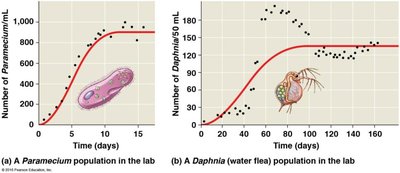
Carrying Capacity (K): Maximum population size an environment can sustain.
Logistic Growth Equation:
Logistic Growth: S-shaped curve; growth slows as population approaches carrying capacity.
Life History Traits and Population Dynamics
Life history traits are evolutionary outcomes that affect survival and reproduction, including age at maturity, frequency of reproduction, and number of offspring.
K-selection: Traits sensitive to population density and carrying capacity; density-dependent selection.
r-selection: Traits maximizing reproductive success in uncrowded environments; density-independent selection.
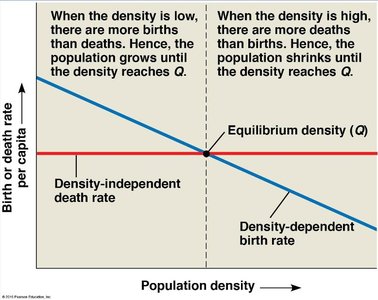
Density-Dependent Regulation: Biotic mechanisms (competition, predation, disease, etc.) reduce birth rates or increase death rates at high population sizes.
Density-Independent Regulation: Abiotic factors (climate, weather, fire, pollution) affect populations regardless of density.
Population Cycles
Some populations exhibit regular boom and bust cycles, such as the snowshoe hare and lynx. These cycles may be explained by food shortages or predator-prey interactions. 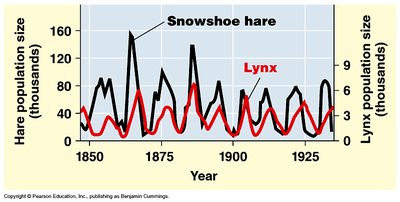
Summary Table: Population Growth Models
Model | Equation | Shape | Key Features |
|---|---|---|---|
Exponential | J-shaped | Unlimited resources, rapid growth | |
Logistic | S-shaped | Growth slows as population nears carrying capacity |
Big Ideas and Enduring Understandings
Evolution: Drives diversity and unity of life; speciation occurs via reproductive isolation.
Biological Systems: Utilize energy and molecular building blocks to grow, reproduce, and maintain homeostasis.
Interactions: Within and between populations influence species distribution and abundance.
Diversity: Variation in populations affects dynamics and ecosystem stability.
