 Indietro
Population Ecology and the Distribution of Organisms
Guida di studio - Note intelligenti
 Appunti personalizzati basati sui tuoi materiali, ampliati con definizioni chiave, esempi e contesto.
Population Ecology & the Distribution of Organisms
Introduction to Ecology
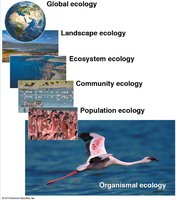
Ecology is the scientific study of the interactions between organisms and their environment. Ecologists investigate these interactions at multiple levels of biological organization, from individual organisms to the entire biosphere.
Population: A group of organisms of the same species living in the same geographic area.
Community: A group of populations of different species living and interacting in an area.
Ecosystem: A community of organisms and the physical factors with which they interact.
Landscape: A mosaic of connected ecosystems.
Biosphere: The global ecosystem, the sum of all the planet’s ecosystems.
Earth’s Climate and the Distribution of Terrestrial Biomes
Climate and Its Components
The most significant influence on the distribution of organisms on land is climate, which refers to the long-term, prevailing weather conditions in a given area. The four major components of climate are temperature, precipitation, sunlight, and wind.
Global climate patterns are determined by solar energy input and Earth’s movement.
Regional and local effects on climate are influenced by the angle of the sun, bodies of water, and mountains.
Ocean currents can heat or cool air masses, affecting coastal climates due to the high specific heat of water.
Biomes and Their Distribution
Biomes are major life zones characterized by vegetation type (terrestrial biomes) or by physical environment (aquatic biomes). Temperature and precipitation are key factors in biome distribution, which often follows latitudinal patterns.
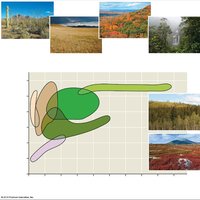
Climograph: A plot of the annual mean temperature and precipitation in a region, used to compare biomes.
Disturbances such as storms, fires, or human activity can modify biome distribution.
Terrestrial biomes are named for predominant vegetation and are characterized by organisms adapted to those environments.
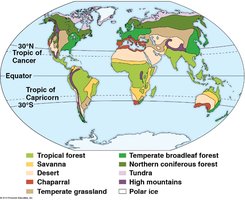
Climograph and Biome Examples
Climographs visually represent the relationship between temperature and precipitation for different biomes, helping to explain their global distribution.
Aquatic Biomes
Characteristics and Zonation
Aquatic biomes are classified by their physical and chemical environment, such as salt concentration (marine vs. freshwater), and are divided into vertical and horizontal zones.
Photic Zone: Sufficient light for photosynthesis.
Aphotic Zone: Little light penetrates.
Benthic Zone: The bottom of all aquatic biomes.
Benthos: The community of organisms living in the benthic zone.
Littoral Zone: Shallow waters near shore, supporting rooted plants.
Pelagic Zone: Open water away from shore.
Limnetic Zone: Well-lit, open surface waters farther from shore.
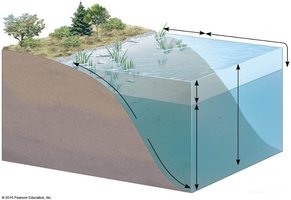
Thermocline: A narrow layer of abrupt temperature change separating warm upper water from cold deeper water.
Marine algae and photosynthetic bacteria are major oxygen producers and carbon dioxide consumers.
Types of Aquatic Habitats
Oligotrophic Lake: Nutrient-poor, oxygen-rich, typically clear.
Eutrophic Lake: Nutrient-rich, often oxygen-depleted in late summer due to high rates of decomposition.
Wetland: Inundated by water at least part of the time, supports water-adapted plants.
Estuary: Transitional area between river and sea, with brackish water.
Intertidal Zone: Area periodically submerged and exposed by tides.
Interactions Between Organisms and the Environment
Species Distribution
The distribution of species is influenced by both ecological factors and evolutionary history. Dispersal, the movement of individuals away from their origin or high-density areas, is a key process.
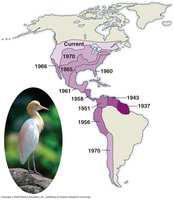
Biotic Factors: Living components such as predation, herbivory, competition, parasites, and pollinators.
Abiotic Factors: Non-living components such as temperature, water, oxygen, salinity, sunlight, rocks, and soil.
Population Density, Dispersion, and Demographics
Population Density and Dispersion
Population ecology examines how biotic and abiotic factors influence the density, distribution, and size of populations. Population density is the number of individuals per unit area or volume, affected by births, deaths, immigration, and emigration.
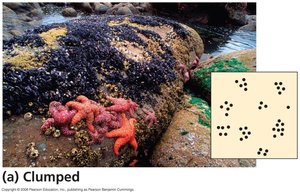
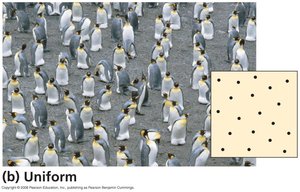
Dispersion: The pattern of spacing among individuals within a population.
Three basic patterns of dispersion:
Clumped: Individuals aggregate in patches, often due to resource availability or social behavior.
Uniform: Evenly spaced, often due to territoriality or competition.
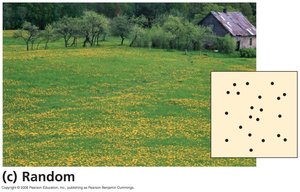
Random: Unpredictable spacing, not strongly influenced by interactions.
Demography and Survivorship Curves
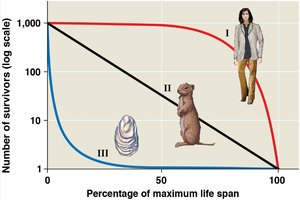
Demography is the study of vital statistics of populations and how they change over time. Life tables track age-specific survival and reproductive rates, often visualized as survivorship curves.
Type I: Low death rates early and mid-life, high in older age (e.g., humans).
Type II: Constant death rate over the lifespan (e.g., rodents).
Type III: High death rates early, lower for survivors (e.g., oysters, fish, insects).
Population Growth Models
Exponential and Logistic Growth
Population growth rate is the change in the number of individuals in a population over time, influenced by births and deaths. Two primary models describe population growth:
Exponential Growth: Idealized, unlimited resource conditions; produces a J-shaped curve.
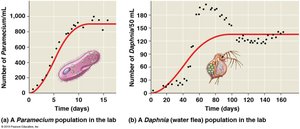
Logistic Growth: Growth slows as population approaches carrying capacity (K); produces an S-shaped curve.
Exponential Growth Equation:
Logistic Growth Equation:
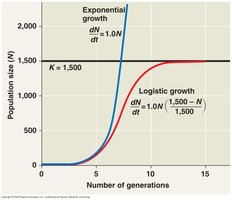
At carrying capacity, birth and death rates are roughly equal.
Life History Traits and Population Dynamics
Life History Strategies
Life history traits are evolutionary outcomes that affect an organism’s schedule of reproduction and survival. These include age at maturity, frequency of reproduction, and number of offspring per episode.
K-selection: Traits favored at high population densities, near carrying capacity; density-dependent selection.
r-selection: Traits that maximize reproductive success in uncrowded environments; density-independent selection.
Population Regulation
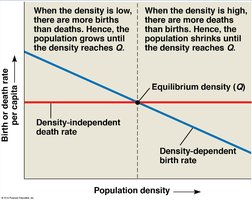
Density-dependent regulation: Birth and death rates are affected by population density (e.g., competition, predation, disease).
Density-independent regulation: Factors unrelated to population density (e.g., weather, climate, fire).
Boom and Bust Cycles
Some populations exhibit regular cycles of rapid growth and decline, often due to food shortages or predator-prey interactions (e.g., snowshoe hare and lynx).
Summary Table: Key Terms and Concepts
Term | Definition |
|---|---|
Population | Group of individuals of the same species in an area |
Community | All populations of different species in an area |
Ecosystem | Community plus physical environment |
Biome | Major life zone defined by vegetation or physical environment |
Carrying Capacity (K) | Maximum population size an environment can sustain |
Exponential Growth | Population growth under unlimited resources |
Logistic Growth | Population growth that slows as it nears carrying capacity |
Density-dependent | Regulation affected by population density |
Density-independent | Regulation not affected by population density |
