 Indietro
Population Ecology and the Distribution of Organisms: Study Notes
Guida di studio - Note intelligenti
 Appunti personalizzati basati sui tuoi materiali, ampliati con definizioni chiave, esempi e contesto.
Population Ecology and the Distribution of Organisms
Ecology: Levels of Organization
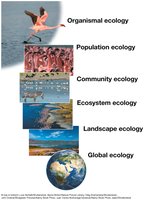
Ecology is the scientific study of the interactions between organisms and their environment. These interactions are organized into a hierarchy, scaling from individual organisms to the entire biosphere.
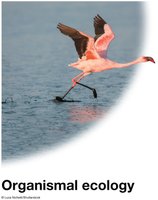
Organismal Ecology: Examines how an organism’s structure, physiology, and behavior help it meet environmental challenges. Includes physiological, evolutionary, and behavioral ecology.
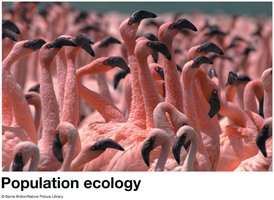
Population Ecology: Focuses on factors affecting population size and changes over time. A population is a group of individuals of the same species living in an area.
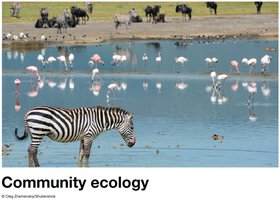
Community Ecology: Studies how interactions between species affect community structure and organization. A community is a group of populations of different species in an area.
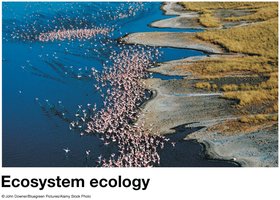
Ecosystem Ecology: Emphasizes energy flow and chemical cycling between organisms and the environment. An ecosystem includes the community of organisms and the physical factors with which they interact.
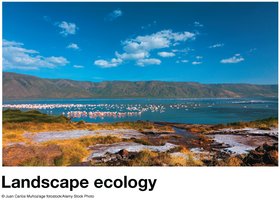
Landscape Ecology: Focuses on factors controlling exchanges of energy, materials, and organisms across multiple ecosystems. A landscape is a mosaic of connected ecosystems.
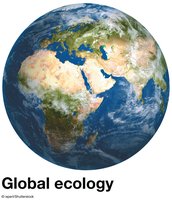
Global Ecology: Examines how the exchange of energy and materials at the regional scale influences the function and distribution of organisms across the biosphere. The biosphere is the global ecosystem, the sum of all ecosystems and landscapes on the planet.
Summary of Ecological Hierarchy:
Biotic and Abiotic Factors
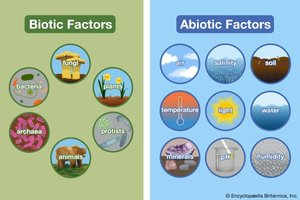
Ecological interactions are influenced by both biotic and abiotic factors.
Biotic Factors: Living components of the environment, such as plants, animals, fungi, bacteria, and protists.
Abiotic Factors: Nonliving chemical and physical attributes, including air, temperature, light, water, minerals, pH, salinity, and humidity.
Earth’s Climate and the Distribution of Terrestrial Biomes
Climate and Its Components
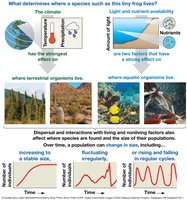
Climate refers to the long-term prevailing weather conditions in an area. Four important physical components of climate are temperature, precipitation, sunlight, and wind.
Abiotic factors shape the physical environment.
Biotic factors are the living organisms that interact within the environment.
Global Climate Patterns
Global climate is determined by the input of solar energy and the planet’s movement in space. Latitudinal variation in sunlight intensity and the speed of Earth’s rotation create global wind patterns.
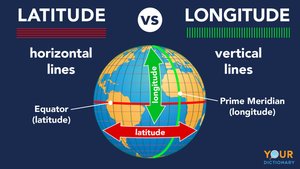
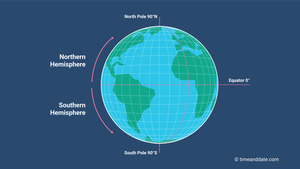
Latitude: Horizontal lines measuring distance north or south of the equator.
Longitude: Vertical lines measuring distance east or west of the Prime Meridian.
Global Air Circulation and Precipitation Patterns
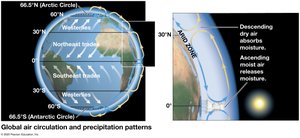
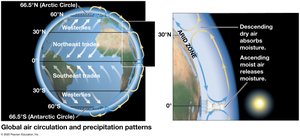
Air circulation and precipitation patterns are driven by solar energy and Earth's rotation. Warm air rises at the equator, cools, and releases moisture, creating tropical rain belts. Descending dry air absorbs moisture, forming deserts at 30° latitude.
Coriolis Effect
The Coriolis effect is caused by Earth's faster rotation at the equator compared to the poles, deflecting moving air to the right in the Northern Hemisphere and to the left in the Southern Hemisphere.
Example: The intended path of air is altered by Earth's rotation, resulting in curved wind patterns.
Seasonality
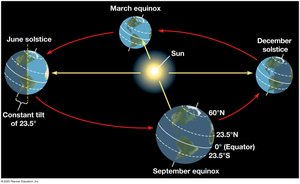
Seasonal variation in climate is caused by Earth's tilted axis and its annual passage around the sun. Day length, solar radiation, and temperature cycle strongly with the seasons, especially at higher latitudes.
Bodies of Water and Climate
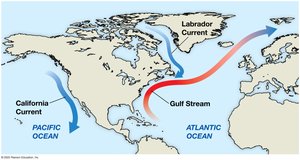
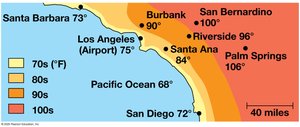
Oceans and large lakes moderate the climate of nearby land by heating or cooling air masses. Ocean currents, such as the Gulf Stream and Labrador Current, influence coastal climates.
Example: The Gulf Stream warms the northwest coast of Europe, while the Labrador Current cools the northeast coast of North America.
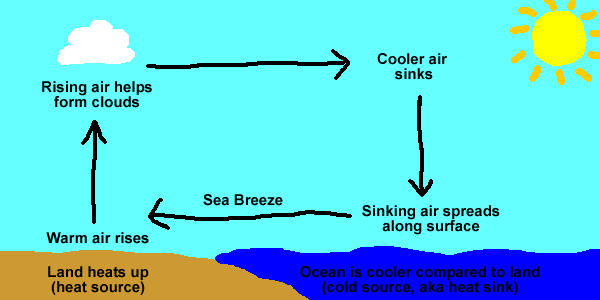
Large bodies of water resist temperature fluctuations and can moderate the climate of nearby land through sea breezes and temperature gradients.
Mountains and Climate
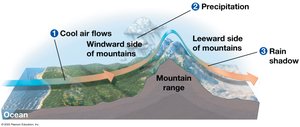
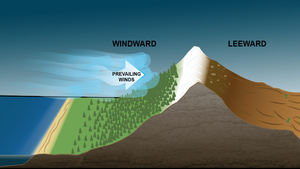
Mountains affect climate by forcing air to rise, cool, and release moisture on the windward side, creating a "rain shadow" on the leeward side where dry air descends and absorbs moisture. Mountains also influence sunlight exposure and vegetation types.
Example: Conifers grow on cooler north-facing slopes; drought-resistant plants inhabit warmer south-facing slopes.
Effects of Vegetation on Climate
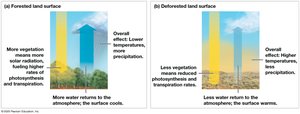
Forests absorb more solar radiation than grasslands or deserts, increasing rates of photosynthesis and transpiration. Evaporative water loss cools surface temperature and increases precipitation in forested regions.
Climate and Terrestrial Biomes
Biomes are major life zones characterized by vegetation type (terrestrial biomes) or physical environment (aquatic biomes). Latitudinal variation in climate influences the distribution of plants and the location of terrestrial biomes.
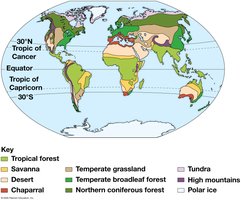
Population Density, Dispersion, and Demographics
Population Density and Dispersion
Population density is the number of individuals per unit area or volume. Dispersion refers to the pattern of spacing among individuals within the population boundaries.
Clumped Dispersion: Individuals aggregate in patches, often due to resource availability or social behavior.
Uniform Dispersion: Evenly spaced pattern, often due to territoriality or competition.
Random Dispersion: Position of each individual is independent of others, often where environmental conditions are uniform.
Demography and Life Tables
Demography is the study of births, deaths, and migration rates in a population. Life tables summarize age-specific survival and reproductive rates, often focusing on cohorts (groups of individuals of the same age).
Survivorship Curves
Survivorship curves graphically represent the proportion of a cohort still alive at each age. There are three general types:
Type I: High survivorship in early and middle life, steep decline in old age.
Type II: Constant death rate over the organism’s life span.
Type III: High death rates for juveniles, lower death rates for survivors.
Population Growth Models
Exponential Growth Model
Exponential growth occurs under ideal conditions, forming a J-shaped curve. The population increases at a constant rate, described by the equation:
Equation: Where is population size, is the intrinsic rate of increase, and is time.
Logistic Growth Model
Logistic growth considers limited resources, forming an S-shaped curve. The population approaches a carrying capacity (), the maximum size the environment can sustain.
Equation: Where is carrying capacity.
Life History Traits and Population Dynamics
Life History Traits
An organism’s life history includes traits affecting its schedule of reproduction and survival, such as age at first reproduction, frequency of reproduction, and number of offspring per episode.
Trade-offs in Life Histories
Organisms face trade-offs between survival and reproduction due to finite resources. Selective pressures influence the number and size of offspring produced.
K-selected species: Few offspring, lots of parental care.
r-selected species: Many offspring, minimal parental care.
Example: Plants in disturbed environments produce many small seeds; some animals invest heavily in fewer, larger offspring to increase survival chances.
*Additional info: Expanded explanations and context were added to ensure completeness and academic quality.*
