 Indietro
Population Growth Dynamics: Exponential and Logistic Models
Guida di studio - Note intelligenti
 Appunti personalizzati basati sui tuoi materiali, ampliati con definizioni chiave, esempi e contesto.
Population Growth in Biology
Quantifying Population Growth
Population growth is a fundamental concept in ecology, describing how the number of individuals in a population changes over time. The growth rate is determined by the difference between birth and death rates, and can be influenced by immigration and emigration.
Growth Rate Formula: The change in population size (N) per unit time (t) is given by:
Per-capita Rate of Increase (r): The difference between birthrate and death rate per individual.
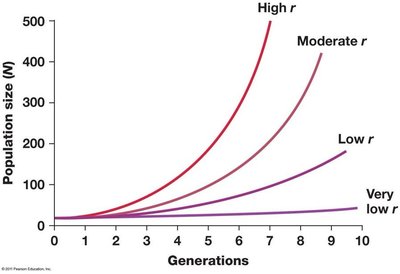
Intrinsic Rate of Increase (rmax): The maximum value of r under ideal conditions (unlimited resources, minimal threats). This is species-specific and depends on life history traits.
Types of Population Growth
Exponential Growth
Exponential growth occurs when the per-capita rate of increase (r) remains constant, regardless of population size. This results in a J-shaped curve and is considered density-independent.
Characteristics:
Occurs when resources are unlimited and threats are minimal.
Observed when a few individuals found a new population (founder effect) or after a population recovers from a catastrophe (genetic bottleneck).
Growth is rapid and not limited by population density.
Equation:
Example: Bacteria growing in a large flask with abundant media.
Logistic Growth
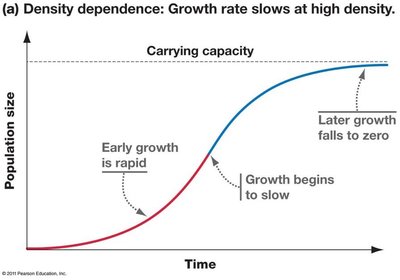
Logistic growth occurs when population density increases and competition for resources begins, causing the growth rate (r) to decrease. This results in an S-shaped curve and is considered density-dependent.
Characteristics:
Birthrate decreases and death rate increases as resources become scarce.
Growth rate declines as population approaches the carrying capacity (K).
Growth rate reaches zero at carrying capacity, stabilizing population size.
Equation:
Example: Birds founding a new population on an island, eventually stabilizing as resources become limited.
Carrying Capacity (K)
The carrying capacity (K) is the maximum number of individuals that a habitat can support over a sustained period. It is determined by resource availability and environmental conditions, and can change if resources are depleted or destroyed.
Key Points:
K is not fixed; it varies with environmental changes.
Population growth slows as it approaches K.
Overshooting K can lead to population crashes if resources are exhausted.
Stages of Population Growth
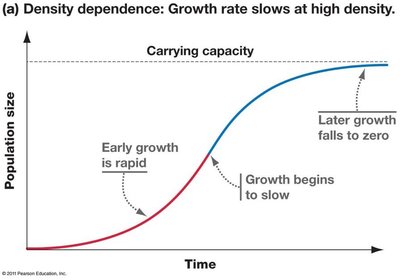
Population growth typically follows three distinct stages:
Stage 1: Exponential growth (r is constant, density independent).
Stage 2: Growth rate declines as competition for resources increases (density dependent).
Stage 3: Growth rate reaches zero at carrying capacity (population stabilizes).
Real-World Examples of Population Dynamics
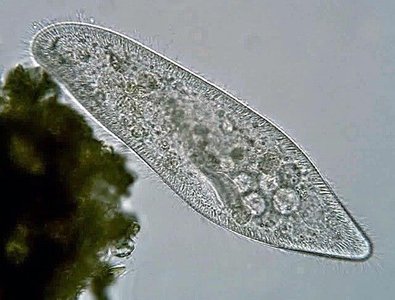
Laboratory Example: Paramecium caudatum
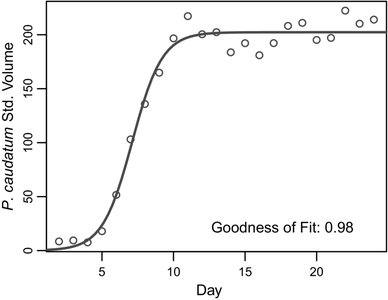
Paramecium caudatum is a single-celled organism often used to study population dynamics in laboratory settings. Its growth follows the logistic model, with an initial exponential phase, followed by slowing growth, and stabilization at carrying capacity.
Overshoot and Stabilization: Populations may overshoot K before stabilizing.
Field Example: Reindeer on St. Paul Island
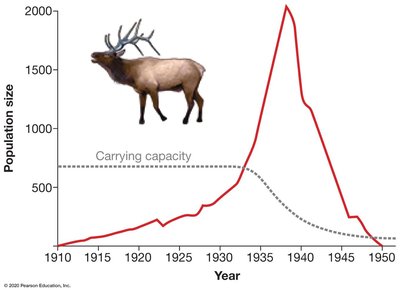
Reindeer (Rangifer tarandus) were artificially introduced to St. Paul Island, Alaska. The population initially grew rapidly, overshooting the carrying capacity, then crashed as resources were depleted and could not recover.
Overshoot: Occurs when resources are abundant, leading to rapid population increase.
Crash: Results from resource depletion, causing population decline.
Changing K: Environmental destruction can lower carrying capacity.
Winter Food Source: Reindeer Lichen
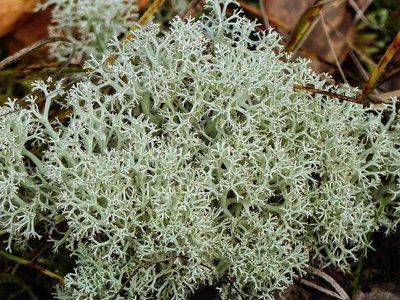
Cladonia rangiferina (reindeer lichen) is a primary winter food source for reindeer. Its availability directly affects the carrying capacity for reindeer populations.
Summary Table: Population Growth Models
Growth Model | Curve Shape | Density Dependence | Key Equation | Example |
|---|---|---|---|---|
Exponential | J-shaped | Independent | Bacteria in flask | |
Logistic | S-shaped | Dependent | Paramecium, reindeer |
Key Terms
Population size (N): Number of individuals in a population.
Growth rate (r): Rate of increase per individual.
Carrying capacity (K): Maximum sustainable population size.
Density-independent: Growth not affected by population density.
Density-dependent: Growth affected by population density.
Additional info: Academic context was added to clarify formulas, stages, and real-world examples for completeness.
