 Indietro
Principles of Biology I: Midterm Study Guide and Learning Objectives
Guida di studio - Note intelligenti
 Appunti personalizzati basati sui tuoi materiali, ampliati con definizioni chiave, esempi e contesto.
Midterm Exam Overview and Study Strategies
General Exam Information
This section outlines the structure and expectations for the Principles of Biology I midterm exam. Understanding the exam format and preparation strategies is essential for success.
Exam Format: 35-40 multiple choice questions, randomized for different versions. Approximately 1 minute per question is recommended.
Procedure: Students answer on paper first, then submit final answers via a clicker poll.
Required Materials: Clicker device, scantron, pencils, and photo ID. Prohibited items include hats, hoodies, smart watches, and earbuds.
Study Cycle and Preparation
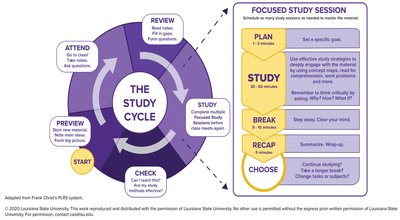
The study cycle is a structured approach to mastering course material, emphasizing active engagement and self-assessment at each stage.
Preview: Complete assignments such as readings, videos, and quizzes before class.
Attend: Participate in lectures, discussions, and activities.
Review: Summarize and clarify notes after class.
Study: Engage in focused study sessions, using active recall and practice questions.
Check: Assess readiness by answering guiding questions and reviewing objectives without notes.
Focused Study Sessions
Effective study sessions are structured to maximize retention and understanding:
Plan: Set a specific goal for the session.
Study: Use active strategies such as summarizing, self-quizzing, and teaching concepts aloud.
Break: Take short breaks to clear your mind.
Recap: Summarize and wrap up the session.
Choose: Decide on the next steps or adjust your study plan as needed.
Learning Objectives and the DEAL Method
Using Learning Objectives
Learning objectives guide your study by clarifying what you need to know and be able to do. Each objective is associated with an action verb indicating the required level of mastery: define, explain, or apply.
Define: Recall and state definitions from memory.
Explain: Describe concepts in your own words, including details and relationships.
Apply: Use knowledge to solve problems, interpret data, or make predictions.
The DEAL Method
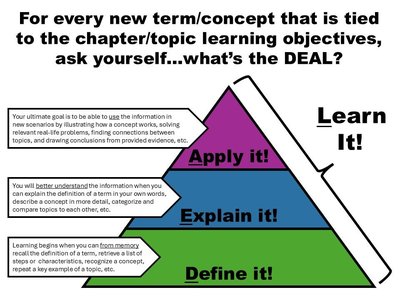
The DEAL method is a hierarchical approach to mastering new terms and concepts:
Define it: Learn the basic definition and recall it from memory.
Explain it: Understand and describe the concept in detail, compare it to related ideas, and categorize it appropriately.
Apply it: Use the concept in new scenarios, solve problems, and draw conclusions from evidence.
Example: For the term enzyme:
Define: An enzyme is a biological catalyst that speeds up chemical reactions in cells.
Explain: Enzymes lower the activation energy of reactions, are specific to substrates, and are not consumed in the reaction.
Apply: Predict how a mutation in an enzyme's active site might affect its function in a metabolic pathway.
Core Biological Concepts for the Midterm
Scientific Process
Understanding the scientific process is foundational to biology. It involves systematic observation, hypothesis formation, experimentation, and analysis.
Biology: The scientific study of living organisms and their interactions with the environment.
Scientific Method Steps: Observation, Question, Hypothesis, Experiment, Data Collection, Analysis, Conclusion.
Scientific Questions: Must be testable, measurable, and falsifiable.
Data Interpretation: Ability to analyze tables and figures, identify variables, controls, and summarize findings.
Properties of Life
All living things share certain characteristics that distinguish them from non-living matter.
Characteristics of Life: Order, response to stimuli, reproduction, adaptation, growth and development, regulation (homeostasis), and energy processing.
Cells: The basic unit of life; all living things are composed of cells.
Application: Use observations to determine if an object (e.g., vesicle) meets the criteria for life.
Cell Structure
Cells are classified as prokaryotic or eukaryotic based on structural and functional characteristics.
Prokaryotic Cells: Lack a nucleus and membrane-bound organelles (e.g., bacteria, archaea).
Eukaryotic Cells: Have a nucleus and membrane-bound organelles (e.g., plants, animals, fungi, protists).
Organelles: Specialized structures within eukaryotic cells (e.g., mitochondria, endoplasmic reticulum, Golgi apparatus).
Cell Structure and Function: Structure is related to function; dysfunction in organelles can affect cell activity.
Membrane Structure
The plasma membrane is a dynamic barrier that separates the cell from its environment and regulates the movement of substances.
Fluid Mosaic Model: Describes the membrane as a flexible layer with proteins embedded in or attached to a phospholipid bilayer.
Components: Lipids (phospholipids, cholesterol), proteins (integral, peripheral), and carbohydrates.
Formation: Phospholipids arrange into a bilayer due to hydrophilic heads and hydrophobic tails.
Lipids and Biochemistry
Lipids are a diverse group of hydrophobic molecules essential for membrane structure and energy storage.
Types of Lipids: Phospholipids, steroids, triglycerides (fats).
Primary Elements: Hydrogen (H), Carbon (C), Nitrogen (N), Oxygen (O).
Structural Formulas: Recognize hydrocarbon skeletons and functional groups.
Intramolecular Bonds: Nonpolar covalent, polar covalent, and ionic bonds based on electronegativity differences.
Molecular Interactions and Membrane Formation
Non-covalent interactions are critical for the structure and function of biological molecules and membranes.
Types of Intermolecular Interactions: Ionic bonds, hydrogen bonds/dipoles, Van der Waals forces.
Hydrophilic vs. Hydrophobic: Hydrophilic regions interact with water; hydrophobic regions avoid water.
Water Properties: Unique characteristics arise from hydrogen bonding (e.g., cohesion, adhesion, high specific heat).
Membrane Formation: Driven by hydrophobic interactions among phospholipid tails.
Membrane Transport
Cells regulate the movement of substances across membranes through various transport mechanisms.
Cellular Structures: Plasma membrane, transport proteins, vesicles.
Concentration Gradients: Molecules move from high to low concentration (diffusion).
Transport Mechanisms: Passive (simple and facilitated diffusion), active transport, bulk transport (endocytosis, exocytosis).
Application: Predict molecule movement based on environmental conditions and transport type.
Proteins
Proteins are polymers of amino acids with diverse functions in cells.
Types of Proteins: Transport, receptor, enzymes, cell identification.
Monomers and Polymers: Amino acids (monomers) form polypeptides/proteins (polymers) via peptide bonds.
Protein Structure: Primary (sequence), secondary (alpha helices, beta sheets), tertiary (3D folding), quaternary (multiple subunits).
Structure-Function Relationship: Protein function depends on shape; changes in structure can affect activity.
Gene Expression
Gene expression is the process by which genetic information is used to synthesize proteins.
Flow of Genetic Information: DNA → RNA → Protein (Central Dogma).
Processes: Transcription (DNA to RNA), translation (RNA to protein), protein folding and modification.
Relationship: Genes encode amino acid sequences, which determine protein structure and function.
Summary Table: Types of Bonds and Interactions
Bond/Interaction | Description | Example |
|---|---|---|
Nonpolar Covalent | Equal sharing of electrons | H2, O2 |
Polar Covalent | Unequal sharing of electrons | H2O |
Ionic | Transfer of electrons, attraction between charged ions | NaCl |
Hydrogen Bond | Attraction between a hydrogen atom and an electronegative atom | Between water molecules |
Van der Waals | Weak attractions due to transient dipoles | Lipid tails in membranes |
Key Equations and Concepts
Electronegativity Difference: Determines bond type.
Nonpolar covalent:
Polar covalent:
Ionic:
Central Dogma of Molecular Biology:
Additional info: The DEAL method and study cycle are evidence-based strategies to promote active learning and long-term retention, which are critical for mastering complex biological concepts.
