 Indietro
Probability Laws and Mendelian Inheritance: Study Notes part 2
Guida di studio - Note intelligenti
 Appunti personalizzati basati sui tuoi materiali, ampliati con definizioni chiave, esempi e contesto.
Probability Laws and Mendelian Inheritance
Mendel’s Laws and Probability
Mendel’s laws of segregation and independent assortment form the foundation of classical genetics and can be understood using the rules of probability. These laws allow us to predict the outcomes of genetic crosses by applying mathematical principles similar to those used in games of chance.
Law of Segregation: Each individual has two alleles for each gene, which segregate during gamete formation so that each gamete carries only one allele for each gene.
Law of Independent Assortment: Alleles of different genes assort independently of one another during gamete formation.
Probability: The likelihood of a particular event occurring, ranging from 0 (impossible) to 1 (certain).
Examples:
Probability of heads in a coin toss: 1/2
Probability of rolling a 3 on a six-sided die: 1/6
Probability of not rolling a 3: 1 - 1/6 = 5/6
Independent Events in Probability and Genetics
In probability, independent events are those whose outcomes do not affect each other. In genetics, the segregation of alleles for one gene is independent of the segregation of alleles for another gene (assuming the genes are on different chromosomes).
Each gamete from a heterozygous parent (e.g., Aa) has a 1/2 chance of carrying either allele (A or a).
The same probabilities apply to sperm and eggs in sexually reproducing organisms.
The Multiplication and Addition Rules in Genetics
Probability rules are essential for predicting the outcomes of genetic crosses. Two main rules are used: the multiplication rule and the addition rule.
Multiplication Rule
The multiplication rule states that the probability of two or more independent events occurring together is the product of their individual probabilities.
Formula:
Example: Probability that two coins tossed at the same time will both land heads up:
In genetics, this rule is used to calculate the probability of specific genotype combinations in offspring.
Application: Monohybrid Cross
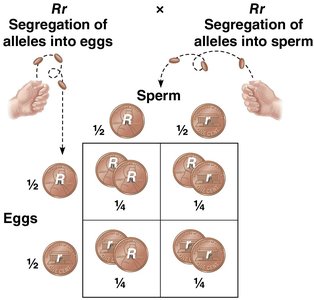
Consider a monohybrid cross between two heterozygous plants (Pp x Pp). Each gamete has a 1/2 chance of carrying either allele (P or p). The probability of producing a homozygous recessive offspring (pp) is:
Probability that the egg carries p: 1/2
Probability that the sperm carries p: 1/2
Combined probability (pp):
Addition Rule
The addition rule states that the probability of any one of two or more mutually exclusive events occurring is the sum of their individual probabilities.
Formula:
Example: Probability of getting a heterozygous offspring (Pp) from a Pp x Pp cross:
P from egg + p from sperm: 1/4
p from egg + P from sperm: 1/4
Total probability:
Use the addition rule for either/or outcomes that cannot happen simultaneously (mutually exclusive events).
Genetic Crosses and Probability Examples
Example 1: In pea plants, tall (T) is dominant over short (t). In a cross between two heterozygous tall plants (Tt x Tt), the probability of getting homozygous recessive (tt) offspring is 1/4 (25%).
Example 2: For a locus with four alleles (Da, Db, Dc, Dd), crossing DaDb x DcDd produces four possible genotypes in equal proportions: 25% DaDc, 25% DaDd, 25% DbDc, 25% DbDd.
Example 3: In mice, the agouti gene (A) produces agouti coat (AA), yellow coat (Aa), and aa homozygotes die early. Crossing Aa x Aa yields a 2:1 ratio of agouti:yellow among live offspring.
Example 4: In humans, normal pigmentation (C) is dominant to albinism (c). If two phenotypically normal parents have an albino child, the probability their next child is albino is 1/4 (25%).
Example 5: In dragons, wings are dominant. Crossing a wingless dragon (ww) with a heterozygote (Ww) yields 50% wingless offspring. Two heterozygotes (Ww x Ww) have a 25% chance of producing a wingless whelp.
Punnett Squares in Genetic Analysis
Punnett squares are diagrams used to predict the genotypes and phenotypes of offspring from genetic crosses. They visually represent the segregation and combination of parental alleles.
Each box in the Punnett square represents a possible genotype for the offspring.
Homozygous dominant, heterozygous, and homozygous recessive genotypes can be identified.
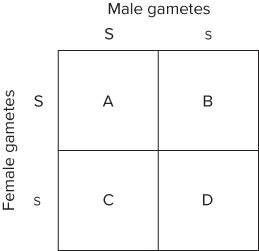
Sample Punnett Square Table
Male gametes: S | Male gametes: s | |
|---|---|---|
Female gametes: S | A | B |
Female gametes: s | C | D |
Purpose: This table helps identify the genotype of each possible offspring from a cross between two heterozygotes (Ss x Ss). For example, box A represents the homozygous dominant genotype (SS).
Practice Questions and Applications
Probability calculations: Use multiplication and addition rules to solve genetic problems.
Punnett squares: Visualize and confirm genotype and phenotype ratios.
Genetic terminology: Understand terms such as homozygous, heterozygous, dominant, and recessive.
Summary Table: Probability Rules in Genetics
Rule | When to Use | Formula | Example |
|---|---|---|---|
Multiplication Rule | Independent events ("and") | Probability of pp offspring: | |
Addition Rule | Mutually exclusive events ("or") | Probability of Pp offspring: |
Additional info: These probability rules are foundational for understanding more complex genetic phenomena, such as dihybrid crosses and linkage, which are covered in advanced chapters.
